
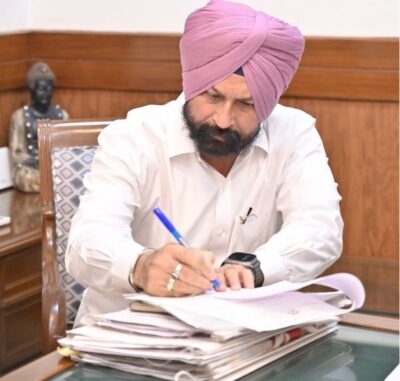
 PATIALA-Former Punjab police officer Gurinder Dhillon IPS has raised a series of constitutional and legal questions over the Election Commission’s Special Intensive Revision (SIR) exercise, stressing that the electoral process must remain firmly governed by the Constitution and due process. In a detailed statement, Dhillon described the Constitution as the “DharamRaj” of Indian democracy and said that every institution and official entrusted with conducting elections remains accountable to constitutional principles.
Dhillon said there should be no dispute about removing ineligible voters through lawful procedures, but warned that the wrongful exclusion of an eligible citizen is fundamentally different because it can directly affect the citizen’s right to participate in representative government. He said this is at the heart of concerns being described as “vote chori” and argued that every eligible Indian citizen must receive a fair opportunity to register and vote.
A major issue highlighted by Dhillon concerns Form 6, used by citizens seeking inclusion in the electoral roll. He referred to the Election Commission’s position that Form 6 itself was not changed and that only an additional declaration was attached. Dhillon pointed to the Supreme Court’s observation that it had not approved modifications to Form 6 and argued that the legal authority, approval and practical effect of the additional declaration now require clear examination.
He further stressed that the Election Commission’s records, including any dissenting opinion, the majority decision and the reasons supporting it, should be placed under appropriate legal and judicial scrutiny. According to Dhillon, whether a requirement is described as an “amendment” or merely an “attachment” should not determine its legality. The substance and actual impact on citizens must prevail over terminology, he argued.
Another important concern raised by Dhillon is the role of technology in the electoral process. He cautioned that an electronic database or software condition must not become an indirect barrier preventing an eligible citizen from being included on the voter list. In his view, technology should protect electoral integrity rather than create new obstacles for citizens exercising their democratic rights.
Dhillon also emphasized that accountability must extend throughout the electoral administration—from the Booth Level Officer (BLO) to the Electoral Registration Officer (ERO), District Election Officer (DEO), Chief Electoral Officer (CEO) and ultimately the Election Commission. He argued that administrative instructions cannot override constitutional provisions or electoral law.
The broader message of his intervention is that electoral integrity requires both inclusion and accountability. Dhillon called for transparent records, timely correction mechanisms, meaningful opportunities for citizens to challenge adverse decisions and judicial scrutiny wherever necessary. He said SIR should strengthen public confidence in elections by ensuring that every eligible citizen is included while ineligible persons are excluded only through lawful procedures and with adequate safeguards.
His intervention comes amid continuing public and political debate over voter-list revision and the safeguards required to prevent legitimate voters from being excluded. Dhillon’s central argument is that the credibility of democracy depends not merely on conducting elections, but on ensuring that every decision affecting a citizen’s electoral participation is lawful, transparent and open to challenge.
Concluding his statement, Dhillon said that constitutional safeguards must operate “in practice”, not merely on paper, and emphasized that no Commissioner, office or administrative decision stands above the Constitution. He ended with a call for fairness, accountability and democratic integrity: “God Bless India. God Bless Indian Democracy. Merit shall prevail.”