
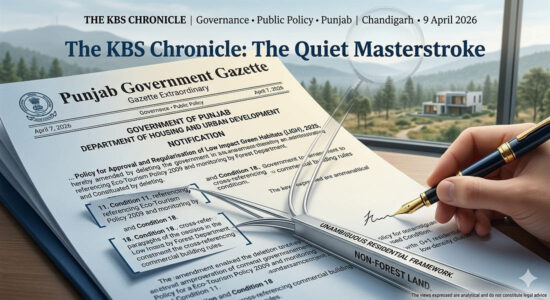
 There is a certain genre of government action that looks, at first glance, like retreat. A notification quietly amended. Two clauses deleted. No press conference. No triumphalist briefing. Just a crisp Gazette Extraordinary, issued under the hand of Vikas Garg, IAS, Principal Secretary to the Government of Punjab, Department of Housing and Urban Development, dated 7 April 2026, and published the Official Gazette of Punjab Government.
Do not be deceived by the quietness of it. This is not retreat. This is manoeuvre.
The amendment to Punjab’s Policy for Approval and Regularisation of Low Impact Green Habitats (LIGH), 2025 — notified originally on 20 November 2025 vide No. H-U-11020/183/2025-4H1/I/1248240/2025 — deletes precisely two provisions from its original text. Condition 11, insofar as it referenced the Eco-Tourism Policy 2009 and mandated Forest Department monitoring. And Condition 18, in its entirety, which had cross-referenced the commercial building rules framework of PUDA. The rest, as the notification drily records, “shall remain the same.”
That “rest”, however, now rests on far firmer legal ground.
I. The First Deletion: Severing the Forest Umbilical
The original Condition 11 had inserted, somewhat incautiously, a cross-reference to the Punjab Eco-Tourism Policy, 2009, with the stipulation that “monitoring in this regard will be done by the Forest Department.”
It was an error born of over-caution. Well-intentioned, perhaps. But legally self-defeating.
The LIGH policy applies, and has always applied, exclusively to lands that were delisted from the Punjab Land Preservation Act, 1900. The operative word is delisted. When the State Government, with the concurrence of the Union Ministry of Environment, Forest and Climate Change, excluded approximately 55,000 hectares from PLPA coverage — across Mohali, Ropar, Nawanshahr, Hoshiarpur, and Gurdaspur districts — those lands shed their forest-law character. They became, in the legal taxonomy, revenue lands. Delisted. Available for bona fide residential and agricultural use.
By importing the Eco-Tourism Policy 2009 — a forest management instrument, designed for land that remains under PLPA purview — into the LIGH framework, the original notification had created an internal contradiction of the first order. It implied, inadvertently, that the delisted land retained some residual forest character. Petitioners before the National Green Tribunal and the Punjab and Haryana High Court were quick to seize this thread. If the government itself felt compelled to invoke forest-management protocols and Forest Department oversight, they argued, surely it was conceding that these lands were, in substance, still forest lands — governed by the Forest (Conservation) Act, 1980, and the Supreme Court’s binding directions.
The 7 April amendment cuts this argument at the root.
By deleting the Eco-Tourism Policy 2009 reference and the Forest Department monitoring mandate, the Punjab Government has made an unambiguous statement of legal position: this land is not forest land. It does not attract forest law. The Forest Department has no locus standi here, because none is conferred by statute upon delisted land. The Eco-Tourism Policy 2009 is a policy for forests; these are not forests.
This is not, it should be noted, a novel legal position invented for convenience. It flows directly from the MoEFCC’s own March 2015 communication, which, while directing that delisted areas continue to be treated as forest under the Forest Conservation Act for purposes of Central clearances, also acknowledged that landowners could utilise delisted PLPA land for bona fide use. The government is now aligning the policy’s internal architecture with that settled position, rather than contradicting it by incorporating instruments of forest governance.
There is, of course, a secondary benefit. The Eco-Tourism Policy 2009 carries considerable political baggage in Punjab. The current government has itself, in another context, described that policy as having been tailor-made to benefit specific private interests during the previous Akali regime. Removing its reference from the LIGH framework also removes an unnecessary target for political point-scoring by opposition benches.
II. The Second Deletion: Quarantining the Commercial Taint
Condition 18, deleted in its entirety, is the less-reported but arguably more consequential of the two excisions.
The original LIGH policy had, in Condition 18, incorporated a reference to the commercial provisions of the PUDA Building Rules — the framework that governs commercial construction permissions under the Punjab Urban Development Authority. This was, on its face, a puzzling inclusion in a policy that loudly and repeatedly proclaimed that no commercial activity would be permitted under LIGH approvals.
Puzzling, and deeply problematic. For two reasons.
First, the presence of a commercial building rules cross-reference handed petitioners precisely the ammunition they needed to argue that the LIGH policy was, beneath its green-residential exterior, actually enabling commercial development in ecologically sensitive areas. An internal contradiction of this severity — a policy prohibiting commercial activity while embedding commercial building norms — is the kind of drafting infirmity that Courts notice and adversaries exploit.
Second, and more critically, the legal landscape had shifted dramatically since November 2025. The Punjab Unified Building Rules, 2025, were notified in December of that year, substantially replacing and superseding the earlier PUDA Building Rules framework. Parts of the new Unified Rules are themselves under a stay granted by the Punjab and Haryana High Court, which directed in December 2025 that provisions inconsistent with earlier rules be kept in abeyance. Maintaining a reference in the LIGH policy to a building rules framework that was itself partially stayed, partially superseded, and the subject of separate litigation, was a recipe for procedural chaos.
Deleting Condition 18 cleanly resolves both problems. The LIGH policy is now quarantined from the building rules litigation. Its commercial-prohibition character is no longer contradicted by any internal reference. And the government can go before the NGT with a policy that is, on its face, a purely residential, low-density framework — with no commercial fingerprints whatsoever.
III. The NGT Gambit: A Stay That May Not Survive Its Own Subject Matter
The National Green Tribunal granted its interim stay on 18 December 2025, against the LIGH policy as it then stood — with Condition 11’s forest cross-reference intact, and Condition 18’s commercial building rules reference embedded. That policy, in its stayed form, no longer exists.
This is not a semantic point. In administrative law, a stay operates upon a specific instrument. When that instrument is materially amended — when its objectionable provisions are removed and its legal character is substantially altered — the question arises whether the stay continues to operate upon the amended instrument, or whether it has been rendered infructuous.
The Punjab Government is now well-placed to move the NGT for vacation of the stay, on the following grounds:
The provisions that formed the primary basis for the stay — the Eco-Tourism cross-reference and the commercial building rules hook — have been deleted. The policy as amended addresses the very concerns that occasioned judicial intervention.
The MoEFCC’s own communications support residential use of delisted land, subject to no commercial activity. The amended policy permits precisely that, and nothing more.
The Supreme Court’s conditions for PLPA delisting — bona fide use, no commercial exploitation, sustainable livelihood support — are all met by a framework that permits only G+1 residential construction on minimum one-acre plots, with mandatory indigenous plantation, rainwater harvesting, and solar energy provisions.
The Supreme Court’s Central Empowered Committee had, in its intervention, sought details of the policy and the delisted land parcels. Its fundamental concern was commercial exploitation of forest-proximate land. The amended policy presents no such face.
IV. What Remains — And Why It Is Defensible
The critics will argue, not without some legitimacy, that the deletions do not address the foundational objections to the LIGH policy. The Shivalik-Kandi belt remains ecologically fragile. The 55,000 hectares of delisted land abut active forest corridors. G+1 construction on one-acre plots, multiplied across hundreds of applications, could still fragment wildlife habitat, accelerate groundwater depletion, and destabilise slopes in the geologically uncertain lower Shivaliks.
These are serious concerns, and they deserve serious engagement. But they are concerns about policy wisdom — not, in the strict sense, about legal validity. The question before the NGT and the High Court is not whether the LIGH policy is the wisest possible approach to the Shivalik ecology. The question is whether it violates any law.
On that narrower question, the amended policy stands on considerably stronger ground. Housing regulation on delisted, non-forest land falls within the State’s legislative competence. The policy’s environmental safeguards — though imperfect in the eyes of environmentalists — are not facially arbitrary. The prohibition on commercial activity aligns the policy with MoEFCC’s own stated position. And the deletion of the two problematic conditions has removed the internal contradictions that made the policy most vulnerable to judicial challenge.
The government’s constitutional posture is straightforward: we have the power to regulate this land, we have done so in a manner consistent with the law, we have corrected drafting infirmities when they were identified, and we stand ready to defend our amended policy on its merits.
That is a posture, one ventures to suggest, that will be difficult to dislodge.
V. Lessons in the Art of Governance
There is something instructive, for students of governance and public administration, in the manner in which this amendment has been handled. The instinct of the Indian administrative state, when faced with judicial challenge, is often to dig in — to file lengthy counter-affidavits, to defend every provision to the last comma, to treat any concession as institutional defeat.
The Punjab Housing Department, under this Principal Secretary, has demonstrated a more sophisticated understanding of the relationship between executive governance and judicial review. Rather than defend provisions that were, on reflection, legally indefensible — the forest cross-reference, the commercial building rules hook — it has removed them cleanly, allowing the policy’s legitimate core to stand unencumbered.
This is not weakness. This is the confidence of a government that knows which battles are worth fighting, and which provisions were always liabilities rather than assets.
As this writer argued in another article in The KBS Chronicle, in a different context, the real choice before Punjab’s policy makers for the Shivalik periphery is not the binary that critics present — all green on one side, farmhouse development on the other. It is, rather, a choice between two futures that are both already being built: the unplanned, unregulated, infrastructure-starved urban sprawl that has consumed Nayagaon and Karoran, where neither forest nor farmhouse norms apply and where the ecology has been devastated not by policy but by the absence of it; and the new, pragmatic, low-density residential framework that the LIGH policy represents — now placed on an even firmer legal footing by the 7 April amendment. The LIGH policy — stripped of its contradictions, aligned with MoEFCC’s position, confined to its residential low-impact purpose — now goes forward into the courts as a cleaner, leaner, more legally coherent instrument. Whether it ultimately survives judicial scrutiny depends on factors beyond the elegance of its drafting. But it enters that scrutiny in far better shape than it did on 20 November 2025. And it enters with a question that its opponents have yet to answer: if not this, then what — Nayagaon replay, only more haphazard?
Share The KBS Chronicle
Chandigarh’s Frag