
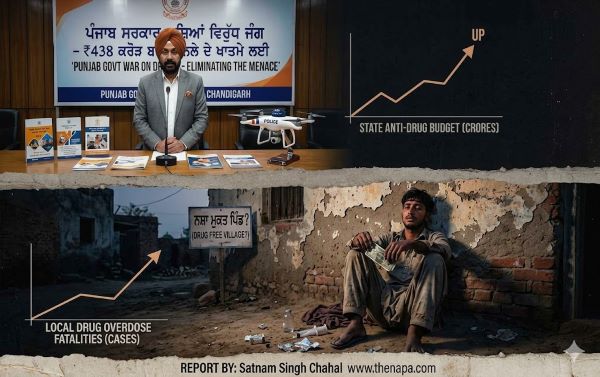
 For over a decade, political parties have swept into power in Punjab on a single, emotionally charged promise: breaking the backbone of the state’s drug syndicate. Yet, despite massive budget allocations and high-profile public relations campaigns, the ground reality tells a devastatingly different story. The current government’s intensive “Yudh Nashian Virudh” (War Against Drugs) campaign has aggressively touted statistics of arrests and asset seizures. However, this multi-crore spending pipeline has largely failed to disrupt the retail availability of narcotics. In the villages and urban slums of Punjab, synthetic drugs, opioids, and illegally diverted pharmaceutical drugs continue to claim the lives of the state’s youth. The issue is no longer just a failure of law enforcement; it is an indictment of governance where public funds flow freely, but the body count continues to rise.
The core contradiction of Punjab’s anti-drug policy lies in the massive disparity between monetary allocation and systemic outcomes. In the recent state budget, the government allocated a whopping ₹438 crore specifically aimed at winning the war against drugs. This massive financial inflow includes ₹150 crore dedicated to conducting the state’s first-ever comprehensive drug census and another ₹110 crore for anti-drone technologies and home guard deployments. While crores are spent acquiring advanced hardware—such as 758 four-wheelers, 916 two-wheelers, and high-tech border surveillance—the retail supply chains within neighborhoods remain virtually untouched. Government press conferences heavily rely on the sheer volume of cases to showcase success, pointing to more than 30,144 FIRs registered and over 40,302 arrests in a single year. Yet, critics and community leaders point out that the vast majority of these arrests target low-level addicts or small-time couriers (peddlers), while the multi-billion rupee kingpins and politically protected cartels operate with relative impunity.
The history of this unending crisis reveals how the state has continuously lagged behind the adaptive tactics of smugglers, despite escalating public expenditure. The alarm bells rang loudly when a landmark study by PGIMER Chandigarh estimated that over 3 million people—roughly 15.4% of Punjab’s population—were consuming illegal substances. In response to tighter land border security, smugglers shifted aggressively toward utilizing GPS-guided Pakistani drones to drop contraband. Major seizures, such as a 77 kg heroin haul in Ferozepur, proved that international supply lines remained wide open. By the time the state government launched its highly publicized “Yudh Nashian Virudh” crackdown, diverting massive amounts of public funds into police modernization and intensive local PR campaigns, the crisis had already evolved. Today, the state faces a pharmaceutical and synthetic nightmare, with a massive spike in the black-market diversion of prescription drugs like Pregabalin, supplementing traditional heroin with cheap, lethal chemical substitutes.
The failure to eliminate drugs is vividly illustrated by recent, systemic breakdowns across the state’s healthcare and regulatory infrastructure. For instance, a shocking incident occurred at a government-run de-addiction center in Moga, where 30 patients escaped following a violent clash with staff. This incident exposed the severe understaffing, lack of psychological care, and prison-like conditions of state-funded facilities. While crores are spent on police vehicles, government-run rehabs remain desperately underfunded, forcing families to turn to exploitative, expensive private clinics. Furthermore, whenever targeted border policing drives up the price of pure heroin (Chitta), local peddlers aggressively flood the market with highly toxic synthetic concoctions. The Food and Drugs Administration (FDA) recently flagged widespread illegal stocking of these pharmaceuticals by both unlicensed entities and corrupt chemists, proving that internal regulatory mechanisms are failing alongside law enforcement.
Ultimately, Punjab cannot arrest its way out of a public health disaster, nor can it buy a solution simply by pouring hundreds of crores into police hardware. The current strategy treats the drug epidemic strictly as a law-and-order problem, neglecting the deep-rooted corruption, institutional rot, and economic hopelessness that fuel demand. High youth unemployment rates mean that as soon as one network of peddlers is arrested, a new crop of vulnerable, unemployed youths takes their place, enticed by the lucrative payouts of the drug trade. Until the Punjab government shifts its financial priorities from high-profile political publicity and basic police logistics to aggressive cross-border intelligence, independent anti-corruption oversight, and world-class, humane rehabilitation networks, the state’s treasury will continue to bleed crores—while its youth continue to bleed to death.
“Disclaimer: The photographic elements used in the accompanying graphic are for symbolic and illustrative purposes only. The individuals depicted do not imply actual endorsement, involvement, or association with substance