
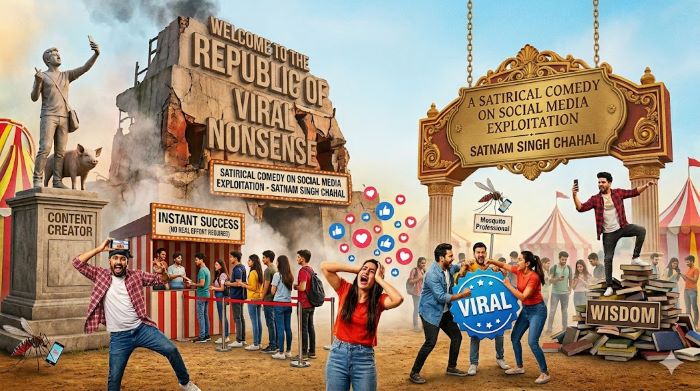
 Once upon a time, parents told children to study hard and become doctors, engineers, scientists, or teachers. Today, social media has introduced a completely different career guidance system. Now the internet whispers to young minds: “Why work hard for years when you can dance for 15 seconds, fake emotions, wear shocking outfits, and become famous overnight?” Apparently, this is what modern success looks like.
We are living in a strange era where attention has become more valuable than talent. Earlier, people earned respect through knowledge, discipline, and character. Now, some people gain millions of followers simply by creating sensational content designed to shock, distract, or exploit curiosity. The louder the nonsense, the faster it spreads. The less meaningful the content, the more “viral” it becomes. Humanity has truly unlocked a special achievement.
A teenager opens social media hoping to learn something useful. Within minutes, the algorithm proudly presents fake luxury lifestyles, staged relationship drama, meaningless pranks, and endless content focused only on physical appearance and cheap popularity. The internet was once called the “Information Age.” Sometimes it now feels more like the “Distraction Age.”
Some influencers loudly claim they are “motivating the youth.” Motivating them for what exactly? To believe that success comes from exposure instead of effort? Does that popularity matter more than personality? Are likes and followers more important than honesty and self-respect? It is a strange kind of inspiration where wisdom gets ignored, but foolishness receives sponsorship deals.
Imagine if history worked according to modern social media standards. Albert Einstein posts a revolutionary scientific equation and gets fifteen views. Meanwhile, someone records themselves doing an embarrassing public stunt for attention and receives fifteen million views in one night. Society claps proudly and calls it “content creation.” Truly remarkable progress.
Even comedy has changed. Earlier, comedians used intelligence, storytelling, and creativity to make people laugh. Today, some creators think shouting nonsense, humiliating strangers, or turning private relationships into public drama is peak entertainment. Apparently, dignity has become optional as long as the camera angle is good.
Whenever anyone criticizes such content, defenders quickly say, “They are just earning money.” By that logic, even mosquitoes are hardworking professionals. Earning money is not wrong, but earning attention by spreading unhealthy influence among young audiences should not become something society blindly celebrates.
The saddest part is not that such content exists. Foolishness has always existed in every generation. The real problem is that society now rewards it more than education, creativity, or meaningful achievement. Teachers struggle for recognition. Writers struggle for readers. Scientists struggle for support. But someone can become rich overnight by posting fake drama and pretending to cry in slow motion. What a magnificent civilization we have built.
Behind the jokes lies a serious truth. Young people slowly become what society repeatedly glorifies. If society constantly celebrates empty fame, unrealistic beauty standards, and attention-seeking behavior, then future generations may start believing that values, intelligence, and hard work no longer matter. That is a dangerous direction for any civilization.
Freedom of expression is important, but influence also carries responsibility. Social media can educate, inspire, and connect people in beautiful ways. Unfortunately, it can also exploit insecurity, encourage shallow thinking, and turn self-respect into entertainment. The younger generation deserves role models who teach confidence, discipline, kindness, creativity, and purpose — not people who treat morality like an outdated app.
Perhaps the biggest joke of all is this: many people spend hours editing their online image while their real character remains unfinished. Filters can improve a photograph, but they cannot improve values.Fame without values is temporary, and attention without purpose is empty. A society that encourages exploitation and rewards meaningless behavior slowly weakens its own future. The youth do not simply watch society they become what society applauds. Maybe it is time we stop making foolishness famous and start making wisdom popular again.