
Yesterday, 23 May 2026, Prime Minister Mark Carney of Canada issued a formal statement commemorating the 112th anniversary of the Komagata Maru incident. It deserves to be read in full, not as a diplomatic formality, but as a moral reckoning.
“On this day in 1914, 376 Sikhs, Muslims, and Hindus of South Asian origin arrived in Vancouver’s harbour aboard the steamship Komagata Maru. Their voyage was made in search of a better life for themselves and their families. Instead of offering them refuge, Canadian authorities refused nearly all on board entry and forced them to remain on the ship for two months, with limited access to food, water, and medical care. When the Komagata Maru was forced to return to India, many of its passengers were imprisoned or killed. The Komagata Maru tragedy is one of the darkest chapters in our history.”
These are not comfortable words for a head of government to utter. They are the words of a nation choosing to confront rather than conceal. They matter — and they matter particularly in 2026, when the politics of immigration and identity are once again roiling Western democracies.
I. The Voyage
In the spring of 1914, a Japanese steamship named Komagata Maru — the words meaning, approximately, “wheel of water” — set sail from Hong Kong carrying passengers who believed the British Empire’s promise of equal rights for all subjects. The 376 passengers, predominantly Sikhs from the Punjab, had chartered the vessel to challenge Canada’s “continuous journey” regulation, a transparently racist device designed to exclude South Asians from immigration by requiring a direct voyage from the country of origin — a route that no shipping company then operated.
The ship arrived in Vancouver harbour on 23 May 1914. It was met not with processing, but with refusal. For two months, the passengers were held aboard in conditions of deliberate privation — restricted food, inadequate water, denied medical attention. Canadian immigration officials, backed by the courts, refused entry to all but twenty-four passengers already resident in Canada. On 23 July 1914, the Komagata Maru was escorted out of Canadian waters by HMCS Rainbow, a warship of the very empire whose subjects these passengers were.
The ship returned to British India. It docked at Budge Budge, near Calcutta, on 29 September 1914 — by which point Britain had declared war on Germany and colonial nerves were raw. British authorities, fearing that the returned passengers harboured revolutionary sympathies — which, given their treatment, was hardly surprising — opened fire on the crowd. Nineteen passengers were killed. Dozens were arrested. The rest were dispersed.
The ‘continuous journey’ regulation was racism dressed as procedure. The Komagata Maru incident was empire at its most nakedly unjust — and when Prime Minister Carney, 112 years later, calls it ‘one of the darkest chapters in our history,’ he is offering an honest, if necessarily diplomatic, admission of precisely that. The euphemism lies not in the sentiment but in the passive construction: Canada did not merely ‘fail to uphold its values.’ It enacted, with deliberation and legal architecture, a racial exclusion that shamed every principle it claimed to hold.
.
II. The Ghadar Party Connection
The Komagata Maru did not sail in isolation. It arrived in the context of a revolutionary movement that had taken root among the Punjabi diaspora in North America — the Ghadar Party, founded in San Francisco on 21 April 1913, barely a year before the ship entered Vancouver harbour.
Sohan Singh Bhakna, a labourer from Amritsar district, was the Founder President of the Ghadar Party — a fact that tends to be overshadowed by the greater literary celebrity of Lala Har Dayal, the revolutionary scholar who provided ideological direction and galvanised Indian immigrants across North America with his oratory and writing. The party’s newspaper, also named Ghadar, circulated to Indian communities worldwide, calling for armed revolt against British colonial rule. Its message was simple, its courage absolute.
The Ghadar Party planned a major uprising in India in 1915, seeking to incite Indian soldiers in the British Army to rebel. British intelligence penetrated the conspiracy. The uprising was pre-emptively crushed. Arrests followed. Trials followed. Executions followed.
Among those who went to the gallows was Kartar Singh Sarabha — nineteen years of age, from Ludhiana district — who would go on to be the acknowledged hero of another revolutionary a generation later: Bhagat Singh kept a photograph of Sarabha in his pocket and called him his mentor. The lineage from Ghadar to the Hindustan Socialist Republican Association is direct, traceable, and insufficiently taught.
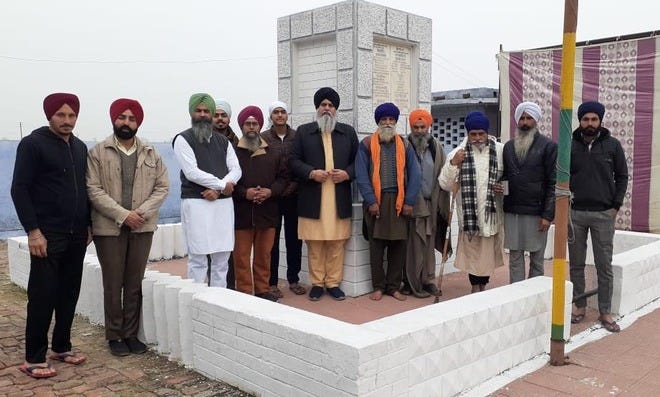
Sohan Singh Bhakna was imprisoned for over sixteen years. He was finally released in 1930 and lived to see independence — dying in 1968, a nonagenarian, with a modest memorial at his ancestral village of Bhakna in Amritsar district that shames the indifference of the governments that followed.
III. Punjab and the Sikhs: The Disproportionate Sacrifice
It is not chauvinism but historical record to note that Punjab and the Sikhs carried a weight in India’s freedom struggle that far exceeded their proportion of the population. The Ghadar Party was disproportionately Punjabi and Sikh. The Jallianwala Bagh massacre of 1919 fell most heavily on Punjabis. The non-cooperation movement found some of its most uncompromising practitioners in the Akali agitation of the 1920s. The Bhagat Singh-Sukhdev-Rajguru executions in 1931 struck at the heart of Punjab.
The Ghadar martyrs — those who returned from America and Canada at the party’s call in 1914–15, fully aware that they were likely sailing to their deaths — represent a strand of the freedom struggle that was internationalist in orientation, working-class in composition, and secular in its politics. They were not armchair nationalists. They were labourers and farmers who had crossed oceans, faced racial violence, and then chosen to sail into the mouth of empire rather than acquiesce.
They are not in the standard history textbooks. Their names are not on the major monuments. The memorial at Bhakna for Sohan Singh Bhakna remains, as a Tribune report noted years ago, modest to the point of neglect. Kartar Singh Sarabha is remembered in Punjab but is virtually unknown in the rest of India. The Ghadar Party’s internationalism — its links to Irish republicans, American socialists, and Turkish nationalists of the era — has never received the historiographic attention it deserves.
The anniversary of the Komagata Maru is, among other things, an occasion to restore them.
and kin’s endless wait for his statue : The Tribune India
A modest memorial at his ancestral village Bhakna, in Amritsar district, dedicated to its Founder President Sohan Singh Bhakna (22.01.1870-21.12.1968)
IV. The Canadian Statement and What It Signals
Prime Minister Carney’s statement is not merely an expression of empathy, though it is that too. It is also a political document, and its political context deserves honest acknowledgement.
Canada is home to approximately 770,000 Sikhs — roughly 2.1 per cent of the total population, making Canada the country with the highest national proportion of Sikhs anywhere in the world outside India. British Columbia, where the Komagata Maru was turned away in 1914, now has a Sikh population exceeding five per cent of its provincial population. The communities of Brampton in Ontario and Surrey in British Columbia are among the most politically organised South Asian communities in the Western world.
Beyond the Sikh community, the South Asian population of Canada — drawing from India, Pakistan, and Bangladesh — constitutes the largest visible minority group in the country. Punjabi is now the third most spoken language in Canada after English and French. These are not marginal demographics. They are core constituencies, and any Canadian Prime Minister who issues a statement on the Komagata Maru anniversary is speaking to them as much as to history.
There is nothing cynical in acknowledging this. Political empathy and genuine reckoning are not mutually exclusive. What matters is whether the statement is followed by policy — on immigration, on anti-racism, on the treatment of newcomers in the present. The measure of a commemoration is not the eloquence of the statement but the conditions it is meant to improve.
What Carney’s statement does signal, unambiguously, is that the politics of the British Columbia and Ontario belts — where a century of Punjabi labour built churches, gurdwaras, farms, and eventually legislatures — are now central to Canadian federal arithmetic. That is a journey that began, in a sense, with the 376 people on that ship.
V. A Word to Those Who Blamed Canada
There is a particular class of commentary in India — emanating from unnamed official sources, television studios, and social media — that held Canada under Justin Trudeau responsible for actively encouraging, or at minimum tolerating, the Khalistan movement on Canadian soil. Some of this commentary was not without basis: a Canadian political culture that treats diaspora grievances with considerable deference, and a Trudeau government that was — to put it charitably — insufficiently attentive to the line between protected expression and incitement, gave New Delhi legitimate grounds for concern.
But the more extreme version of this critique — that Canada was a hostile state, an enemy of India’s territorial integrity, a sponsor of separatism — was always overdrawn. And it became positively untenable when Trudeau stood up in the House of Commons in September 2023 and alleged “credible” links between Indian government agents and the assassination of Hardeep Singh Nijjar on Canadian soil. What followed was a diplomatic rupture, mutual expulsions of diplomats, and a prolonged freeze — with irresponsible statements on both sides hardening positions that statesmanship should have managed quietly.
The record since then is instructive. Mark Carney replaced Trudeau in early 2025. The tone changed almost immediately. Carney invited Prime Minister Modi to the G7 summit in Kananaskis, Alberta, in June 2025. High Commissioners were restored. Trade negotiations were revived. A Canadian public inquiry commission, examining foreign interference, concluded that no definitive link to a foreign state in the Nijjar killing had been proven. A senior Canadian government official, ahead of Carney’s visit to New Delhi in March 2026, characterised India as “no longer a threat” — a formulation that represented a studied and deliberate recalibration of Canada’s official posture. When Carney and Modi met at Hyderabad House, neither leader mentioned Nijjar. The silence was diplomatic, but it was also a message.
Those who argued that Canada under Trudeau was irredeemably hostile to India should now reckon with the Canada of Carney — which has, in the space of a year, quietly managed down a crisis that his predecessor recklessly ignited in a parliamentary chamber. The Komagata Maru statement, issued on 23 May 2026, is of a piece with this. It is a Canada that chooses honest historical reckoning over political convenience. That is not the profile of a state that harbours animus toward India or toward Sikhs as a people. It is the profile of a mature democracy navigating a complicated diaspora inheritance.
VI. Epilogue: The Forgotten and the Living
The Komagata Maru passengers wanted what all migrants want: a better life. They were denied it by laws designed to keep Canada white. They returned to a colonial India that imprisoned and shot them. The revolutionary movement their humiliation helped fuel was suppressed, its leaders hanged, its newspapers seized, its memory buried in the footnotes of a freedom struggle that the mainstream nationalist movement preferred to narrate differently.
A hundred and twelve years later, the Prime Minister of Canada calls it “one of the darkest chapters in our history.”
In Punjab, Sohan Singh Bhakna’s memorial remains modest. Kartar Singh Sarabha’s name is remembered largely in the recitation of martyrs before political speeches. The Ghadar Museum in San Francisco — the actual site of the party’s founding — struggles for funding and footfall.
We owe them more than a footnote. We owe them the full sentence — and the paragraph that follows, explaining why men who had faced the cold prejudice of Vancouver’s harbour still chose to sail back into the jaws of empire and die for a country that has since struggled to remember their names.
Mark Carney remembered them yesterday. We should remember them every day.