
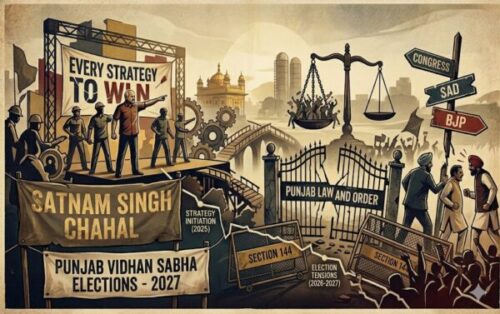
 The political landscape of Punjab is increasingly witnessing a complex interplay between aggressive electoral strategies and the state’s delicate law-and-order situation as the 2027 Vidhan Sabha elections approach. This dynamic was brought to the forefront by senior Aam Aadmi Party (AAP) leader Manish Sisodia during a recent address to party workers. By stating that the party would adopt every possible strategy to secure a victory in the upcoming elections, the ruling dispensation has signalled a high-stakes campaign. While such statements are intended to galvanise the party’s grassroots cadre, they simultaneously raise concerns about the potential escalation of political friction across the state.
This aggressive posturing by the ruling party has drawn sharp criticism from opposition factions, who warn that heavy-handed political tactics could destabilize the region’s internal security. Historically, highly polarised electoral campaigns in Punjab tend to spill over into public unrest. When political rhetoric intensifies, local administrative disputes, candidate nominations, and grassroots rivalries frequently turn into flashpoints for protests, blockades, and localised clashes. Observers note that prioritising electoral victory at all costs risks putting immense strain on the state’s law and order machinery.
Compounding this volatile atmosphere is a profound lack of coordination among the primary opposition parties, including the Indian National Congress, Shiromani Akali Dal, and the Bharatiya Janata Party. Instead of forming a cohesive, unified front to challenge the ruling government, these parties remain highly fragmented. Deep-seated personal animosities and public rivalries between key opposition leaders have severely hindered any cooperative strategy. This internal division not only dilutes the effectiveness of the opposition but also creates a chaotic, multi-cornered political environment.
Ultimately, the bitter relationships and lack of communication among political leaders across the spectrum could further worsen the law and order situation on the ground. When political leadership is fragmented and adversarial, it creates a security vacuum that can be exploited by disruptive elements. As the timeline ticks closer to the 2027 elections, the primary challenge for Punjab will be ensuring that intense political competition does not compromise public safety, demanding a high level of maturity from both the ruling party and the fractured opposition.
“Disclaimer: The photographic elements used in the accompanying graphic are for symbolic and illustrative purposes only. The individuals depicted do not imply actual endorsement, involvement, or association with substance