
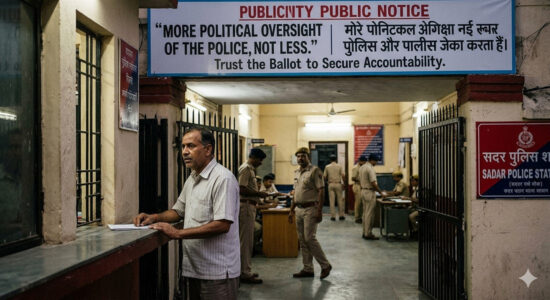
 The article by OP Singh, former Director General of Police, Haryana, is well-intentioned and professionally credible. Its diagnosis of status inconsistency — drawing on Lenski and Lipsky — correctly identifies the structural trap in which the constable and the clerk are caught. But its prescriptions, and indeed its entire analytical frame, sit squarely within a consensus that has governed Indian police reform discourse for the last seven decades: insulate the police from politics, remove them from the superintendence of the Home Secretary and the District Magistrate, place them under judicial and quasi-independent oversight, professionalise the cadre, and good behaviour will follow.
That consensus deserves to be examined more critically — and its internal tensions honestly acknowledged.
Seven Decades of the Wrong Remedy
Since Independence, the dominant thrust of police reform — from the National Police Commission (1977–81) through the landmark Prakash Singh judgment of 2006 to the provisions of the new Bharatiya Nagarik Suraksha Sanhita — has been to wall the police off from elected politicians. The Supreme Court’s directions in Prakash Singh mandating fixed two-year tenures for DGPs, State Security Commissions, and Police Establishment Boards were precisely aimed at reducing political interference and substituting judicial and quasi-independent oversight. The new criminal procedure law gestures in the same direction.
The result, after nearly two decades of this experiment, is instructive. The constable still does not look up. The clerk still waves you away. The thana gate remains the engine of every unpleasant encounter.
What the insulation-from-politics model has produced is not a service-oriented police force; it has produced a police force that is insulated from everyone — including the elected representative who is, in a democracy, the legitimate voice of the citizen. The statutory Police Complaints Authorities mandated by Prakash Singh — generally headed by retired senior bureaucrats or retired High Court judges — were designed to fill that accountability vacuum. They have not. Chronically understaffed, rarely publicised, and operating without coercive powers worth the name, they have become institutional fig leaves: bodies that exist on paper, satisfy judicial compliance reports, and change nothing at the thana gate. The citizen who has been roughed up, extorted, or falsely arrested is not going to travel to a state capital to file a complaint before a retired judge who has no power to punish, suspend, or prosecute the offending officer. The architecture is well-intentioned. The outcomes have been disappointing.
The Case for Political Oversight
The case for more political oversight, not less, is uncomfortable but not irrational. A District Superintendent of Police who knows that the MP or MLA will be called to account in Parliament or the Assembly for every unlawful arrest, every custodial death, every investigation that drags on for years without charge — that officer faces a real-time accountability loop that no Service Commission or High Court bench, sitting in a distant city, can replicate. Political accountability is immediate, local, and electoral. It is also, paradoxically, self-correcting: the politician who shields a brutal thana in-charge pays a price at the booth. The politician who delivers a cleaner, faster police service wins votes.
The Objection Answered: What About Political Targeting?
The obvious objection is that political oversight is itself a vector for abuse — that the ruling party will direct the police against its opponents, weaponising the thana for electoral ends. The objection is not trivial. But it proves less than it appears to. The targeting of political opponents through the police is not a hypothetical risk introduced by greater political accountability; it is the present reality, accomplished daily through the existing system of unscrupulous politicians and equally obliging officers — with no self-correcting mechanism in sight.
What political oversight adds, crucially, is a feedback loop that the current judicial insulation model lacks: governments change. Electoral cycles are merciless. The party that misuses the police against opponents in 2025 finds those same institutional arrangements turned against it in 2027. No High Court bench or State Security Commission offers that discipline. The ballot does. It is an imperfect corrective — democracy usually is — but it is a real one, and it is available to every citizen, including the one standing at the thana gate.
The Deeper Failure: The Citizen Without a Remedy
But the article’s more serious omission — one that the entire reform discourse has consistently sidestepped — lies elsewhere. It concerns the individual citizen who is today without remedy.
Despite the clear provisions of Section 41 of the CrPC (now replicated in the BNSS) requiring written reasons before arrest, despite the Supreme Court’s directions in Arnesh Kumar v. State of Bihar (2014) that arrests in offences carrying less than seven years’ imprisonment must not be routine, the unlawful arrest remains the most common instrument of harassment available to the police. The Court issues directions; the thana ignores them; there is no consequence.
Two structural failures compound this. First, there is no judicially enforced timeline for investigation. An FIR can remain in limbo for years — neither charge-sheeted nor closed — leaving the accused in legal purgatory, his bail papers in order but his life suspended. Second, and more critically, when an arrest is eventually declared unlawful — by a Sessions Court, a High Court, or the Supreme Court — the officer who made it faces no built-in mechanism of personal liability. The state pays any compensation ordered; the officer is transferred. There is no functional equivalent of the tort of false imprisonment operating against the individual officer. The D.K. Basu guidelines have been on the books since 1997; compliance remains, at best, uneven in practice.
The Reform No One Is Willing to Design
Any proposal to place the police under closer supervision of the Home Secretary or the District Magistrate tends to be received, in professional circles, as reopening an old inter-service IAS-IPS debate rather than as a serious structural argument. Whatever the merits of that characterisation, the effect has been to foreclose a legitimate conversation about executive accountability before it can properly begin.
The tension surfaces in an instructive way even within the Police Commissionerate system — a model designed precisely to vest both magisterial and police powers in a single uniformed authority, thereby streamlining command and removing jurisdictional ambiguity. Under this system, the police exercise a wide range of executive functions without any requirement for civilian concurrence: issuing arms licences, granting permissions for public gatherings, passing prohibitory orders under Section 144 CrPC or its BNSS equivalent. These powers are exercised with confidence and, generally, without controversy.
Yet when circumstances turn more serious — when an unlawful assembly turns restive, when dispersal seems difficult, when the spectre of police firing arises — the instinct, even within the Commissionerate system, is often to secure the presence of an Executive Magistrate, be it only a Naib Tehsildar. This is understandable: decisions involving the use of lethal force carry consequences — legal, political, and human — that no police officer, howsoever senior, takes lightly. But it does illustrate a broader truth that the reform discourse has been slow to acknowledge: that those who exercise coercive state power tend, in moments of genuine gravity, to seek the cover of democratic and executive legitimacy. The question worth asking is whether that legitimacy should be available only in extremis, or whether it ought to be woven into the ordinary fabric of police accountability.
What is needed, therefore, is not more sensitivity training for constables — that argument has been made since the 1980s — but a two-track institutional correction that no one is yet willing to even discuss, much less, design.
The first track is democratic: restore meaningful political accountability for aggregate police behaviour, so that the elected government is answerable for how its force treats citizens — not merely for whether it has observed the formality of a fixed DGP tenure or whether a Police Complaints Authority has been constituted on paper.
The second track is legal: create a statutory compensation regime under which unlawful arrest, prolonged investigation beyond a prescribed period, and custodial mistreatment trigger automatic, officer-specific liability — not merely state liability — with recovery from salary and pension where negligence or malice is established. The state must cease to be the sole absorber of the costs of police misconduct. The officer who makes an unlawful arrest must have personal skin in the game.
In Summary: The Thana Gate in 2026
OP Singh knows the police from the inside, and his prescriptions — dignity, incentives, the structural wisdom of Lenski — are not without merit. But culture is the slowest variable in any reform equation. The citizen who walks into a thana in 2026 — uncertain of his rights and acutely aware that everyone in the room outranks him — cannot wait for a generational shift in institutional ethos. He needs a remedy that works in days. What he gets, when he gets anything at all, arrives in months or years, filtered through courts that are themselves overwhelmed, and is very often simply a mirage. The reform that would actually help him — enforceable timelines, officer-specific liability, democratic accountability that bites — requires politicians to place themselves under scrutiny and officers to accept that their authority carries genuine personal responsibility. That is precisely why, across seventy-five years of independence and innumerable reform commissions, it has never been seriously attempted.
Seven decades of insulating the police from politics have not saved the citizen at the counter. Perhaps it is time to have an honest conversation about the alternative — and to trust the ballot to do what the bench, thus far, has not.