
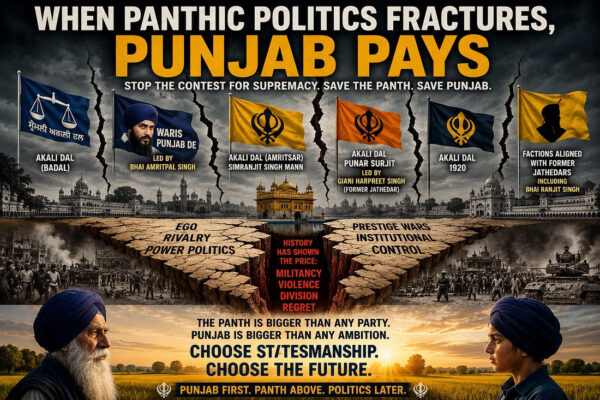
 Punjab is once again entering a phase where Panthic rivalry threatens to overwhelm political wisdom. The immediate flashpoint may be the anti-sacrilege law enacted by the Bhagwant Mann government, but the real crisis runs far deeper: the accelerating fragmentation of Panthic politics and the growing struggle for control over Sikh institutions, Sikh sentiment and the authority to speak for the Panth.
This is not merely political competition. It is a dangerous contest that risks weakening the very foundations of Sikh cohesion and Punjab’s stability. This political competition weakens, confuses and divides the Sikhs globally.
The Panthic landscape today stands sharply divided:
Shiromani Akali Dal (Badal), which currently controls the SGPC and other insitutions
Waris Punjab De led by jailed MP Bhai Amritpal Singh,
Akali Dal Amritsar led by Simranjit Singh Mann,
Akali Dal Punar Surjit headed by Giani Harpreet Singh, former Jathedar of Sri Akal takht
Akali Dal 1920,
and factions aligned with former jathedars, including Bhai Ranjit Singh, the former Akal Takht Jathedar.
Then there are other non political groups like Sant Samaj and Bhai Baldev Singh Wadala who spear headed the struggle for missing Birs and the Law on Be-adbi
All invoke the language of Panthic defence. All claim to represent Sikh interests. Yet instead of strengthening Sikh society, this competition is steadily fragmenting the Panthic centre itself.
That is precisely the danger.
For decades, Parkash Singh Badal managed this delicate ecosystem with remarkable political shrewdness. One may criticise his politics, but one cannot deny that he understood Sikh institutions, gurdwara politics and Panthic psychology better than most leaders of his generation. He balanced factions, religious pressures, SGPC dynamics and electoral compulsions in a way that prevented internal Panthic rivalry from spiralling completely out of institutional control. The slow decay of the education system lowers the limits of the thought, discussion, debate and understanding of the political schemes. The de-educational policy is evident from the fact that SGPC made no effort to make any educational institute after Guru Nanak Engineering College or Guru Ram Das Medical College.
The race for controls over the institutions, eliminated the role of SGPC in Dharam Prachar. Focus was more on fortifying the Maryada, beautification of the Gurdwaras. Ritual than spiritual has been the agenda. De-Education is the promoter of ritualism, that was understood.
When at peak, everything has to come down. Then came Behbal Kalan and Bargari.
The sacrilege incidents of 2015 fundamentally altered Sikh political consciousness. The perception that the Badal-led Akali establishment failed both to protect the sanctity of Guru Granth Sahib and to deliver justice shattered its moral authority among large sections of Sikhs. AAP recognised that the collapse of Akali credibility had opened a rare vacuum in Panthic politics and moved swiftly to occupy it.
The new anti-sacrilege law was therefore not merely legislation. It was political symbolism. The law already existed since 2008 brought in by Akali Dal Badal Government, AAP just amended it and refreshed it, in minds.
Bhagwant Mann attempted to project himself not simply as Chief Minister but as a defender of Sikh sentiment and protector of Guru Granth Sahib. Politically, it was a sharp move because it directly challenged the Akali monopoly over Panthic space.
That pushed the SGPC-Akal Takht establishment into visible confrontation, because Akali Dal Badal perceived it as a political threat in their personal turf. The panth is vertically divided, a segment welcoming the Law and another opposing it.
Some concerns raised regarding terminology such as “custodian”, possible legal intrusion into maryada and state overreach deserve serious discussion. Such issues should ideally have been resolved through scholarship, consultation and institutional dialogue. Instead, the matter is steadily turning into a prestige battle.
And prestige wars inside Panthic politics have historically produced instability in Punjab.
The warning signs are not theoretical. Punjab has already travelled this road once before.
The 1978 Sikh-Nirankari clash became a turning point in Punjab’s political and religious trajectory. Bhai Ranjit Singh former Jathedar of Sri Akal Takht is associated with the assassination of Nirankari chief Gurbachan Singh following the fallout of the 1978 Sikh-Nirankari clash which initially appeared to be a defence of Panthic honour gradually hardened into competitive religious mobilisation.
Mainstream Akali leadership increasingly came under pressure from more aggressive Panthic forces claiming greater authenticity and commitment to Sikh causes. Once Panthic legitimacy shifted from institutions to emotional mobilisation, moderation steadily lost relevance. Sant Jarnail Singh Bhindranwale emerged from precisely such an atmosphere. Initially, established Akali leaders believed they could politically manage and contain the rising radical energies. Eventually, the situation consumed everybody. Punjab descended into militancy, assassinations, social fracture and one of the darkest periods in its history.
Punjab paid for that fragmentation in blood.
The same pattern resurfaced repeatedly:
Akalis versus Nirankaris,
Panth versus Dera Sacha Sauda,
Sarbat Khalsa versus institutional Akali authority,
repeated struggles over who truly represents Sikhism.
Every confrontation begins in the language of defending the faith. Every confrontation deepens division within Sikh society itself. The deep desire to control Political Space via Panthic space, the Gurdwaras and the institutions is a dangerous territory which should be avoided. The news and videos of violent clashes, with swords flashing, turbans tossed, in gurdwaras in the presence of Sri Guru Granth Sahib are very disturbing. The violence or show of strength has often been seen at Sri Akal takht Sahib.
There is also another deeper transformation underway that Punjab still hesitates to openly discuss. Sikhism historically evolved as a universal, inclusive and outward-looking faith rooted in Guru Nanak’s message of equality, openness and fearless moral engagement. But modern Panthic politics increasingly appears trapped in narrower and harder “Khalsa Panth” political assertion.
The shift is subtle but unmistakable.
The transformation from simply being a Sikh in the broad Guru Nanakian sense to proving oneself through more rigid and exclusivist Panthic assertion is becoming increasingly visible. In such atmospheres, moderation is not merely weakened, it is delegitimised and seen with suspicion.
And once moderation weakens, hardliners slowly acquire legitimacy.
Punjab today is already battling:
drugs,
migration,
unemployment,
law and order collapse triggered by drugs and unemployment,
agrarian distress,
ecological collapse,
and economic stagnation or rather collapse.
This is not the time for Panthic factions to fight each other for supremacy.
No individual, no party owns the Panth.
No family owns Sri Akal Takht Sahib.
No faction owns Sikh sentiment.
What Punjab urgently requires today is Panthic statesmanship; leadership willing to rise above ego, rivalry and institutional insecurity. The Panth survived through sacrifice, collective wisdom and restraint, not through endless contests for supremacy.
History is clear: when moderate Panthic leadership fractures, extremes inherit the space. Punjab has seen this before. Hence now Punjab needs a united party for this space, more than ever.