
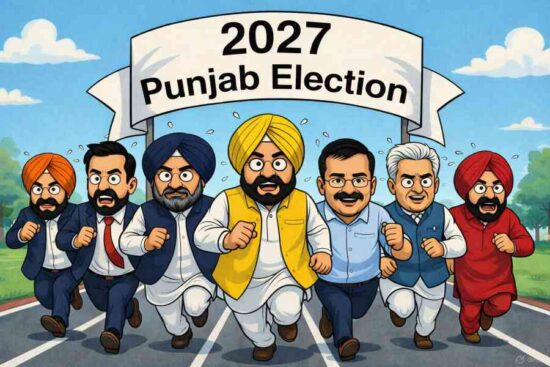
 The political atmosphere in Punjab before the 2027 Assembly election is very different from what it was in 2022. At that time, the people of Punjab were emotionally connected with the promise of change made by the Aam Aadmi Party. Voters were tired of traditional politics and gave AAP a historic mandate by winning 92 seats in the 117-member Assembly. But today, the political ground reality appears very different. The excitement and wave which existed in favor of AAP in 2022 is no longer visible at the same level.
Punjab politics has historically followed an anti-incumbency pattern where voters often change governments after one term. Many political observers now believe that the AAP government is facing increasing public dissatisfaction in several regions of Punjab.
One of the biggest reasons behind this changing atmosphere is the gap between promises and delivery. During the 2022 election campaign, AAP promised major reforms in employment, drugs, corruption, law and order, agriculture, and governance. While the government introduced schemes like free electricity and some welfare measures, many voters now feel that the larger structural problems of Punjab still remain unresolved.
The drug issue continues to remain politically sensitive. Every government in Punjab has promised to eliminate drugs, but the problem still dominates public discussion. Opposition parties are continuously attacking the Bhagwant Mann government over the issue and accusing it of failing to completely control narcotics networks. Congress leaders have even accused the government of using anti-drug campaigns for political purposes rather than genuine reform.
Another major issue hurting the ruling party politically is Punjab’s financial condition. The opposition is strongly targeting the government over rising debt and repeated borrowings. Recently, the Punjab government raised thousands of crores through market borrowings, which immediately became a political controversy. Congress and Akali leaders accused the government of increasing Punjab’s debt burden while failing to provide long-term economic solutions.
Law and order has also become an important political topic. Incidents related to gangsters, extortion, shootings, and political clashes have damaged the image of stability that voters expected after 2022. Opposition parties are trying to create the perception that governance has weakened under the present administration.
There are also signs of internal discomfort and political instability inside AAP itself. The recent controversies involving Rajya Sabha members and public allegations made by former AAP leaders have provided ammunition to opposition parties. Harbhajan Singh’s statement alleging irregularities regarding Rajya Sabha seats created fresh political embarrassment for the ruling party.
The Congress party currently appears to be benefiting the most from anti-incumbency against AAP. Congress still has strong rural networks, experienced district-level leadership, and traditional vote banks among sections of Dalits, farmers, and older voters. Leaders like Amrinder Singh Raja Warring, Partap Singh Bajwa, and Charanjit Singh Channi are trying to rebuild the organization aggressively before 2027. Congress leaders are openly saying that public disappointment with AAP is helping their revival.
At the same time, the Shiromani Akali Dal is also attempting a comeback by focusing on Panthic politics, Sikh identity, and regional emotional issues. Although SAD remains weaker than its past strength, it still has influence in several rural constituencies and among traditional Akali supporters. Sukhbir Singh Badal has been continuously attacking the Mann government over law and order, debt, employee issues, and governance failures.
The Bharatiya Janata Party is also trying to expand independently in Punjab after separating from the Akali Dal. BJP’s growth remains limited in many rural Sikh-majority areas, but the party is working aggressively in urban constituencies and among Hindu voters. BJP leaders are hoping that division among opposition parties may help them increase their seat tally in 2027.
One important factor which may decide the election is opposition unity. If Congress, SAD, BJP, and smaller Panthic groups remain divided, AAP may still remain competitive because vote splitting always helps the ruling party. However, if anti-incumbency grows stronger and opposition parties successfully consolidate voters constituency-wise, then the 2027 election may become extremely difficult for AAP.
Another major challenge for the ruling party is the changing mood among youth. In 2022, many young voters strongly supported AAP believing it represented a new political culture. But unemployment, migration abroad, lack of industrial growth, and frustration among educated youth are now creating disappointment in some sections of society. Many Punjabi families still see foreign migration as the only secure future for their children, which politically damages the image of any ruling government.
At present, the overall political assessment suggests that AAP is not in the same strong winning position that it enjoyed in 2022. The party still has government power, organizational structure, welfare schemes, and Bhagwant Mann’s personal popularity in some areas. But growing anti-incumbency, debt concerns, law-and-order criticism, internal controversies, and opposition revival have made the political battle much more difficult for the ruling party.
The 2027 Punjab Assembly election may eventually become one of the closest and most unpredictable elections in recent Punjab history. As of today, no political party can confidently claim a clear winning position. However, compared to the situation in 2022, the political momentum of AAP appears weaker, while opposition parties appear more energized and hopeful.
“Disclaimer: The photographic elements used in the accompanying graphic are for symbolic and illustrative purposes only. The individuals depicted do not imply actual endorsement, involvement, or association with substance