
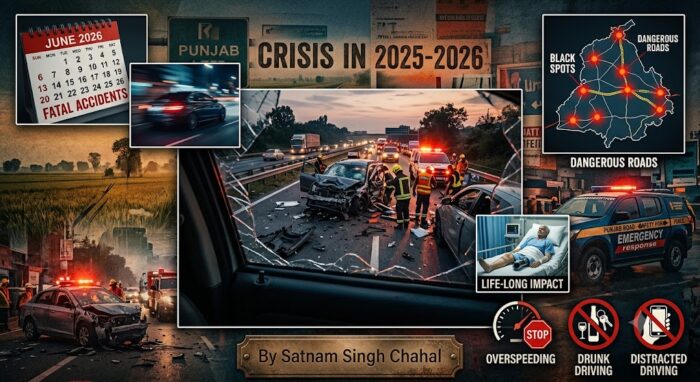
 Road accidents continue to be one of the most serious public safety challenges facing Punjab. Despite advancements in road infrastructure, stricter traffic regulations, and the deployment of the Punjab Road Safety Force, hundreds of accidents continue to occur every month, resulting in the loss of precious lives and causing immense suffering to families across the state. The situation has raised important questions about road safety, driver behaviour, traffic law enforcement, and the condition of Punjab’s roads.
The year 2025 began with renewed concerns about the rising number of road accidents. Traffic experts, law enforcement agencies, and social organisations repeatedly highlighted the dangers of overspeeding, reckless driving, drunk driving, and the increasing use of mobile phones while driving. Major highways connecting cities such as Ludhiana, Jalandhar, Amritsar, Patiala, Mohali, and Bathinda witnessed several serious accidents involving cars, buses, trucks, and motorcycles. Young drivers and two-wheeler riders remained among the most vulnerable groups.
During the first half of 2025, road accidents continued to dominate local news headlines. Fatal crashes on national highways and state roads exposed the dangers of speeding and poor lane discipline. Many accidents involved head-on collisions, vehicles overturning at high speeds, and motorcycle riders travelling without helmets. Families affected by these tragedies repeatedly called for stronger enforcement and safer roads.
By the middle of 2025, concerns were growing that road safety awareness campaigns alone were not enough. Experts pointed out that while awareness is important, strict implementation of traffic laws is equally necessary. They argued that penalties for dangerous driving should be accompanied by improved road engineering and better maintenance of highways and rural roads.
As 2025 progressed, several districts reported a continuing pattern of fatal accidents. Urban centres experienced increasing traffic congestion, while rural areas struggled with poorly marked roads, dangerous intersections, and inadequate lighting. The combination of increasing vehicle ownership and insufficient traffic discipline contributed significantly to the problem.
Entering 2026, the Punjab government continued strengthening the Punjab Road Safety Force, which was created to provide rapid emergency response to accident victims. The force played an important role in reducing response times and ensuring that injured persons received quicker medical assistance. Many lives were reportedly saved because accident victims reached hospitals within the critical golden hour following a crash.
However, despite these positive developments, the fundamental causes of road accidents remained largely unchanged. Overspeeding continued to be the leading factor behind fatal crashes. Drunk driving, distracted driving, dangerous overtaking, and failure to use helmets and seat belts also remained widespread. Traffic experts observed that while emergency response had improved, preventing accidents in the first place remained the state’s biggest challenge.
A comparison between 2025 and 2026 reveals both progress and continuing concerns. On the positive side, emergency services became more efficient, awareness campaigns expanded, and road safety received greater attention from policymakers. Public discussions about accident prevention became more frequent, and citizens increasingly demanded accountability from authorities responsible for road maintenance and traffic management.
On the other hand, the overall risk on Punjab’s roads remained high. The growing number of vehicles, combined with inadequate traffic discipline, continued to create dangerous conditions. Many accident-prone locations, commonly known as black spots, still require engineering improvements. Potholes, poor road markings, unauthorized highway cuts, and inadequate lighting continue to contribute to accidents across various parts of the state.
The social and economic impact of road accidents is enormous. Every fatal crash leaves behind grieving families, while many survivors face lifelong disabilities. In many cases, the victims are young adults in their most productive years, resulting in a loss not only for their families but also for society and the economy. Medical expenses, rehabilitation costs, and lost income place additional burdens on affected households.
Another worrying trend is the increasing involvement of young drivers in serious accidents. Social media culture, thrill-seeking behavior, and the desire to show off high-speed driving have contributed to risky practices on public roads. Experts believe that stronger driver education programs and stricter licensing standards are essential to addressing this issue.
Road safety activists argue that Punjab’s road accident crisis cannot be solved through enforcement alone. A comprehensive approach is required, involving better road design, regular maintenance, improved public transportation, stricter vehicle inspections, and continuous public education campaigns. Technology such as speed cameras, automated traffic monitoring systems, and intelligent traffic management can also play an important role in reducing violations.
The comparison of 2025 and 2026 shows that Punjab has made some progress, particularly in emergency response and public awareness. Nevertheless, the number of accidents and fatalities remains a matter of grave concern. The challenge now is to move beyond reacting to accidents and focus on preventing them through a combination of enforcement, education, engineering, and responsible driving behavior.
Ultimately, road safety is not merely a government responsibility; it is a collective responsibility. Every driver who obeys traffic rules, every motorcyclist who wears a helmet, and every citizen who values safe driving contributes to saving lives. Punjab’s future depends not only on better roads but also on a culture of responsibility and respect for human life. Until that culture takes root, road accidents will continue to cast a shadow over the state’s progress and development.