
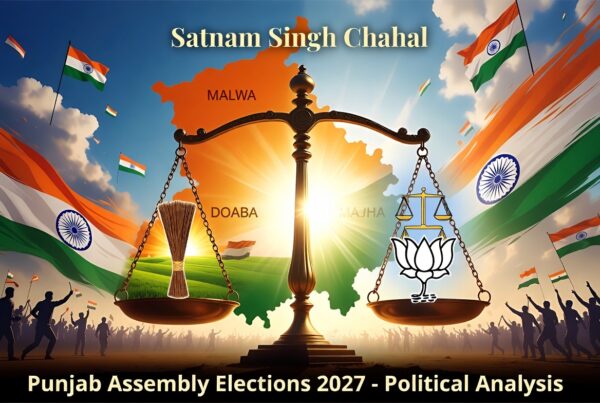
 As of mid-2026, Punjab’s next Legislative Assembly elections are scheduled for February 2027, with 117 seats where 59 are needed for a majority. The Aam Aadmi Party (AAP) is the incumbent ruling party after its landslide victory in 2022, when it won 92 seats with around 42% vote share under Chief Minister Bhagwant Mann. Recent urban civic body elections in May 2026 have served as an important indicator, where AAP demonstrated strong performance by securing approximately 958 out of 1,977 wards (about 48%), winning majorities in 56 out of 104 civic bodies, and taking 5 out of 8 municipal corporations.
This result has provided a significant boost to AAP ahead of 2027, highlighting voter appreciation for its welfare schemes such as free power (up to 300 units), improvements in health and education, and job creation initiatives. However, the party faces challenges including internal factionalism, some signs of anti-incumbency, and recent defections of several Rajya Sabha MPs to the BJP. Opinion polls remain mixed and volatile, with some surveys projecting AAP to secure around 30-40 seats while others show it holding ground due to effective governance delivery in urban and semi-urban areas.
The Congress (INC) stands as the principal opposition party. It performed as a distant second in the civic polls, winning around 397 wards and 24 civic bodies. Historically dominant in Punjab, Congress was reduced to just 18 seats in 2022 but retains organisational networks and traditional support bases. Some recent surveys have shown Congress leading with projections of around 50 seats, capitalising on potential anti-incumbency against AAP, though the party continues to grapple with internal leadership issues and organisational weaknesses.
The Shiromani Akali Dal (SAD) has experienced a continued decline. In the civic polls, it won only about 192 wards and 12 bodies, reflecting its weakened position post-farm laws protests and perceptions of dynastic politics. SAD’s core strength lies in rural areas with strong Panthic (Sikh identity) and Jat Sikh support, particularly in regions like Malwa and Majha, but it struggles to regain broader appeal.
The Bharatiya Janata Party (BJP) has shown noticeable improvement in urban pockets. It tripled its ward wins to around 170-172 in civic polls and secured victories in places like Abohar and Pathankot. BJP is actively pursuing social engineering by appointing a Jat Sikh leader as state president, consolidating urban Hindu votes (especially Khatri and Arora communities), and reaching out to Dalit sections such as Ravidasia groups, alongside non-Jat OBCs. Discussions of a possible alliance revival with SAD persist, though the party is also building independent strength.
Punjab’s politics is deeply influenced by caste and community dynamics. Jat Sikhs, comprising roughly 18-21% of the population but influential in many rural seats, remain a key swing factor with agrarian concerns. Dalits/Scheduled Castes, making up about 32% (the highest proportion in India), are fragmented across subgroups (Mazhabi, Ravidasia, etc.) and deras (religious sects), often playing a decisive role without forming a unified bloc.Hindus (around 35-38%) are stronger in urban and trading communities, particularly in Doaba and parts of Majha.
AAP has built a broad anti-establishment and welfare-oriented appeal that cuts across these groups, especially among youth and middle classes. Congress traditionally draws from Hindus, certain Dalit sections, and some Jat Sikhs. SAD relies heavily on Jat Sikh and Panthic rural bases, while BJP focuses on urban Hindus with expanding outreach to Dalits and non-Jat communities. Regional variations matter significantly: Malwa often favors AAP and SAD, Doaba sees strong Dalit and Hindu influences, and Majha has its own dynamics.
Looking ahead to 2027, AAP enters with the advantage of incumbency and recent civic momentum but must address governance challenges and internal unity. Congress could gain if anti-incumbency consolidates effectively. SAD and BJP are in rebuilding mode, and a potential SAD-BJP alliance might help consolidate anti-AAP votes, though historical frictions remain.
In a multi-cornered contest, even 25-30% vote share can translate into significant seats due to vote fragmentation. Key issues likely to dominate include agricultural distress, economy and jobs, drug menace, sacrilege incidents, power and water availability, and communal or dera influences. Overall, the situation remains fluid. Politics in Punjab can shift rapidly due to unforeseen events, national trends, alliance formations, or effective booth-level mobilization. While civic polls favor AAP and some surveys tilt toward Congress, actual outcomes will depend heavily on voter turnout and last-mile campaign strategies closer to the election.