
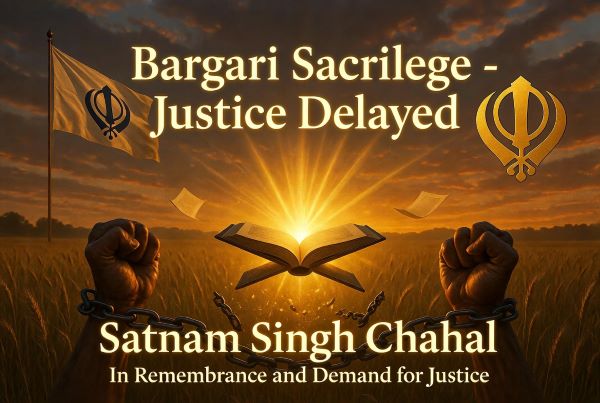
 Unresolved Pain, Dera Sacha Sauda’s Alleged Role, and the Ongoing Demand for Justice. The Bargari sacrilege issue continues to linger in Punjab more than a decade after the painful events of 2015, remaining a deep emotional wound for the Sikh community. In June that year, a copy of Sri Guru Granth Sahib was stolen from a gurdwara in Burj Jawahar Singh Wala village in Faridkot district. Then, on 12 October 2015, over 110 torn pages (Angs) of the holy scripture were found scattered outside a gurdwara in Bargari village. This deliberate act of desecration sparked widespread outrage across Punjab, especially in the Malwa region. It led to massive protests, bandhs, and serious accusations of police brutality.
The protests turned tragic when police firing in Kotkapura and Behbal Kalan resulted in the deaths of two Sikh protesters and injuries to many others. Additional incidents of desecration were reported in nearby villages, further deepening the sense of hurt and anger. The episode quickly became a major political flashpoint, contributing significantly to shifts in political power in the state over the years. Multiple investigations under successive governments have failed to deliver full justice. The Akali Dal-BJP regime faced sharp criticism for its initial handling and police actions. Subsequent Congress and AAP governments set up Special Investigation Teams (SITs), made arrests, and pursued cases in court. However, trials continue to move at a snail’s pace, with no major convictions in the core Bargari incidents as of 2026.Role of Dera Sacha Sauda
Several probes, particularly the Punjab Police SIT report submitted in 2022, have directly blamed Dera Sacha Sauda and its head Gurmeet Ram Rahim Singh as key conspirators. The SIT alleged that Dera followers, acting on instructions linked to Ram Rahim, orchestrated the desecration incidents as an act of revenge or to create unrest in Punjab. Key Dera-linked individuals, including national committee members like Sandeep Bareta (arrested later in 2023), were named as accused or absconders. Cases against Ram Rahim and seven Dera followers were transferred to Chandigarh courts by the Supreme Court. In 2024, the Punjab government granted sanction to prosecute Ram Rahim, and the Supreme Court lifted stays, allowing trials to proceed.However, earlier CBI investigations had filed closure reports citing insufficient evidence against Dera elements. These contradictory findings across agencies, combined with political accusations and procedural delays, have kept the matter highly contested.
Many in the Sikh community view the Dera’s alleged role as central to the sacrilege, yet full legal closure through convictions is still awaited.As of 2026, the wound remains open. Sikh organisations and victim families continue to demand accountability. In April 2026, Punjab passed the Jaagat Jot Sri Guru Granth Sahib Satkar (Amendment) Act, introducing strict punishments including life imprisonment and heavy fines for desecration. While this law aims at future deterrence and assigns responsibilities to gurdwara committees, it does not resolve the pending 2015 cases. All major political parties Akali Dal, Congress, and AAP have faced accusations of exploiting the issue for electoral gains rather than ensuring complete justice.Responsibility remains deeply contested. Investigations point strongly towards Dera Sacha Sauda elements for the sacrilege acts, but systemic delays, shifting probes, and political interference have prevented full accountability. The Bargari issue highlights deeper challenges in protecting religious sentiments, delivering timely justice, and rising above politics in Punjab.