
 The statement issued by Pargat Singh is more than a routine political remark. It reflects a growing concern within Punjab’s political and intellectual circles that the state’s most serious challenges are increasingly being overshadowed by political theatre, social media battles, and headline-driven politics. His intervention raises a fundamental question: Is Punjab discussing the issues that will determine its future, or is it becoming distracted by short-term political narratives?
Punjab today faces a combination of economic, social, demographic, and governance challenges that have been building for decades. While governments change and political slogans evolve, many of the state’s core problems remain unresolved. In this context, Pargat Singh’s call for meaningful discussion and honest introspection deserves attention beyond partisan considerations.
The first and perhaps most pressing challenge is Punjab’s economy. Once considered one of India’s most prosperous states, Punjab has witnessed a gradual slowdown in industrial growth and private investment. Rising debt, limited industrial diversification, and increasing dependence on government employment have created structural weaknesses. The state requires a long-term economic vision that encourages manufacturing, technology, logistics, agro-processing, and entrepreneurship. Without a comprehensive economic revival strategy, promises of development will remain difficult to achieve.
Equally important is the issue of youth migration. Thousands of young Punjabis continue to seek opportunities abroad, often viewing foreign countries as offering greater prospects than their home state. This trend represents not only an economic challenge but also a social one. The continued outflow of educated and skilled youth raises concerns about Punjab’s future workforce, innovation capacity, and demographic balance. Creating quality employment opportunities within Punjab must therefore become a central political objective rather than merely an election promise.
Education represents another critical area highlighted in Singh’s remarks. Punjab possesses a strong educational tradition, yet concerns persist regarding infrastructure, quality, research capacity, and the alignment of education with modern employment markets. Strengthening schools, universities, technical institutes, and vocational training centres will be essential if Punjab hopes to compete in a rapidly changing global economy.
Governance and administrative efficiency also remain major concerns. Citizens increasingly expect transparency, accountability, and measurable outcomes from public institutions. Political announcements often generate public attention, but long-term governance success depends on implementation. Whether the issue is healthcare, infrastructure, law and order, or public service delivery, Punjab requires institutions capable of translating policy into results.
Agriculture, the backbone of Punjab’s economy, continues to face uncertainty. Farmers are confronting rising input costs, environmental pressures, groundwater depletion, and questions about future crop sustainability. Any roadmap for Punjab’s future must address agricultural diversification while ensuring economic security for farming communities.
The challenge of drug abuse remains another issue that demands sustained attention. Successive governments have promised decisive action, yet the problem continues to affect families and communities across the state. Addressing this issue requires not only law enforcement measures but also investment in rehabilitation, education, mental health support, and employment opportunities.
Perhaps the most significant aspect of Pargat Singh’s statement is his criticism of political spectacle. Modern politics increasingly rewards visibility, viral moments, and media attention. However, governance requires patience, planning, and difficult policy decisions. His argument suggests that Punjab’s future will be determined less by political performances and more by the quality of leadership, policy formulation, and institutional effectiveness.
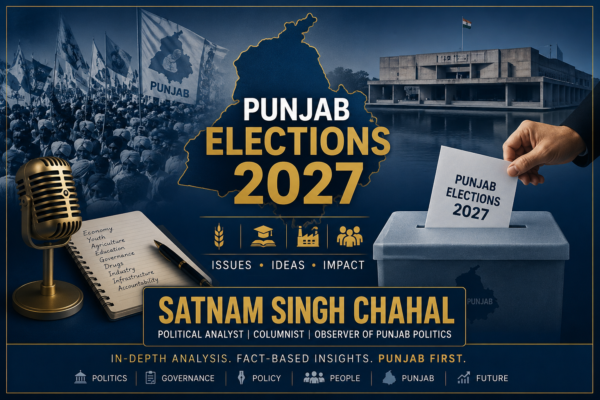
As Punjab approaches another electoral cycle, debates over governance, economic revival, education, employment, agriculture, and public administration are likely to intensify. The state’s voters may ultimately judge political parties not by their ability to dominate news cycles, but by their capacity to present credible solutions to long-standing challenges.
Pargat Singh’s remarks therefore serve as a reminder that Punjab stands at an important crossroads. The real debate is not about personalities or political theatre. It is about whether the state’s leadership can provide the vision, substance, and seriousness necessary to secure Punjab’s future in the decades ahead