
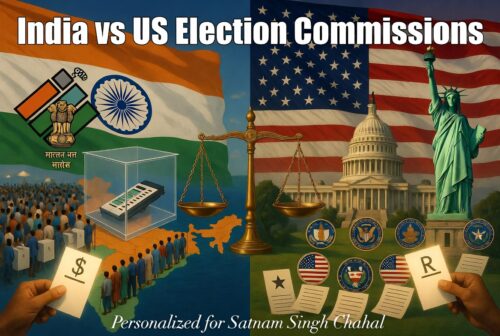
 The Election Commission of India (ECI) and the election administration system in the United States represent two contrasting models, one highly centralised and authoritative, the other decentralised and fragmented. The ECI, established in 1950 under Article 324 of the Indian Constitution, serves as a powerful, independent constitutional body with complete superintendence, direction, and control over the entire electoral process across the country. It manages everything from preparing electoral rolls and issuing Voter ID cards to announcing election schedules, enforcing the Model Code of Conduct, registering political parties, allocating symbols, monitoring campaign spending, and even transferring officials or ordering repolls when necessary. This centralised structure enables uniform rules and efficient management of the world’s largest democratic exercise involving nearly a billion voters.
In contrast, the United States has no single national election commission equivalent to India’s ECI. Election administration is primarily handled at the state and local levels, resulting in over 10,000 separate jurisdictions. At the federal level, two main bodies exist: the Federal Election Commission (FEC), which focuses almost exclusively on campaign finance regulations for federal elections, and the Election Assistance Commission (EAC), which provides voluntary guidelines, funding, and certification of voting equipment but lacks binding authority over how elections are actually conducted. State officials (often Secretaries of State) and county clerks manage voter registration, polling places, ballot design, vote counting, and result certification. This decentralised approach allows flexibility and local adaptation but often leads to wide variations in rules, procedures, and accessibility across states.
India’s ECI model ensures national uniformity and strong enforcement powers, which has been credited with successfully conducting massive elections with high turnout. However, it has faced criticism in recent years regarding perceived political influence and delays in addressing violations. The US system, rooted in federalism, promotes local responsiveness and experimentation but can result in inconsistencies, legal disputes, and challenges in maintaining uniform standards, especially concerning issues like voter ID, mail-in voting, and election security. Both systems have strengths aligned with their countries’ governance structures centralized efficiency in India’s parliamentary democracy versus decentralized autonomy in America’s federal republic — and continue to evolve while facing ongoing debates about fairness, independence, and technological modernization.