
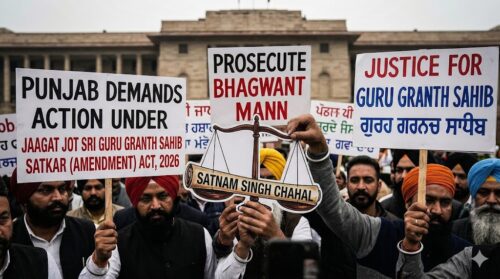
Punjab’s political landscape has witnessed a dramatic escalation after several opposition parties and religious bodies urged Punjab Governor Gulab Chand Kataria and Punjab Director General of Police Gaurav Yadav to initiate legal proceedings against Chief Minister Bhagwant Mann under the recently enacted Jaagat Jot Sri Guru Granth Sahib Satkar (Amendment) Act, 2026, commonly known as the Anti-Sacrilege Law. The demand follows an intensifying controversy surrounding an alleged video and claims that have triggered widespread political and religious debate across Punjab.
The controversy has united several opposition parties, including the Congress, Shiromani Akali Dal and various Sikh organizations, which argue that the law enacted by the Punjab government must apply equally to every citizen, irrespective of political position. Opposition leaders have maintained that if ordinary citizens can be investigated under the provisions of the anti-sacrilege legislation, then the Chief Minister should not be treated differently. Congress leaders have openly demanded the registration of an FIR and have called for Bhagwant Mann’s resignation pending any investigation.
Ironically, the law at the center of the controversy was introduced and strongly championed by the Mann government itself. The Punjab Assembly unanimously passed the legislation in April 2026, and it subsequently received the assent of Governor Gulab Chand Kataria. The Act provides stringent punishment for sacrilege-related offences, including imprisonment extending up to life terms, substantial financial penalties, and strict provisions for conspiracy and digital dissemination of content deemed sacrilegious. The law also categorizes such offences as cognizable, non-bailable, and non-compoundable.
Political opponents are now arguing that the government cannot selectively invoke the law. They contend that if allegations have been raised and religious sentiments have allegedly been hurt, then the police should conduct an impartial investigation under the very legislation that the government described as historic and essential for protecting the sanctity of Sri Guru Granth Sahib. Several opposition leaders have submitted memorandums and public statements urging the Governor and DGP to ensure that the rule of law prevails without political influence.
The Aam Aadmi Party, however, has strongly rejected the allegations. Chief Minister Bhagwant Mann has described the accusations as politically motivated and part of a campaign designed to tarnish his image. Senior AAP leaders have argued that the evidence being cited by opponents is disputed and that attempts are being made to exploit religious sentiments for political gain. The party has maintained that the Chief Minister has committed no act that would warrant prosecution under the anti-sacrilege legislation.
The issue has also generated a broader constitutional and political debate. Legal experts note that while opposition parties may demand action, any criminal proceedings would depend upon the findings of investigative agencies and the availability of admissible evidence. The Governor does not directly register criminal cases, but representations made to Raj Bhavan can increase pressure on law enforcement agencies to examine allegations independently. The final decision regarding registration of a case would rest with the police and investigative authorities in accordance with legal procedures.
For the opposition, the controversy presents an opportunity to challenge the credibility of the Mann government on an issue that has deep emotional significance among Sikhs worldwide. For the ruling AAP, the matter has become a test of political resilience, as the government seeks to defend both the Chief Minister and the legislation that it projected as a landmark measure to protect religious sanctity.
As demands for legal action grow louder, Punjab finds itself witnessing an unprecedented situation where a Chief Minister is being asked to face scrutiny under a law enacted by his own government. Whether the controversy results in a formal investigation, legal proceedings, or remains a political battle will depend on the actions of the Punjab Police and the interpretation of the provisions of the Anti-Sacrilege Act in the days ahead. Referances:Times of India
Disclaimer: This article and accompanying images are for informational and illustrative purposes only. Some visuals may be AI-generated or digitally enhanced and may not depict actual events or persons. Views expressed are based on publicly available information and analysis.