
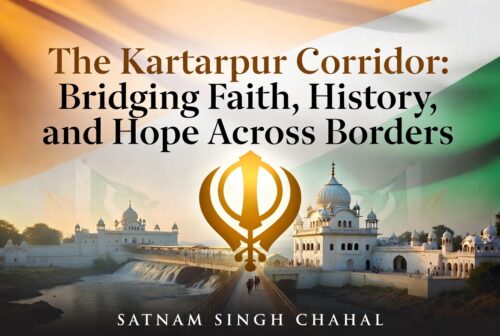
 The Kartarpur Corridor is a 4.7 km (about 2.9 miles) visa-free passage connecting Dera Baba Nanak in India’s Gurdaspur district, Punjab, to Gurdwara Darbar Sahib Kartarpur (also called Kartarpur Sahib) in Pakistan’s Narowal district. It allows Indian Sikh pilgrims and other eligible Indian citizens to visit one of Sikhism’s holiest sites without a full visa process. The corridor represents a significant symbol of religious access and people-to-people contact between the two countries.en.wikipedia.org
Guru Nanak Dev Ji, the founder of Sikhism, established the town of Kartarpur in 1504 CE on the right bank of the Ravi River after his missionary travels. He settled there, plowed fields, set up the first Sikh langar (community kitchen), and built a commune based on principles of honest labor, sharing, and meditation on the divine name. He lived there for the last 18 years of his life and passed away on 22 September 1539. After his death, Hindus and Muslims both honored him in acts of interfaith harmony. Floods from the Ravi River affected the original structures over time. The present gurdwara building was constructed in 1925 with major contributions from Maharaja Bhupinder Singh of Patiala and later restored and expanded, including significant work by the Pakistani government around 1995–2004.en.wikipedia.org
The site symbolizes Guru Nanak’s teachings of equality, peace, and interfaith harmony. It is one of the most sacred Sikh shrines, alongside the Golden Temple in Amritsar and his birthplace at Nankana Sahib. After the 1947 Partition, Kartarpur fell in Pakistan while Dera Baba Nanak remained in India. This separated the Sikh community from easy access to this key pilgrimage site for decades. The gurdwara came under the management of Pakistan’s Evacuee Trust Property Board (ETPB) and was largely abandoned initially before being repaired.The idea of a direct corridor dates back to 1998–1999, when Indian Prime Minister Atal Bihari Vajpayee and Pakistani Prime Minister Nawaz Sharif discussed it during the Delhi–Lahore bus diplomacy. It was raised again in the 2000s but did not materialize due to bilateral tensions. The project gained momentum in 2018 ahead of Guru Nanak’s 550th birth anniversary. Foundation stones were laid on 26 November 2018 by PM Narendra Modi on the Indian side and by PM Imran Khan on the Pakistani side two days later. An agreement was signed on 24 October 2019, allowing up to 5,000 Indian pilgrims per day with Electronic Travel Authority registration.medium.com
The corridor was inaugurated on 9 November 2019. Pakistani PM Imran Khan inaugurated it at the gurdwara complex, with thousands of pilgrims present. Indian PM Narendra Modi inaugurated the Integrated Check Post on the Indian side. It was hailed as a “corridor of hope” and a symbol of peace. When operational, pilgrims could make day visits, and the facility boosted religious tourism while embodying Guru Nanak’s message of unity.The corridor has faced periodic closures, including due to the COVID-19 pandemic (reopened in November 2021). In May 2025, India suspended services from its side amid heightened security concerns following tensions. As of mid-2026, it remains suspended from the Indian side, though there are ongoing calls from the Sikh community for reopening. Pakistan has maintained its side during some periods, and the underlying agreement has seen extensions.Overall, the Kartarpur Corridor stands as a powerful example of how shared religious heritage can foster dialogue amid complex relations. It has allowed thousands of pilgrims to connect directly with the site of Guru Nanak’s final years and teachings, and it remains a landmark achievement in cross-border religious access, even as geopolitical challenges periodically affect its operation. For the latest status, check official portals of the Indian Ministry of Home Affairs or Pakistan’s ETPB.
Referance:Wikipedia