
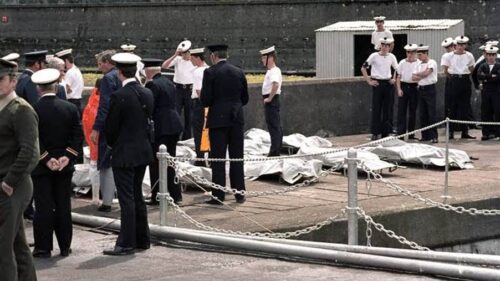
 For forty-one years, the ghosts of Air India Flight 182 have stood outside Canada’s conscience. Now, slowly and perhaps reluctantly, Ottawa seems to be opening the door.
The latest Hindustan Times report (25.6.2026) by Anirudh Bhattacharyya records a major shift in Canada’s official language. The Canadian Security Intelligence Service has explicitly blamed Canada-based Khalistani extremists for the 1985 bombing of Air India Flight 182, known to most Indians as Kanishka. This is not New Delhi saying it. This is Canada’s own intelligence agency saying it.
On June 23, 1985, a bomb destroyed Air India Flight 182, killing all 329 people on board. Most were Canadians. Many were children. The aircraft was flying to India, but the conspiracy was born in Canada. The failure was Canadian. The victims were largely Canadian. The grief, therefore, should have been Canadian from day one.
Yet, for decades, Canada behaved as if Kanishka was a distant Indian wound. It treated the tragedy as a spillover of South Asian politics, not as the deadliest terrorist attack in Canadian history. That moral distance allowed extremism to breathe.
The Hindustan Times editorial (25.6.2026), “Why Canada can no longer ignore the Khalistan challenge”, correctly notes that Prime Minister Mark Carney is shedding the traditional hesitation of the Canadian establishment in dealing with Sikh extremism. But the editorial also makes a crucial point: this shift is not merely to satisfy India. It is to protect Canadians.
That distinction is important. India has warned Canada for years that violent Khalistani extremism cannot be dismissed as diaspora politics. Free speech must be protected. Peaceful advocacy, even for Khalistan, is not extremism. No democracy should criminalise an idea merely because it is unpopular.
But there is a clear line between advocacy and violence, between a slogan and terror funding, between protest and threatening diplomats, between religious identity and intimidation.
CSIS itself has drawn this line. Its 2025 report says only a small group using Canada as a base to promote, fundraise or plan violence, primarily in India, is considered Khalistani extremist. That is a fair distinction. It protects ordinary Sikhs while denying violent extremists the shield of community identity.
This must be said clearly. The vast majority of Canadian Sikhs are hardworking, law-abiding citizens. They are not responsible for a violent fringe. In fact, many moderate Sikhs have themselves faced intimidation from extremists who claim to speak in the name of the Panth.
Canada’s failure was not multiculturalism. Canada’s failure was confusing intimidation with representation.
For decades, a loud fringe was treated as a vote bank. Politicians attended events without asking who was on the stage, who was collecting funds, whose photographs were being glorified, and whose death was being celebrated. Extremist symbolism was given the cover of cultural assertion. Threats were given the cover of protest. Hate was given the cover of hurt sentiment.

The radicalisation is now dangerous and alarming. Young minds who land in Canada for education, employment or a better life are often exposed almost immediately to a highly organised anti-India narrative. Many arrive with hope and innocence. Some are quickly pulled into a world of slogans, grievance, videos, staged anger and emotional manipulation. This is not normal political debate. When young people are pushed to hate the country of their parents and grandparents, when dissenters are bullied into silence, and when intimidation is dressed up as activism, it is not free speech. It is hatred. It is coercion. It is psychological capture. And to top it, it is driven by secret agencies of Anti-India Countries.
This is exactly why Canada’s new Bill C-9, the Combatting Hate Act, matters. Canada is strengthening its Criminal Code to protect access to places of worship, schools, community centres and other community spaces, and to address hate-motivated crime and public display of certain terrorism and hate symbols. The law must now be tested fairly. If a Hindu temple is vandalised, act. If a gurdwara is threatened, act. If Indian diplomats are targeted, act. If a Sikh critic of Khalistani extremism is intimidated, act. Selective enforcement will only deepen mistrust.
The Bob Rae report of 2005 had already made the core truth plain. Air India 182 was not an Indian disaster that happened to touch Canada. It was a Canadian catastrophe. The conspiracy was conceived, planned and executed in Canada, and most victims were Canadians. That should have shaped Canadian public memory permanently. Instead, the lesson was diluted by politics.
Prime Minister Mark Carney has now described the tragedy again as the deadliest terrorist attack in Canadian history and said remembrance must also mean vigilance. These words are welcome. But words are not policy. Remembrance is not justice.
Canada must now act. It must follow the money, because terrorism does not survive on slogans alone. It needs fundraising, laundering, safe channels and community pressure. It must investigate suspected diversion of community donations toward violent activity. It must protect Sikh moderates who say “not in my name”. It must stop political patronage of extremists. No Canadian politician should share a stage with anyone glorifying violence or terror.
India and Canada must rebuild ties without illusion. Canada has concerns about alleged foreign interference. India has concerns about Canada-based extremism and terror financing. Both must be addressed through law, intelligence cooperation and diplomatic seriousness. No country should conduct unlawful operations on foreign soil. Equally, no country should allow its soil to become a base for violent separatism against another democracy.
There is also a message here for the United States. Sikhs for Justice has a presence in the United States and is banned by India. Washington may view it mainly through free speech and civil liberties. That is understandable in a constitutional democracy.
But the lesson from Canada is clear: democracies must not wait for forty years before drawing the line between speech and violent mobilisation.
The United States need not criminalise peaceful political opinion. But it must not allow its soil to be used for threats, intimidation, fundraising for violence, or campaigns that destabilise another friendly democracy. Today, Washington may feel this is not its problem. Canada also thought so for decades. Finally, Canada is admitting the truth.
Kanishka was not only a crime of 1985. It was a warning. Punjab knows what happens when romantic slogans become armed movements. It knows how quickly religion, politics, foreign sanctuaries and money can produce a fire that burns ordinary homes first. It could have been a severe reaction to 1984 Operation Blue star and the riots that followed. But no crime is justified with another crime.
Canada has finally admitted that Khalistani extremism worries Canada. Now it must prove that it worries enough to act.
Reference anchors
HT’s Anirudh Bhattacharyya reported that CSIS explicitly blamed Canada-based Khalistani extremists for the 1985 Air India Flight 182 bombing and called it Canada’s deadliest terrorist attack. (Hindustan Times)
The HT editorial, “Why Canada can no longer ignore the Khalistan challenge”, said Carney is shedding Canada’s traditional hesitation on Sikh extremism, but mainly to protect Canadians rather than to satisfy India. (Hindustan Times)
The CSIS 2025 report says Canada-based Khalistani extremists pose a national security threat, while distinguishing peaceful advocacy from those using Canada as a base to promote, fundraise or plan violence. (Hindustan Times)
Canada’s Justice Department says Bill C-9, the Combatting Hate Act, received Royal Assent on June 18, 2026, and strengthens protections around places of worship, schools, community centres, hate-motivated crime and certain terrorism or hate symbols. (Ministère de la Justice)