
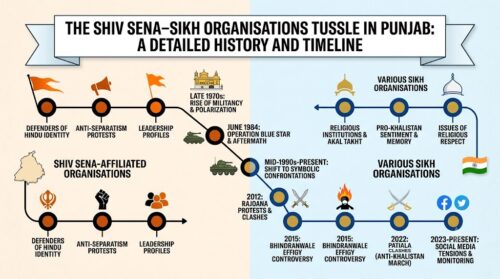
 The tussle between Shiv Sena-affiliated organisations and various Sikh organisations in Punjab is one of the state’s longest-running socio-political conflicts. While it is often described as a Hindu-Sikh confrontation, the reality is more nuanced. The dispute has been shaped by competing political ideologies, religious sensitivities, the legacy of militancy, and disagreements over issues such as Khalistan, freedom of expression, and the protection of religious identities. It is also important to note that neither “Shiv Sena” nor “Sikh organisations” refers to a single unified body. Punjab has numerous independent organisations that use the Shiv Sena name, while Sikh organisations range from mainstream religious institutions and political parties to Nihang groups and pro-Khalistan organisations, each with its own objectives and leadership.
The origins of the conflict can be traced to the late 1970s and early 1980s, when Punjab experienced increasing political and religious polarization. During this period, demands for greater autonomy by sections of the Sikh community intensified, alongside the rise of militant groups advocating for an independent Khalistan. The situation escalated dramatically after Operation Blue Star in June 1984, when the Indian Army entered the Golden Temple complex to remove armed militants. The operation deeply hurt Sikh religious sentiments, while the subsequent assassination of Prime Minister Indira Gandhi and the anti-Sikh riots that followed further widened communal distrust. Amid this volatile atmosphere, several Shiv Sena organisations emerged in Punjab, presenting themselves as defenders of the Hindu minority in the state and advocating a strong stance against Sikh militancy.
Between 1985 and the mid-1990s, Punjab witnessed one of the most violent phases in its modern history. Sikh militant groups targeted political leaders, police personnel, and civilians, including members of various Shiv Sena factions. Several Shiv Sena leaders were assassinated during this period because they openly opposed militancy and the demand for Khalistan. At the same time, thousands of Sikh civilians, activists, and suspected militants were killed or disappeared during counter-insurgency operations conducted by security forces. As a result, both communities suffered significant losses, although under different circumstances. This period established a legacy of mutual suspicion that continued even after militancy declined.
Following the restoration of relative peace in the late 1990s, the nature of the conflict changed. Instead of large-scale violence, confrontations increasingly revolved around protests, speeches, symbolic acts, and allegations of religious disrespect. Numerous Punjab-based Shiv Sena factions remained active, often organizing demonstrations against Khalistan or criticizing Sikh religious figures whom they associated with separatism. Many of these organisations continued to receive police protection because intelligence agencies considered their leaders potential targets of extremist violence.
In 2012, tensions resurfaced during protests surrounding the death sentence of Balwant Singh Rajoana, who had been convicted in the assassination of Punjab Chief Minister Beant Singh. Demonstrations by Sikh groups coincided with activities by Shiv Sena organisations, leading to clashes in which police opened fire. A young Sikh protester, Jaspal Singh, was killed during the incident. His death became a rallying point for several Sikh organisations and reinforced grievances regarding the handling of religious protests.
Another significant controversy occurred in 2015, when Shiv Sena activists attempted to burn an effigy of Jarnail Singh Bhindranwale in Amritsar. While Bhindranwale is regarded by many Sikhs as a martyr or religious figure, others associate him with the rise of militancy in Punjab. The attempt to publicly burn his effigy provoked strong protests from Sikh organisations, leading to clashes with the police and highlighting how historical memories continue to shape present-day politics in Punjab.
Although not directly involving Sikh organisations, the 2018 Phagwara clashes between a Shiv Sena faction and Dalit groups demonstrated that identity-based confrontations involving Shiv Sena organisations extended beyond Sikh-Hindu issues. These incidents reflected the increasingly fragmented nature of social and political mobilization in Punjab, where various organisations frequently organized demonstrations around questions of identity and community rights.
During 2021, several Shiv Sena leaders became involved in controversies over speeches and public statements that Sikh organisations considered offensive. Among the most prominent was Sudhir Suri, leader of Shiv Sena (Taksali), whose videos criticizing the placement of religious texts near idols in temples generated widespread anger among Sikh groups. His remarks led to protests, police cases, and increased security concerns, illustrating how social media had become an important arena for communal tensions.
The most serious confrontation in recent years occurred on 29 April 2022 in Patiala. A local Shiv Sena leader, Harish Singla, announced an anti-Khalistan march, which several Sikh organisations vowed to oppose. As both groups gathered in the city, clashes broke out involving stone-pelting, the display of swords by some protesters, and confrontations with the police. Authorities imposed a curfew in parts of Patiala, suspended mobile internet services temporarily, and arrested individuals from both sides. The Punjab government later removed Harish Singla from the Shiv Sena following the violence. The Patiala clashes attracted national attention because they represented one of the most serious instances of communal tension in Punjab since the end of militancy.
Later that year, in November 2022, Sudhir Suri was shot dead while participating in a protest outside a temple in Amritsar. Police arrested the alleged shooter shortly afterward, and investigations indicated that the attack was linked to longstanding tensions surrounding Suri’s public statements. His killing renewed concerns about extremist violence and the security of controversial public figures in Punjab.
From 2023 onward, tensions have continued at a lower intensity. The disputes have largely shifted toward social media campaigns, legal complaints, symbolic protests, and occasional demonstrations over issues related to Khalistan, religious processions, or alleged insults to Sikh beliefs. Punjab Police continue to provide security to several Shiv Sena leaders because of perceived threats, while authorities closely monitor public gatherings involving organisations from both sides to prevent escalation.
The central issues driving the Shiv Sena–Sikh organisations tussle remain largely unchanged. Shiv Sena factions generally oppose the Khalistan movement, advocate strong nationalist positions, and frequently organize protests against individuals or organisations they believe promote separatism. Many Sikh organisations, meanwhile, strongly object to statements or actions they perceive as disrespectful toward Sikh Gurus, religious symbols, or historical figures. Disputes over processions, speeches, social media content, and historical narratives often become flashpoints because they evoke memories of the violence of the 1980s and early 1990s.
Despite the visibility of these confrontations, most Punjab-based Shiv Sena factions have relatively limited electoral influence. Their significance lies more in activism, protest politics, and media attention than in electoral success. On the other hand, Sikh religious institutions such as the Shiromani Gurdwara Parbandhak Committee (SGPC) and the Akal Takht continue to exercise substantial religious influence, while political organisations like the Shiromani Akali Dal remain important players in Punjab’s political landscape. Consequently, the Shiv Sena–Sikh organisations tussle is best understood not simply as a communal conflict but as a complex interaction of historical memory, religious identity, regional politics, and contemporary debates over nationalism and freedom of expression.
Disclaimer: This article and accompanying images are for informational and illustrative purposes only. Some visuals may be AI-generated or digitally enhanced and may not depict actual events or persons. Views expressed are based on publicly available information and analysis.