
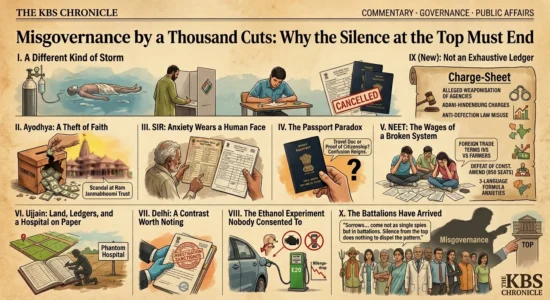
 The Modi government has weathered worse headlines before. During the COVID-19 pandemic, the country watched people gasping for oxygen and dying even as cylinders were being exported abroad, and putrefying dead bodies floating down the Ganga even as officialdom insisted all was under control. What distinguishes the present moment, well into Modi 3.0, is not scale but character. Where COVID was one global calamity met, however imperfectly, with visible state action, what is accumulating now is a steadier and less dramatic thing: increasing instances of misgovernance, each smaller than a pandemic, together pinching the entire citizenry — the citizen at the till, the voter at the booth, the aspirant at the exam hall, and the devotee at the temple. And in each instance, the response has come from a spokesperson, a ministry clarification, or a junior functionary — rarely from the Prime Minister himself, and only fitfully from the Home Minister. What follows is a note of caution for the government and, properly read, an opening for an Opposition that has yet to know quite what to do with it.
II. Ayodhya: A Theft and Betrayal of Faith
The unfolding scandal at the Ram Janmabhoomi Teerth Kshetra Trust sets the tone. Police have recorded the statement of the Trust’s general secretary, who has offered to resign taking moral responsibility, while investigators examine whether security personnel facilitated the alleged embezzlement. The State Bank of India had flagged irregularities in the temple’s cash-counting arrangements nearly three months before the scam surfaced, and the proposed removal of suspect staff was reportedly blocked by Trust-linked functionaries. A Special Investigation Team is now examining whether stolen gold and silver ornaments were melted down to defeat identification, and has sought five years of construction and donation records for a fuller audit. This is money entrusted by ordinary citizens — many making a single, modest, once-in-a-lifetime donation through formal banking channels — on the assumption that faith and institutional propriety would coincide. On an institution so central to the government’s own political narrative, the Centre’s reticence is conspicuous.
III. SIR: Anxiety of the Voter Wears a Human Face
What looked, from a distance, like a Bengal problem has arrived at every citizen’s doorstep. Elderly voters are being asked to produce proof of a father’s presence on the 2002 electoral roll; genuine electors are not receiving the forms they need. It is no longer an abstraction debated on television; it is a queue outside a Booth Level Officer’s desk. In an earlier era, the flak for such administrative distress would have fallen squarely on the Election Commission of India, the constitutional body actually running the exercise. But in a climate where the Commission is increasingly perceived, rightly or wrongly, as having lost its arm’s-length independence from the Centre, it is the Modi government itself that is absorbing the public’s frustration.
IV. The Passport-Citizenship Paradox
Into this anxious climate came an entirely avoidable statement: that an Indian passport is a travel document and not conclusive proof of citizenship. The Election Commission was compelled to clarify that the passport remains one of twelve valid documents for the electoral rolls, and that its status was unchanged. Legally defensible, perhaps — a former Foreign Secretary called the MEA’s position correct in strict law — but tone-deaf in timing, arriving as it did squarely amid the SIR exercise. A government confident in its own processes does not need to remind ninety-nine crore passport-holders that the document in their hand proves less than they assumed.
V. NEET: The Wages of a Broken System
The NEET-UG 2026 examination, sat by over 2.27 million aspirants, was cancelled after investigators found the paper had leaked in advance, with insiders from the National Testing Agency among those arrested. The Education Minister conceded a “breach in the command chain.” Student groups reported acute stress in the aftermath, and multiple students are reported to have taken their own lives. Here it is not merely an examination schedule that has been compromised, but a generation’s faith in its own merit.
VI. Madhya Pradesh CM under Cloud—Ujjain Land, Ledgers, and the Indore Hospital on Paper
In Madhya Pradesh, an investigation has reported that the family of Chief Minister Mohan Yadav saw its landholdings in Ujjain rise from 82 acres to 167 between 2021 and 2023, and then to 335 by 2024–25 — acquisitions, the Opposition alleges, concentrated near highways and master-plan zones the Yadav government itself has announced. The state BJP calls the reporting politically motivated and notes the Chief Minister’s holdings were declared in his 2023 election affidavit; his office has not responded to detailed queries put to it. The allegation of conflict of interest remains an allegation, but it merits an answer on the record.
It is compounded by a second finding from the same state: doctors and staff transferred to a hospital in Indore’s Khajrana that has existed only on paper for six years, not a single brick laid, while appointments and postings proceeded as though the building stood. The district health authority cites a land dispute for the delay. A land controversy and a phantom hospital might, taken separately, pass as routine administrative friction. Together, in the same state and the same season, they read as governance by paperwork, answerable to no one in particular.
VII. Delhi Health Scam: A Contrast Worth Noting
Not every episode here follows the same script. In Delhi, the Anti-Corruption Branch arrested Dr Vatsala Aggarwal, former Director General of Health Services, over an alleged procurement racket in the Central Procurement Agency valued by investigators at roughly Rs 650–700 crore — portable X-ray machines billed at three times the market rate, bedsheets at three times, ORS sachets at six. A second official had been arrested days earlier, and the Enforcement Directorate has since opened a parallel money-laundering probe. The LG Taranjit Singh Sandhu and the Chief Minister Rekha Gupta sanctioned the corruption investigation into her own Health Department under Section 17A of the Prevention of Corruption Act, rather than waiting for the matter to be forced upon them. The contrast is instructive: a swift, self-initiated probe is entirely possible where the political will exists. The question the rest of this piece raises is why that will is so unevenly distributed.
VIII. The Ethanol Experiment Nobody Consented To
The transition to E20 fuel has provoked genuine unrest over engine durability and a want of transparency about which vehicles are truly E20-ready, sharpened after the government was reported to have called the blending programme an “experiment” before the Supreme Court, then denied using the term. Even its own defence concedes the core complaint: mileage does fall, by an estimated one to two per cent in compliant vehicles and more in older ones, yet the price at the pump has not moved to reflect a cheaper input. A modest two-wheeler owner, weighing his fuel bill against his falling mileage, has done arithmetic the government has not troubled itself to explain.
IX. Not an Exhaustive Ledger
This is not offered as an exclusive or exhaustive account. Longer charge-sheets circulate in the Opposition and in elite circles: the alleged weaponisation of investigating agencies, particularly the Enforcement Directorate; the alleged misuse of the anti-defection law; foreign leaders, President Trump prominent among them, making personal and demeaning remarks about the Prime Minister with no visible rebuttal; the Prime Minister’s frequent foreign travel set against quiet at home; trade terms unfavourable to India’s farm sector; the Adani stock-market allegations following the Hindenburg report, with the accompanying charge of crony capitalism favouring a handful of business houses; the Constitution (131st Amendment) Bill — meant to expand the Lok Sabha to 850 seats and finally unlock the long-promised one-third reservation for women — which was defeated on the floor of the House for want of a two-thirds majority; and CBSE’s new three-language formula, requiring Class 10 students to study two Indian languages, which has revived old anxieties over linguistic imposition in the southern states.
These are serious charges, and they deserve their own reckoning elsewhere. But they belong chiefly to the discourse of Parliament, business journals, and op-ed pages such as this one. What precedes them in this piece is different in kind — bread-and-butter grievance, felt in the pocket, the ration queue, the exam hall, and the electoral roll, by virtually every citizen of the country. That distinction is what should determine where the government’s voice is heard first, and loudest.
X. The Battalions Have Arrived
Shakespeare’s warning is apt: sorrows, when they come, come not as single spies but in battalions. None of these episodes is manufactured by the Opposition, and none can be laid at Pandit Nehru’s door seven decades on. Each stands on its own facts; together they form a pattern that quiet from the top does nothing to dispel.
Two duties follow, for two different sets of shoulders. The Opposition has so far treated this constellation as a scatter of disconnected outrages, prosecuted state by state and news cycle by news cycle; a constellation viewed only in pieces is, politically, nowhere, and it needs a coherent, consolidated approach if the pattern is to register with voters at all — this is the opportunity before it, and it is running out of excuses not to seize it. As for the government, Mann Ki Baat reaches 1.4 billion citizens once a month; it cannot claim that reach and decline the corresponding duty to speak when its own citizens are anxious, cheated, or afraid. What this moment calls for is not another bland reassurance from a spokesperson, but an interactive Mann Ki Baat from the Prime Minister himself — one that begins with an acknowledgement of regret and ends with coherent, verifiable action. The Home Minister, equally, cannot address a nation only through set-piece remarks at public forums in India. Leadership, after all, is not merely a matter of claiming the credit and apportioning the blame; it falls to the supreme leader himself to assume responsibility when the ledger has grown this long. Even a monarch cannot be permitted to fiddle while Rome burns, as Nero once famously did; a Prime Minister answerable to 1.4 billion citizens certainly cannot. This is the warning the government would do well to heed before the pattern hardens into a verdict.