
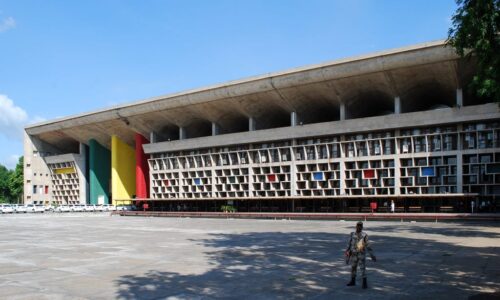
 On 3 August 2026, a Division Bench of the Punjab and Haryana High Court, comprising Acting Chief Justice Ashwani Kumar Mishra and Justice Rohit Kapoor, dismissed the appeals filed by the State of Punjab and PSPCL against a Single Judge’s judgment dated 08.04.2026 in Nirmal Singh Dhanoa and others v. Additional Chief Secretary to Government of Punjab — the ruling that had quashed the government’s Liquidation Plan and, in doing so, sidelined the Single Judge’s own earlier order dated 12.03.2026 in Surinder Singh and others v. State of Punjab (CWP-23651-2024 and four connected matters). What is legally settled, at least until the next round, is now sharply at odds with what is fiscally admitted. During the hearing, the government had pegged the liability at just over ₹14,000 crore — a figure that matches the ₹14,191 crore recorded in the judgment itself. Within hours of dismissal of its LPAs, an unnamed government source told The Indian Express that the real number was closer to ₹25,000 crore — an amount well beyond what the state could realistically raise inside a fortnight — and that Punjab had already resolved to move the Supreme Court in appeal.
The Bench arrived at that conclusion in a legally coherent and comprehensive manner. Across a closely reasoned, 76-page order, it framed and answered nine separate issues, methodically addressing every procedural and substantive objection the State and PSPCL could muster — from the propriety of the roster to the constitutionality of a five-year payment plan — before distilling its findings into a tight, unambiguous operative order. What follows sticks closely to that operative part, before turning to what comes next.
The Operative Order
The judgment’s operative summary, at paragraph 125, disposes of every ground the State and PSPCL had raised, in eight numbered findings.
On procedure, the Bench held that the writ petitions suffered no fatal non-joinder — PSPCL had been arrayed and was “exhaustively heard” in the appeals, so no prejudice was suffered — and that the judgment was not coram non judice: the matters were correctly listed before the roster Bench for Statutory Corporations, the directions against the State were “inseverable from the adjudication,” and any irregularity of allocation stood “effaced by the present appellate adjudication.” The in rem character of the relief was affirmed as the “necessary consequence” of quashing an instrument of general application.
On the Cabinet decision of 18.06.2021, the Bench held it stood validly communicated and notified through the 2021 Rules, and expressed in the Governor’s name in the instructions of 07.09.2021 and 02.11.2021 — implemented, in fact, for five years running. The objection founded on Articles 163 and 166 of the Constitution, and on Bachittar Singh, was rejected.
On the central question, the Bench held that the State of Punjab, and derivatively PSPCL, had adopted the Central Government pattern for DA/DR, and that — on the authority of the Supreme Court’s own ruling in State of West Bengal v. Confederation of State Government Employees (2026 INSC 123) and Purshottam Lal — the benefit of that adopted standard cannot now be denied. The Finance Department’s 2021 “endeavour” comment, the Bench clarified, qualified only the simultaneity of release, not the entitlement or the rate itself. And withholding accrued instalments indefinitely, while All India Service officers continue to be paid at full Central rates from the very same exchequer, was held to be violative of Article 14.
On the Liquidation Plan of 18.02.2025, the Bench held it was rightly quashed — both for staggering payment of arrears “uncompensated with its deferral” and for arbitrarily fixing 42 instalments selectively for certain pensioners within what is otherwise a homogeneous group. PSPCL’s adoptive Finance Circular No. 03/2025 was quashed to the same extent.
On the two competing precedents, the Bench held that neither the Division Bench’s earlier compliance order in the contempt proceedings (CACP No. 47 of 2024) nor the Single Judge’s judgment in Surinder Singh (CWP No. 23651 of 2024) had actually decided the Plan’s validity — the former was confined to contempt jurisdiction, the latter was sub silentio on the point. The Bench found no breach of the judicial-discipline principle in Dawoodi Bohra, and treated any infelicity in the per incuriam label used below as “cured” by its own adjudication.
On the remaining pleas, the Bench held that the directions issued were a legitimate exercise of judicial review and did not trench upon fiscal policy, that the comparative-emoluments and financial-burden arguments were “misconceived in law,” and that PSPCL’s separate legal personality did not insulate it from the obligation — if anything, the unchallenged DA notifications over five years supported the petitioners’ case rather than undermining it.
The Directions
Because the Single Judge’s original deadline of 30.06.2026 had already lapsed by the time the appeal was heard, the Bench modified the timelines — and the timelines alone — as follows:
Payment within a fortnight. The State and PSPCL must release all pending DA/DR instalments to every employee and pensioner, at the same rates paid to All India Service (IAS/IPS/IFS) officers serving in Punjab, in accordance with the Central Government pattern.
6 per cent simple interest on default, running from the expiry of the fortnight until actual realisation.
A compliance affidavit from the Chief Secretary by 31 August 2026.
No unproductive expenditure until dues are cleared — the Bench specifically named “large-scale advertising campaigns in print or social media” as expenditure that “cannot justify the denial of dues admissible to State employees.”
All pending applications were disposed of accordingly.
A Word on the Supreme Court
Nothing in the operative part suggests the Bench expected — or made any allowance for — further appeal. Yet within hours of the judgment, an unnamed government source told The Indian Express the state would move the Supreme Court, saying: “We will move the Supreme Court of India. There is no other option.” Finance Minister Harpal Singh Cheema struck a more circumspect note, saying only that the government would decide once it had studied the detailed order — a gap between an anonymous source’s certainty and a minister’s caution that is itself worth noting.
Whatever the political decision, the legal odds look unfavourable. The core entitlement the Bench enforced rests on a principle the Supreme Court laid down itself, in State of West Bengal v. Confederation, only months earlier; the procedural objections were each answered with case-specific reasoning rather than broad discretion; and an SLP would not automatically stay compliance in any event, leaving the State to seek separate interim relief against a fortnight-long clock that will likely have run out before any such application could even be heard. If Punjab and PSPCL do reach the Supreme Court, the more realistic ask is a modification of timeline or interest — not a reversal of the entitlement itself. The sharp jump in the government’s own estimate of the liability, from roughly ₹14,000 crore argued before the Division Bench to ₹25,000 crore cited to justify an appeal, will also invite scrutiny on its own terms: a Supreme Court asked to grant relief on the scale of the burden will first want to know why the number nearly doubled the moment the case was lost.
A Word on the Politics
The eight conclusions read, in sum, as a comprehensive rejection of a defence built substantially on procedure — wrong roster, wrong forum, wrong pleadings — rather than on any denial that the money is owed. That is a difficult position to defend publicly, and it has already cost the government some support within its own ranks, with PSPCL’s own employee associations distancing themselves from the corporation’s litigation stance during the appeal. The advertising restriction sharpens the problem: it puts the State’s own visible spending habits directly against its pensioners’ unpaid dues, a contrast the Opposition scarcely needs to construct for itself. The Indian Express reports that the ruling lands at a moment when the AAP government has already disbursed roughly ₹3,000 crore under its flagship women’s cash-assistance scheme — spending that will inevitably be set, in the forthcoming Assembly session, against a court order making clear that unproductive expenditure cannot take priority over admitted employee dues. The Opposition is expected to press exactly that comparison when the House convenes; the government’s own position — that DA parity with All India Service officers imposes an unaffordable burden — sits awkwardly next to a fresh, discretionary cash commitment of its own choosing. With Assembly elections due in 2027, the practical question facing the government is less whether to comply than how much further political cost — in this session, and in the run-up to that vote — it is willing to absorb before it does.