
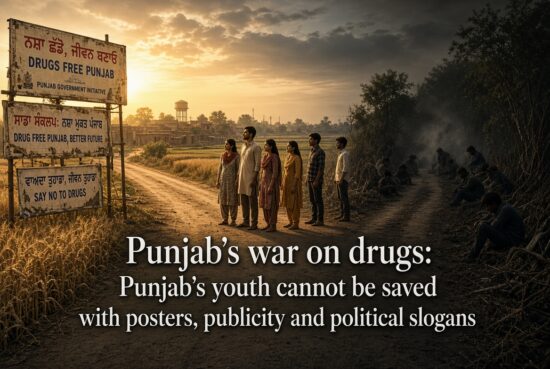
 Punjab is facing a drug crisis that cannot be hidden behind government advertisements, colourful posters or political slogans. The state’s drug problem continues to destroy families, consume the future of young people and leave thousands struggling with addiction. Yet four years into the Aam Aadmi Party government, serious questions are being raised about whether Punjab’s much-publicised “war on drugs” is producing the results that the people were promised.The political criticism is becoming increasingly sharp: the AAP government has failed to protect Punjab’s youth and has failed to demonstrate convincing results in its campaign against drugs. The government may point to raids, awareness campaigns, treatment centres and publicity programmes, but the people of Punjab have the right to ask a much more fundamental question: How many people have actually recovered from addiction and remained drug-free?
Figures cited from a Punjab Vidhan Sabha committee report have brought the state’s use of buprenorphine-based treatment into the spotlight. According to the figures being cited, more than 43.44 crore buprenorphine tablets were purchased during approximately four-and-a-half years. Buprenorphine is a recognised medication used in the treatment of opioid dependence, and its use alone cannot be described as evidence of failure. However, the scale of procurement raises legitimate questions about treatment outcomes and whether patients are ultimately moving toward stable, independent lives.
One of the most serious claims being circulated is that less than one per cent of people undergoing treatment are ultimately able to quit drugs completely. This figure should be independently verified and clearly defined before being treated as an established statistic. But if it accurately reflects the findings of the legislative committee, it would represent an extremely serious failure requiring immediate government scrutiny and corrective action.Punjab has also reportedly spent approximately ₹15 crore on a poster and wall-painting campaign covering more than 13,000 villages. Public awareness certainly has a legitimate role in preventing drug abuse. But Punjab does not have a shortage of slogans. What Punjab desperately needs is measurable recovery.
A young person struggling with addiction does not need another poster telling him that drugs are dangerous. His family needs an accessible rehabilitation programme, professional counselling, medical treatment, vocational training, employment opportunities and long-term support. A drug dealer does not fear a painted wall, and an organised narcotics network will not disappear because another government poster has been installed in a village.The bigger question concerns the government’s overall publicity expenditure. According to RTI-based figures cited in the controversy, the Punjab Government has spent approximately ₹317 crore on print-media advertising since March 2022. This reported figure does not include expenditure on television and digital-media advertising. The scale of this spending deserves public scrutiny because every rupee spent by the government ultimately belongs to the people of Punjab.
If hundreds of crores can be spent communicating government achievements, citizens have every right to demand the same level of transparency about actual anti-drug outcomes. How much has been spent on rehabilitation? How many people entered treatment? How many completed treatment? How many relapsed? How many received psychological counselling? How many received vocational training? How many found employment after rehabilitation? And how many remained drug-free over the long term?Punjab deserves answers to these questions—not more advertisements.
The government must also recognise the difference between treatment and recovery. Medication can be an important component of treatment for opioid dependence, but successful rehabilitation must go beyond medication. A comprehensive programme must include medical care, psychological support, family counselling, education, skills development, employment and sustained after-care.Without these components, patients can remain trapped in a cycle of dependence. Punjab cannot measure the success of its anti-drug strategy simply by counting tablets purchased, patients registered, raids conducted or advertisements published. The ultimate measurement must be the number of lives permanently rebuilt.
NAPA believes Punjab urgently needs a comprehensive and independent audit of the state’s anti-drug programme. The public should be able to see, district by district, how much money is being spent, how many people are entering treatment, how many are completing treatment, what the relapse rates are, how many are achieving long-term recovery and how many recovering addicts are receiving vocational training and employment support.The government should also disclose the expenditure on buprenorphine procurement, rehabilitation centres, counselling, awareness campaigns and print, television and digital advertising. Without transparent data, the people of Punjab are being asked to judge a massive public programme through government publicity rather than independently verified results.NAPA Executive Director Satnam Singh Chahal said Punjab’s youth deserve far more than slogans.
“Punjab has heard enough announcements about a war on drugs. The people want to see the results of that war. They want to see young people coming out of addiction, returning to their families, finding employment and rebuilding their lives,” Chahal said.He said the government must stop confusing publicity with performance.
“If the government can tell us how many posters were printed, how many advertisements were published and how many tablets were purchased, it must also tell us how many young Punjabis were actually saved from addiction. That is the number that matters,” Chahal said.
Chahal stressed that NAPA does not oppose legitimate medical treatment for opioid dependence. “Buprenorphine has a recognised role in addiction treatment. Our question is not whether medicine should be used. Our question is whether the government is properly measuring recovery, preventing relapse and providing patients with a genuine path toward independent lives,” he said.
He called for an independent review involving medical experts, addiction specialists, civil-society organisations and representatives of affected families. According to Chahal, Punjab needs a system in which every rupee spent on the drug crisis can be traced and every treatment programme can be evaluated on measurable long-term outcomes.Punjab does not need a “war on drugs” that exists primarily on television screens, newspaper pages and village walls. It needs a war that is visible inside rehabilitation centres, hospitals, schools, villages and families—and most importantly, in the lives of recovering young people.
The AAP government came to power promising change. On the drug issue, it now has the responsibility to demonstrate that its promises have produced measurable results. The people of Punjab should not have to depend on government advertisements to determine whether the campaign is working.NAPA’s message to the Punjab Government is simple: Stop counting posters. Stop counting advertisements. Stop counting tablets. Start counting recovered lives.Punjab’s youth are not a publicity campaign. They are Punjab’s future.
Satnam Singh Chahal, Executive Director of NAPA, said: “A government can spend ₹15 crore on posters and hundreds of crores on publicity, but no advertisement can rescue a young person from addiction. Punjab needs accountability, evidence and recovery—not political marketing. If the government believes its drug policy is succeeding, open the books, publish the outcomes and let the people of Punjab judge for themselves. Our youth cannot be sacrificed while governments celebrate their own advertisements.”
Disclaimer: This article and accompanying images are for informational and illustrative purposes only. Some visuals may be AI-generated or digitally enhanced and may not depict actual events or persons.Views expressed are based on publicly available information and analysis