
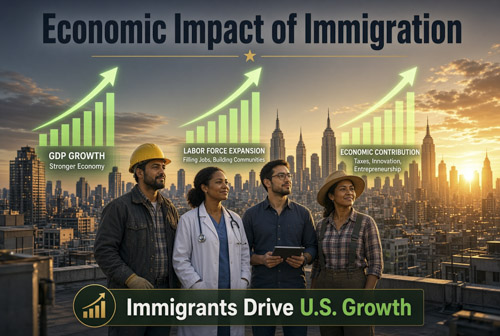
 Immigration has long shaped the U.S. economy by expanding the labor force, boosting consumer demand, and contributing to overall growth, though its effects vary by skill level, legal status, and timing. Recent surges followed by sharp policy-driven reductions have highlighted both benefits and trade-offs.The immigration surge from roughly 2021 to mid-2024 added millions of workers and consumers. According to the Congressional Budget Office, this influx was projected to increase nominal GDP by about $8.9 trillion over the 2024–2034 period and raise the level of GDP by 3.2 percent by 2034 relative to a no-surge baseline. It also generated net fiscal benefits at the federal level, with the surge estimated to reduce cumulative deficits by roughly $0.9 trillion over that decade through higher income and payroll tax revenues that outweighed increased mandatory spending and interest costs. Immigrants in the surge population were expected to pay hundreds of billions in taxes while initially earning lower wages that gradually converged with natives of similar education levels.
Labour-market effects were mixed but generally expansionary. The surge supported robust job growth in the early 2020s by increasing labor supply, particularly in lower-skilled occupations, while also generating demand for goods, services, and housing. Some analyses noted modest downward pressure on wage growth for workers with 12 or fewer years of education in the short term. Overall, immigrants have accounted for a disproportionate share of prime-age labor force growth in recent decades, helping offset slower native-born population increases driven by aging and lower fertility.Policy shifts beginning in 2025 dramatically altered the picture. Net international migration turned low or negative in 2025 (estimates ranging from roughly –295,000 to near zero) and is projected to remain subdued or negative in 2026. Brookings Institution analysis indicates that reduced migration dampens labor force growth, consumer spending (by an estimated $60–110 billion combined over 2025–2026), and GDP. Breakeven monthly job growth consistent with stable unemployment fell to 20,000–50,000 in late 2025 and could approach zero or turn negative in 2026. CBO projections incorporate these lower immigration rates, noting slower labor force expansion (averaging about 0.4 percent annually from 2026–2029), reduced potential output, and dampened long-run GDP growth relative to earlier forecasts that assumed higher inflows.
In short, high immigration expands the economic pie through more workers and consumers, generating federal fiscal gains over time, while sharp reductions constrain labor supply and moderate growth particularly as the native-born working-age population stagnates. Local and state fiscal impacts can differ, especially where education and service costs for lower-income or unauthorized households are concentrated.Exploring U.S. Asylum System ReformsThe U.S. asylum system has undergone significant changes since early 2025, aimed primarily at reducing large backlogs, deterring what the administration describes as non-meritorious claims used for delay or work authorization, and accelerating adjudications and removals.By mid-2026 the affirmative asylum backlog at U.S. Citizenship and Immigration Services stood at approximately 1.4 million cases, with average processing times stretching to more than seven years in some estimates. Defensive asylum cases in immigration courts numbered in the millions as well.
Previously, USCIS practice generally required an interview before deciding whether to grant asylum, deny it, or refer the case to an immigration judge. The new rule removes regulatory language describing an applicant’s “right” to an interview and eliminates the requirement that a referral notice include a credibility assessment. USCIS retains the authority (and obligation in many instances) to interview applicants before issuing a final grant or denial of asylum. Referrals without interview are authorized when, based on the written record, supporting documents, background checks, and other evidence, the officer determines the applicant is barred from applying for asylum (most commonly the one-year filing deadline without a qualifying exception), barred from a grant of asylum, does not merit a discretionary grant, or is ineligible on the merits of the claim.
DHS estimates the rule could affect up to 444,724 pending cases—approximately 31 percent of the affirmative asylum backlog of roughly 1.43 million applications as of late fiscal year 2025—primarily those filed more than one year after entry. Going forward, the agency projects that about 132,167 new affirmative asylum applications each year may be referred without an interview under the same criteria. The rule applies both to pending applications and to future filings, giving USCIS flexibility to prioritize categories of cases through subsequent policy guidance.
Officials justified the change as a necessary response to an unsustainable backlog. Average processing times for affirmative asylum cases had stretched to approximately 7.3 years, creating prolonged uncertainty for applicants while enabling what the administration described as strategic use of the process for delay and temporary work authorization rather than genuine protection claims. By skipping interviews in cases likely headed for referral anyway, USCIS aims to free resources for meritorious claims, shorten overall adjudication timelines, curb backlog growth, and strengthen system integrity. USCIS Director Joseph Edlow stated that the asylum system had been “exploited for purposes of delay and work authorization, not legitimate claims of protection,” and that the rule would redirect resources toward timely decisions on genuine cases.
Critics, including immigration advocates and legal experts, argue the rule undermines due process and fairness. The non-adversarial interview has historically allowed applicants—many of whom lack counsel or face language barriers—to explain complex persecution claims in their own words before a specialized officer. Bypassing it risks erroneous referrals of potentially grantable cases based solely on paper records. Once referred, applicants enter an adversarial court environment where asylum grant rates have fallen sharply (to historically low levels in early 2026 data), increasing the likelihood of removal orders. The rule’s retroactive application to pending cases, some of which have waited years for an interview, is viewed by opponents as changing the rules midstream. Advocacy groups note that the change effectively shifts rather than eliminates the backlog, transferring cases from an already strained USCIS docket to immigration courts that themselves face millions of pending matters.
Projected operational impacts include a faster reduction in the USCIS affirmative asylum backlog and an increase in EOIR caseloads, potentially accelerating removals for non-meritorious claims while pressuring court capacity. Early implementation data are limited as of early August 2026, but the rule is expected to raise the volume of direct referrals beyond the tens of thousands already transferred in prior periods. Economically and humanely, applicants facing referral without interview may experience heightened uncertainty and reduced opportunities to present evidence orally, while the government anticipates efficiency gains and reduced opportunities for prolonged presence pending adjudication.The rule took effect immediately as an interim final rule, with a 60-day public comment period running through approximately September 28, 2026. Legal challenges are anticipated, focusing on administrative procedure, due process, and consistency with the Immigration and Nationality Act’s interview timelines. As of mid-August 2026, no major court injunctions have halted implementation. The measure forms part of a broader set of 2025–2026 asylum and enforcement reforms aimed at restricting access, accelerating decisions, and prioritizing removals. Its long-term effectiveness will depend on judicial capacity, the volume of new filings, and the outcomes of both public comments and any litigation.
Referances:federalregister.gov,visaverge.com +1,latintimes.com +1,latintimes.com +1,brennancenter.org,uscis.gov,brookings.edu +1,cis.org
Disclaimer: This article and accompanying images are for informational and illustrative purposes only. Some visuals may be AI-generated or digitally enhanced and may not depict actual events or persons.Views expressed are based on publicly available information and analysis