
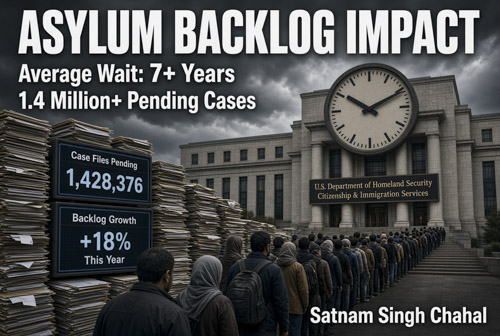
 The backlog imposes heavy operational and fiscal burdens on the system itself. USCIS’s overall pending caseload has climbed past 11.3 million applications across all categories, with average clearance times nearly doubling in recent quarters (from about 9.4 months to 18.6 months year-over-year in one comparison). Asylum cases divert staff and resources that could otherwise address green cards, naturalizations, or other benefits, contributing to longer waits system-wide. Immigration courts face packed dockets, with judges handling dramatically higher daily caseloads in some locations, and efforts to accelerate completions have included hiring additional judges and temporary personnel. High volumes of asylum claims have historically slowed the entire removal process, allowing individuals ordered removed to remain pending appeals or non-appearances.
Economically, the impacts cut in multiple directions. When asylum seekers obtain work authorization and enter the labor force, local studies indicate positive effects: inflows equivalent to 1 percent of a commuting-zone population have been associated with higher incumbent employment, wages, and local GDP. Aggregated estimates suggest working-age asylum seekers arriving in earlier surge years contributed substantially to output. However, multi-year delays postpone full labor-market integration, reduce productivity, and impose costs on localities for temporary services, education, and healthcare. Proposed or implemented restrictions on work authorization risk further losses—potentially tens of billions in forgone economic activity—while the administrative expense of managing millions of pending cases adds to federal budgets. Longer-term fiscal analyses of immigration overall show net federal gains from higher tax revenues, but localized short-term costs remain significant during extended waits.
The July 2026 interim final rule represents the most direct recent attempt to address the affirmative backlog. It authorizes USCIS asylum officers to refer certain cases—potentially affecting more than 444,000 pending applications (about 31 percent of the backlog, often those filed more than one year after entry) and roughly 132,000 future annual filings—directly to immigration judges without a prior non-adversarial interview. Officials describe this as a streamlining measure to eliminate redundant review, focus resources on meritorious claims, and shorten overall adjudication timelines by moving cases into the court system faster. Critics contend it shifts rather than reduces the burden, places more applicants into adversarial proceedings with currently low grant rates, and raises due-process concerns by removing an initial opportunity for applicants to present their claims in a non-court setting. Early implementation is expected to shrink the USCIS asylum queue while increasing court volumes, with outcomes still unfolding amid public comment and potential litigation.
Overall, the asylum backlog has eroded confidence in the system’s ability to deliver timely protection or enforce removals efficiently. It has incentivized volume-driven claims that overwhelm capacity, prolonged legal limbo for hundreds of thousands of people, strained agency resources, and created measurable economic frictions through delayed integration and administrative overhead. Recent reforms aim to accelerate decisions and prioritize genuine cases, but the scale of the accumulated caseload means meaningful reduction will take sustained effort, additional judicial capacity, and policy consistency. The ultimate impact will depend on how quickly cases move through the courts and whether new filings remain suppressed under current enforcement conditions.
Analysis of the July 2026 Interim Final Rule on Affirmative Asylum Referrals Without InterviewOn July 28, 2026, the Department of Homeland Security (DHS), through U.S. Citizenship and Immigration Services (USCIS), published and immediately implemented an interim final rule titled “Affirmative Asylum Referrals Without Interview.” The rule fundamentally alters longstanding procedures for processing affirmative asylum applications (Form I-589) filed by noncitizens who are not already in removal proceedings. It permits asylum officers to refer certain cases directly to the Department of Justice’s Executive Office for Immigration Review (EOIR)—immigration courts—without first conducting the traditional non-adversarial interview.