
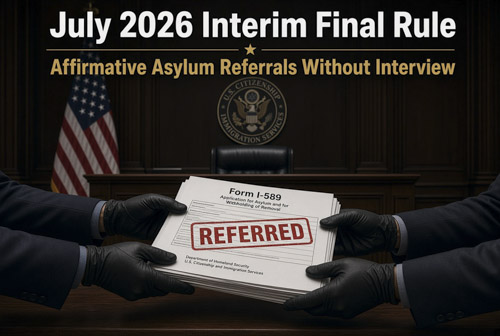
 A major reform took effect in late July 2026 via an interim final rule from USCIS. It allows asylum officers to refer certain affirmative asylum applications directly to immigration judges without first conducting the customary non-adversarial interview. The agency estimated the change could affect up to roughly 444,000 pending cases (about 30 percent of the backlog, particularly those filed more than one year after entry and thus potentially barred) and around 132,000 future annual applications. Officials framed the rule as a backlog-reduction and efficiency measure that eliminates a “second chance” review and directs resources toward genuine protection claims rather than delay tactics. Critics argued it undermines due process by removing an initial interview opportunity and funnels more applicants into adversarial court proceedings that can lead more quickly to removal orders.
Broader reforms include sharply lower refugee admissions ceilings (set at a historic low of 7,500 for fiscal year 2026, with limited subsequent adjustments focused on specific groups), termination or non-renewal of certain Temporary Protected Status designations, restrictions on work authorization for asylum seekers (including proposed longer waiting periods and discretionary approvals), enhanced vetting, and pauses or slowdowns in adjudications for applicants from designated countries. Border-level measures have also limited access to asylum claims for many who cross irregularly. Some of these actions have faced legal challenges, with mixed court outcomes.
These changes have coincided with steep declines in border encounters and overall net migration. Proponents argue they restore integrity to a system long strained by volume and exploitation. Opponents contend they restrict legitimate protection claims, increase deportation risks without full hearings in some cases, and shift burdens onto immigration courts already facing capacity constraints. Implementation continues amid ongoing litigation and public comment periods on the latest rules, leaving the long-term shape of the asylum system still evolving as of August 2026.
The U.S. asylum backlog remains one of the most significant operational challenges in the immigration system as of August 2026, with profound effects on applicants, government agencies, the broader immigration process, and the economy. Affirmative asylum applications pending at U.S. Citizenship and Immigration Services (USCIS) exceed 1.4 million cases—reaching approximately 1.43 million in recent reports—while immigration courts under the Executive Office for Immigration Review (EOIR) handle a total backlog that has declined modestly but still stands near or below 3.5 million cases, with asylum claims comprising a substantial share (previously reported around 2.3 million). Average decision times for affirmative asylum cases stretch to roughly 7.3 years.
These multi-year delays create severe hardship for applicants. Individuals and families endure prolonged uncertainty about their legal status, limited ability to plan for the future, and restricted access to full work authorization or benefits in some cases. Many face financial strain, housing instability, and elevated stress while waiting for interviews or hearings that may never materialize under prior procedures. Genuine claimants in need of protection experience delayed relief, while those with weaker claims gain extended presence in the United States through the sheer length of processing. Recent data also show rising in-absentia removal orders, as some applicants fail to appear for court hearings after years of waiting.
Disclaimer: This article and accompanying images are for informational and illustrative purposes only. Some visuals may be AI-generated or digitally enhanced and may not depict actual events or persons.Views expressed are based on publicly available information and analysis