
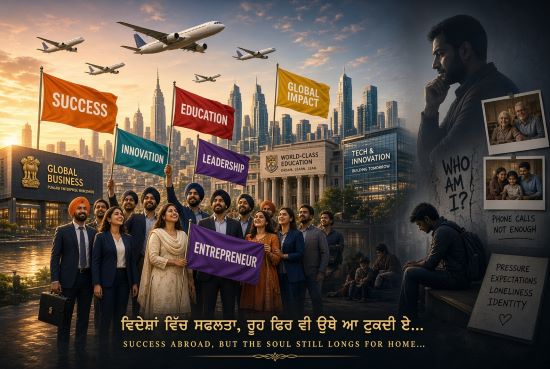
 The Punjabi diaspora stands as one of the most widespread and economically significant communities in the world. Originating from the Punjab region of South Asia, divided between India and Pakistan, Punjabis have established homes across the United Kingdom, Canada, the United States, Australia, New Zealand, Italy, and the Gulf nations. Estimates suggest that more than 15 million people of Punjabi heritage now live outside their ancestral homeland. Yet beneath the outward markers of success the thriving businesses, the celebrated bhangra culture, and the growing number of political representatives lies a quieter and more painful reality.
 Rates of divorce and domestic violence within Punjabi diaspora communities have risen steadily over the past four decades. This increase stems from a profound collision between deeply rooted patriarchal traditions and the values of gender equality and individual autonomy that define the host societies. This article examines the causes, historical timeline, and consequences of this crisis across the globe. It draws on documented research, legal records, and community studies from the United Kingdom, Canada, the United States, and Australia.
Timeline: Key Events and Shifts in the Punjabi Diaspora. In the 1950s and 1960s, the first major wave of Punjabi migration reached the United Kingdom following the Partition of 1947. Families settled in tight-knit, insular communities in places such as Southall, Birmingham, and Bradford. Domestic issues were rarely reported outside the community.
Honour culture dominated social interactions, and family disputes were almost always resolved internally.During the 1970s, immigration expanded to Canada and the United States. Arranged marriages across continents became common, and “visa marriages” emerged as a recurring pattern. These arrangements often created dynamics of coercion and dependency, since a spouse brought on a spousal visa risked deportation if they left the marriage. Communities began to form in Ontario and British Columbia.The 1980s saw the second generation born and raised in the West—begin to challenge traditional norms. Dowry disputes and honour killings appeared in the UK press. The landmark Kiranjit Ahluwalia case in 1989 brought national attention to domestic violence against Punjabi women in Britain and contributed to a partial legal reform of the defence of provocation.By the 1990s, divorce rates had begun rising visibly across Punjabi communities in the UK and North America. South Asian women’s organisations, including Southall Black Sisters in London, were established.
Community panchayats and Shariah councils continued to operate as informal alternatives to civil courts, frequently pressuring women to remain in abusive marriages.In the 2000s, forced marriage and honour-based violence became formal legal categories in the UK and Canada. Academic research documented significantly elevated rates of domestic abuse among South Asian women in the diaspora. The internet enabled women to seek information and help anonymously, and the community taboo surrounding these issues began to erode slightly among younger generations.The 2010s brought further legislative change. The UK passed the Anti-Social Behaviour, Crime and Policing Act in 2014, which criminalised forced marriage.
Australia recorded rising divorce rates among South Asian communities. Social media simultaneously amplified awareness of the problem and intensified community shaming of those who spoke out. Second- and third-generation Punjabis began discussing mental health and relationship breakdown more openly.In the 2020s, COVID-19 lockdowns dramatically increased domestic violence cases globally, including within Punjabi diaspora households. “Pink divorce” divorces initiated by women—rose sharply in Punjabi communities in Canada and the UK. In the post-pandemic period, conversations around coercive control, financial abuse, and psychological manipulation gained mainstream attention within South Asian communities.Causes of Divorce and Domestic Violence1. The Cultural Collision
No single factor has proved more consequential than the tension between two fundamentally different worldviews. First-generation immigrants often carry deeply embedded patriarchal norms from rural Punjab, where a woman’s worth was traditionally measured by her subservience, her domestic skills, and her ability to produce male heirs.
No single factor has proved more consequential than the tension between two fundamentally different worldviews. First-generation immigrants often carry deeply embedded patriarchal norms from rural Punjab, where a woman’s worth was traditionally measured by her subservience, her domestic skills, and her ability to produce male heirs.
These norms clash sharply with the egalitarian values of Western societies, in which women possess legal protections, economic independence, and social freedom.The collision plays out in everyday life. A wife who wishes to work may be labelled “shameless,” while a husband who expects complete submission is labelled “abusive.” Neither partner may initially understand the other’s cultural framework, and the marriage can become a battlefield of competing expectations. Culturally competent counselling services remain critically underused.
Arranged marriages remain common across the Punjabi diaspora, yet the boundary between arrangement and coercion is frequently blurred. In many cases, particularly among Pakistani Punjabi families, young women or men are taken “back home” for weddings with partners they have never met or have barely consented to meet. Immigration law further complicates these situations: a spouse brought on a visa may face deportation if they leave an abusive partner, creating legal constraints that trap victims in dangerous circumstances.Studies from the UK Home Office have shown that South Asians—a group in which Punjabis form a significant portion—account for a disproportionate share of forced marriage cases. The Forced Marriage Unit in the UK handles more than 1,000 cases each year, with Pakistan and India consistently ranking among the top countries of origin.
The concept of izzat honour or reputation remains one of the most powerful social forces in Punjabi culture and is tragically double-edged. On one hand, it binds communities together through strong expectations of dignity and respect. On the other, it silences victims of abuse and traps them in violent marriages. A woman who reports domestic abuse risks being seen as destroying her family’s honour, while a man who admits marital failure faces social ridicule.Children are frequently used as emotional leverage, with relatives urging victims to “stay for the sake of the children” and asking “what will people say?” Extended family members and community elders often pressure victims to reconcile rather than pursue legal action, viewing involvement of the police or courts as a catastrophic breach of communal honour. This cultural framework makes escape extraordinarily difficult.
Financial abuse is a particularly common form of domestic abuse in Punjabi diaspora households. Many women, especially those who arrived as spouses, possess limited English-language skills, no independent bank accounts, and no professional qualifications recognised in their new country. This economic dependency makes leaving practically impossible without significant institutional support.At the same time, some men face distinctive financial pressures of diaspora life: sending remittances to Punjab, meeting extended-family expectations, and contending with underemployment, racial discrimination, and high housing costs. These stresses can generate resentment that erupts as domestic violence.
Second- and third-generation Punjabis often experience an acute identity crisis. They may feel “too Western” for Punjab and “too Brown” for full social acceptance in their host countries. This “in-between” existence creates profound psychological stress. Marriages between differently acculturated partners—one raised in Punjab and the other in Birmingham or Brampton—frequently break down under the weight of incompatible expectations regarding gender roles, sexuality, communication styles, and personal autonomy.Many second-generation Punjabis enter marriage without any education in relationship communication, consent, or emotional intimacy—topics that remain deeply taboo in traditional households. The mismatch between idealised notions of marriage and its daily reality can prove catastrophic.6. Alcohol and Substance Abuse
Alcohol misuse is a significant yet frequently underacknowledged factor in domestic violence within the Punjabi diaspora, particularly among Sikh Punjabi households where drinking despite religious prohibition—remains culturally widespread among men. Studies have linked heavy alcohol use to elevated rates of intimate partner violence across South Asian communities in the UK, Canada, and Australia. Substance use does not excuse violence, but addressing it forms an essential component of any serious intervention strategy.
Alcohol misuse is a significant yet frequently underacknowledged factor in domestic violence within the Punjabi diaspora, particularly among Sikh Punjabi households where drinking despite religious prohibition—remains culturally widespread among men. Studies have linked heavy alcohol use to elevated rates of intimate partner violence across South Asian communities in the UK, Canada, and Australia. Substance use does not excuse violence, but addressing it forms an essential component of any serious intervention strategy.
Children of divorced or domestically abused Punjabi diaspora parents face compounded trauma. They are often caught between two conflicting cultural codes: a parent who enforces traditional expectations and a wider society that views those expectations as oppressive. Research in the UK indicates higher rates of anxiety, depression, and academic underperformance among South Asian children from disrupted homes. Many also internalise shame, believing the family breakdown is their fault or a source of dishonour.Children who witness domestic violence are statistically more likely either to perpetuate it or to accept it in their own adult relationships. Advocates are working to interrupt this generational cycle through school-based education programmes in areas with high South Asian populations.
Women leaving abusive Punjabi diaspora marriages confront multiple barriers simultaneously: immigration-status uncertainty, lack of financial resources, language difficulties, absence of local family support networks, and the heavy psychological weight of community shame. Refuges and support organisations report that South Asian women are significantly less likely to seek help early and often remain in abusive situations for many years.The consequences of prolonged abuse include severe post-traumatic stress disorder, depression, physical health complications, and in the most tragic cases honour killings. The UK’s Crown Prosecution Service has prosecuted numerous honour-based violence cases involving Punjabi families, and similar cases have occurred in Canada and Australia. Each such case represents a catastrophic failure of community, family, and institutional safeguarding.
The rising divorce rate, while painful, also signals meaningful progress. Women in the Punjabi diaspora are increasingly choosing not to tolerate abuse. Specialist charities such as Southall Black Sisters in the UK, Apna Ghar in the United States, and the South Asian Legal Clinic in Canada have provided essential lifelines. Greater legal literacy, access to employment, and the visibility of community role models have transformed the landscape compared with the 1970s.Third-generation Punjabi women, in particular, are reshaping the narrative. Active in media, politics, law, and medicine, they publicly contest the stigma surrounding divorce and openly discuss domestic abuse, forcing conversations that earlier generations avoided. Podcasts, YouTube channels, and social-media accounts run by Punjabi women now offer peer support and information to thousands.
Both perpetrators and victims of domestic violence, as well as those who divorce, frequently experience severe mental-health consequences. Depression, post-traumatic stress disorder, and substance abuse rates are significantly elevated. Yet the Punjabi cultural stigma surrounding mental health—the belief that being labelled “pagal” (mad) is among the worst possible outcomes—keeps many from seeking professional help.Men who experience female-perpetrated abuse face additional layers of silence; community taboos make it virtually impossible to speak openly about such violence. Mental-health services in most host countries remain insufficiently equipped to provide culturally competent care to Punjabi-speaking clients, with very few therapists who understand the specific cultural dynamics involved.
The rise in domestic-violence and forced-marriage cases within Punjabi diaspora communities has driven significant legislative change. The UK’s Forced Marriage Act of 2014, the establishment of Multi-Agency Risk Assessment Conferences for high-risk cases, and dedicated South Asian liaison officers within police forces all respond, at least in part, to the dynamics observed in these communities.In Canada, provinces have strengthened civil protection-order frameworks. In Australia, the national plan to reduce violence against women includes specific provisions for culturally and linguistically diverse communities. These advances represent genuine progress, although enforcement remains inconsistent and trust in police and legal institutions stays low among many Punjabi families.
The United Kingdom hosts the oldest and largest Punjabi diaspora in the Western world, with major concentrations in Southall (London), Birmingham, Wolverhampton, Leicester, and Bradford. Domestic-violence rates among South Asian women are reported to be significantly higher than the national average; studies suggest that nearly one in three South Asian women experiences domestic abuse in her lifetime. The UK government’s Forced Marriage Unit and specialist police units have worked to address honour-based violence, yet community leaders still frequently pressure victims to reconcile rather than prosecute.The Kiranjit Ahluwalia case remains a defining moment in British-Punjabi history. After enduring years of severe abuse, she took action that led to her imprisonment, partial exoneration, and ultimately contributed to legal reform concerning the defence of provocation for victims of prolonged abuse. Her story, told in the film Provoked and the book Circle of Light, catalysed a generation of advocacy.
Canada’s Punjabi community centred in the Greater Toronto Area (Brampton, Mississauga) and Metro Vancouver (Surrey, Abbotsford) is now among the most politically and economically powerful immigrant groups in the country. Punjabi is the third most spoken language in Canada. Despite this prominence, domestic violence remains a hidden crisis. Organisations such as Daya in Toronto and SEWA-AISC in Vancouver offer culturally sensitive support. Research from York University and the University of British Columbia has documented the specific barriers Punjabi women face in reporting abuse, including deep distrust of police, language barriers, and intense cultural pressure to keep families intact.United States
The American Punjabi diaspora is smaller yet significant, concentrated in California’s Central Valley and Yuba City (often called “Little Punjab”), New Jersey, and the New York metropolitan area. Organisations such as Apna Ghar in Chicago and Narika in the San Francisco Bay Area provide direct services. Research indicates that South Asian women in the United States are among the least likely of any ethnic group to report domestic abuse to law enforcement, a pattern driven primarily by cultural stigma, immigration vulnerability, and distrust of state institutions.
Australia and New Zealand have experienced substantial growth in their Punjabi communities since the 1990s, particularly in Melbourne, Sydney, and Auckland. Domestic violence within these newer diaspora communities is a growing concern for social services. Challenges are compounded by geographic isolation, distance from family support networks, and the particular vulnerability of recent immigrants on temporary visas. Both governments have invested in culturally tailored domestic-violence resources in recent years, though coverage remains uneven.Conclusion: Healing the DiasporaThe Punjabi diaspora is not monolithic, and neither are its challenges. The dynamics of divorce and domestic violence differ between Sikh and Muslim Punjabi families, between first- and third-generation immigrants, between urban and rural settlement patterns, and between the British and North American models. Yet common threadshonour culture, patriarchy, economic dependency, and identity conflict—run through all these communities with remarkable consistency.
Progress is being made. Younger generations speak more openly about mental health, consent, and healthy relationships. Feminist Punjabi voices have become increasingly prominent on social media and in mainstream outlets. Legislation in host countries has tightened substantially around forced marriages, honour-based violence, and coercive control. Community organisations are more numerous, better funded, and more professionally skilled than ever before.Nevertheless, the roots of this crisis run deep. They are nourished by centuries of tradition and reinforced by diaspora insularity. The path to healing requires not only better laws and shelters but a fundamental cultural reckoning one that demands honesty about patriarchy, the weaponisation of honour, and the cost of silence. That reckoning is the work of the Punjabi community itself: at home and abroad, across generations, in gurdwaras and mosques, at dinner tables and in community halls. It is already underway. It must accelerate.