
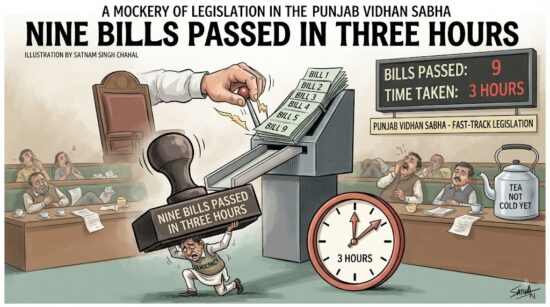
 CHANDIGARH: Punjab has apparently discovered a revolutionary new model of democracy: why spend days discussing laws when you can pass nine of them before the tea gets cold? The Punjab Vidhan Sabha’s decision to pass nine Bills in an extraordinarily compressed period has raised serious questions about the quality of legislative scrutiny, the space available for Opposition voices and the very meaning of parliamentary debate.
Welcome to “Fast-Track Democracy — Punjab Edition.” Forget long debates. Forget clause-by-clause examination. Forget giving every elected representative sufficient time to understand what exactly is being legislated. Just bring the Bill, read the Bill, move the Bill, vote on the Bill, pass the Bill — and quickly move to the next one. At this speed, Punjab Assembly may soon need not a Legislative Secretary but a Formula One pit crew.
Once upon a time, a legislature was supposed to be a place where laws were debated, questioned, examined, challenged and improved. Today, Punjab appears to have invented “legislation by express delivery.” The people send their elected representatives to Chandigarh expecting them to debate matters affecting millions of Punjabis. But the new philosophy seems to be: “Why debate the Bill when you can celebrate the Bill?”
Perhaps the Assembly should install a giant digital scoreboard: Bills Passed — 1. Bills Passed — 2. Bills Passed — 3. And when the ninth Bill is passed, the Speaker could announce: “Congratulations! You have completed today’s legislative target.” Game over. Democracy over. Tea break.
There is something almost poetic about nine pieces of legislation being pushed through in such a compressed period. A law can affect a farmer. A law can affect a student. A law can affect a worker. A law can affect a businessman. A law can affect a village. A law can affect the environment. A law can affect the future of an entire generation. Yet apparently the legislative calendar says: “Please keep it short. We have another Bill waiting.”
This is the danger of legislation being driven by the clock. The problem is not simply speed. The real problem is what may disappear in that speed — questions, objections, amendments, expert opinions, alternative suggestions, dissent and public accountability. A law is not merely a document to be passed; it is a decision that can shape people’s lives for years.
The situation becomes even more ironic when one considers the constitutional role of the Opposition. In a healthy democracy, the Opposition is supposed to question the government, challenge its policies, expose weaknesses and demand explanations. But if Bills arrive and disappear faster than a magician’s playing cards, what exactly is the Opposition expected to do?
Perhaps the new procedure should be: Government says, “Here is the Bill.” Opposition says, “We object.” Speaker says, “Noted.” Government says, “Vote.” Speaker says, “Passed.” Then comes the immortal parliamentary phrase: “Next Bill.” And somewhere outside the Assembly, democracy quietly whispers: “Was I invited to this meeting?”
The greatest joke is that after legislation is passed, there will inevitably be elaborate explanations about how historic, revolutionary and people-friendly the Bills are. Ministers will explain their importance. Government spokespersons will celebrate their achievements. Social media will be filled with congratulatory messages. But the public has a legitimate question: How much time was actually given inside the House to challenge, test, examine and improve these Bills before they became law?
Explaining a law after passing it is not the same as debating it before passing it. The public does not elect MLAs merely to clap for government announcements. They elect them to question power. Democracy is not simply the art of counting hands; democracy is the art of hearing voices before counting hands.
That distinction matters. If legislation becomes nothing more than a mathematical exercise — government has the numbers, therefore the Bill passes — then the Assembly risks becoming a voting machine rather than a deliberative institution. A majority may determine the outcome of a vote, but it should never determine whether questions are allowed to be asked.
There is also a bitter poetry in the present situation:
Nine Bills entered the House,
Nine Bills left with a crown.
Debate searched for a chair,
But democracy could not sit down.
And perhaps another verse deserves to be written on the walls of the Assembly:
Bring the Bill, don’t ask why;
Read it fast, let the cameras fly.
Raise your hands, let the motion pass;
Democracy moves fastest when questions are bypassed.
The Speaker’s chair carries enormous constitutional responsibility. It is not merely a place from which motions are announced and votes are counted. The Speaker is expected to protect the dignity of the House and ensure that legislative proceedings remain meaningful. If an elected representative wants to raise a legitimate question, the answer cannot always be “Next business.”
The Opposition is not an unwanted interruption in democracy. The Opposition is part of democracy. A government can have complete confidence in its own Bills, but democracy demands something more valuable than confidence: accountability.
Nobody is suggesting that every Bill must consume weeks. Nobody is arguing that every legislative proposal must become an endless political speech. There are certainly circumstances in which legislation can and should be passed efficiently. The real question is much simpler: Was there enough meaningful scrutiny before these nine Bills were passed?
If the answer is yes, the government should have no difficulty demonstrating it. How much time was spent discussing each Bill? How many MLAs participated? What amendments were proposed? Which objections were considered? How many clauses were examined? What expert input was taken? What changes were made because of the debate?
That is the real report card of a legislature — not merely the number of Bills it can pass in a day.
A government with a majority has the constitutional authority to pass legislation. That is parliamentary democracy. But majority rule and meaningful democracy are not identical twins. A majority gives a government the power to pass a Bill; it does not give the government a licence to avoid scrutiny.
The irony is that today’s majority may become tomorrow’s minority. Today’s government may become tomorrow’s Opposition. And the very rules being rushed through today may one day govern the people sitting on the other side of the aisle.
Democracy has a long memory.
Punjab is facing enormous challenges — debt, unemployment, drugs, agriculture, migration, environmental degradation, law and order, education and a rapidly changing economy. These problems require serious policy. Serious policy requires serious legislation. And serious legislation requires serious deliberation.
The Punjab Assembly cannot become a legislative fast-food counter, where laws are ordered, packed and delivered before anyone has time to ask what is inside the packet. Punjab needs laws that are examined carefully enough to survive political changes, court scrutiny and the test of time.
Because a legislature should never measure its success by how quickly it can silence disagreement. It should measure its success by how intelligently it can accommodate disagreement.
Nine Bills in a day may look impressive on a government achievement sheet. But democracy is not a productivity competition. The Vidhan Sabha is not trying to beat Amazon’s delivery time. The objective is not simply to ask, “How many Bills did we pass?” The real question should be: “How good were the laws we passed, and how thoroughly were they examined?”
So Punjab should remember a simple democratic equation: Fast voting is not fast democracy. Majority is not accountability. Passing a Bill is not debating a Bill. And silence in the Assembly is not consensus.
Nine Bills may have crossed the legislative finish line. But the bigger question remains hanging over the Punjab Vidhan Sabha: Did democracy actually get a chance to run the race — or was the race finished before democracy had even tied its shoelaces?
Nine Bills. One day. A few hours.
And somewhere in the corridors of the Punjab Vidhan Sabha, the ghost of parliamentary debate may still be asking:
“Excuse me, gentlemen —
when exactly was my turn to speak
Disclaimer: This article and accompanying images are for informational and illustrative purposes only. Some visuals may be AI-generated or digitally enhanced and may not depict actual events or persons.Views expressed are based on publicly available information and analysis