
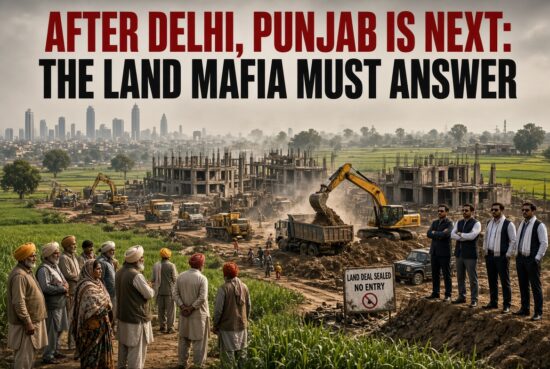
The arrest of former Delhi minister Satyendar Jain by the Delhi government’s Anti-Corruption Branch in the alleged Delhi Jal Board tender case has sent a politically significant message: public office cannot place anyone above the law. Jain and other accused have been arrested in connection with alleged irregularities in sewage-treatment-plant tenders; a Delhi court has since sent Jain and others to judicial custody. The allegations remain subject to the judicial process, and Jain and AAP have denied wrongdoing and questioned the political motivation behind the action. But the Delhi development raises an obvious question for Punjab: when will the spotlight turn towards the state’s alleged land and real-estate nexus?
For the past four-and-a-half years, questions have repeatedly been raised over land dealings, development authorities, farmhouse-related permissions, property conversions and alleged influence networks surrounding bodies such as GMADA, GLADA and PUDA. These are serious allegations and must ultimately be tested through documents, investigation and, where appropriate, the courts, not merely through political accusations. Yet if there is nothing to hide, there should be nothing to fear from a thorough investigation.
The files must speak
Punjab’s land is not merely a commodity.It is one of the state’s most valuable economic assets. When land-use changes, development permissions, licences, colonies, farmhouses and commercial projects are involved, enormous financial interests can be created.That is precisely why the system must be transparent.Who obtained the approvals?Who purchased the land?At what price?
Who benefited from changes in land use?
Were rules applied equally to ordinary citizens and politically connected individuals?
Were government officials pressured?
Were procedures followed?
And, most importantly, did the public exchequer receive everything it was legally entitled to receive?These are not questions of political revenge. They are questions of public accountability.
GMADA, GLADA and PUDA cannot become political shields
Development authorities exist to regulate planned growth, protect public interest and ensure that urban expansion takes place according to law.They cannot become convenient gateways through which powerful individuals acquire advantages unavailable to ordinary citizens.If allegations concerning particular properties, farmhouse developments, colonies or land conversions exist, the answer should not be another political speech.The answer should be an independent, document-based investigation.Every file should be capable of surviving scrutiny.Every signature should have an explanation.Every approval should have a legal basis.
Every rupee should have a trail.And every official who acted outside the law should be prepared to answer for that decision.Political patrons must not become invisibleThe bigger problem is not necessarily the individual land transaction.It is the alleged nexus behind it.Whenever politicians, businessmen, property developers, intermediaries and sections of the bureaucracy begin operating too closely together, ordinary citizens naturally start asking whether the system is being manipulated.That is where political patronage becomes dangerous.A government can change.
A minister can change.A chief minister can change.But if the same networks continue to operate behind the scenes, changing governments makes little difference.Punjab does not need a change of faces alone. It needs a change in the system.
Bureaucracy has a choice
The message to Punjab’s bureaucracy should be equally clear:Stand with the law—not with the powerful.An officer’s first responsibility is not to a minister, political party, businessman or influential individual.It is to the Constitution, the law and the people.If an illegal instruction is given, it should not become legal simply because it came from a powerful office.If a file is questionable, it should not receive approval merely because someone important is interested in it.And if a transaction is lawful, it should be able to withstand scrutiny without political interference.
The Delhi lesson
The latest action against Satyendar Jain should not be interpreted as proof that every allegation against every politician is true.That is for courts and investigators to determine.But it does demonstrate something important:Investigations can reach people who once occupied powerful positions.That principle should apply equally in Punjab.If allegations concerning land deals are false, investigations can establish that.If they have substance, investigations can establish that too.Either way, Punjab deserves the truth.
No selective accountability
There is also a warning for every political party.Accountability cannot be demanded when the opponent is accused and opposed when one’s own political allies come under scrutiny.The standard must be the same.If corruption is wrong under one government, it is wrong under another.If misuse of authority is unacceptable under one political party, it must be unacceptable under every political party.If a former minister must answer questions about alleged irregularities, then politically connected people in Punjab must also be prepared to answer legitimate questions about government land, development permissions and property transactions.
The law cannot have one standard for the powerful and another for everyone else.Punjab is asking for answers
The people of Punjab have watched governments come and go.They have seen promises of clean governance, anti-corruption campaigns and administrative reform.Now they want results.If there is evidence of wrongdoing in land-related matters, bring it before the appropriate investigating agency and ultimately before the court.If there is no evidence, say so clearly and close the matter.But allowing serious allegations to remain buried beneath political statements serves nobody.The files should be opened.
The transactions should be examined.The money trail should be followed.The ownership records should be checked.The approvals should be audited.And those found responsible should face the law, regardless of political affiliation.The era of political protection must endPunjab has already paid a heavy price for corruption, political patronage and weak accountability.Every rupee lost through corruption is money that could have built a road, improved a hospital, strengthened a school, created employment or supported a struggling family.
Every illegal land deal that escapes scrutiny weakens public confidence.And every official who bends the rules for the powerful sends the wrong message to an entire generation.The message from Delhi should therefore be bigger than the arrest of one former minister.
It should be this:
No chair is higher than the law.
No political connection is stronger than evidence.
No bureaucratic position provides immunity from accountability.
And no land mafia should be allowed to operate above the public interest.
Punjab is watching.Punjab is asking questions.And sooner or later, the files will have to speak.The demand is simple:
Investigate fairly. Follow the evidence. Protect the honest. Prosecute the guilty. And let the courts decide the truth.The era of political protection for corruption must end.The time for accountability has begun.
Disclaimer: This article and accompanying images are for informational and illustrative purposes only. Some visuals may be AI-generated or digitally enhanced and may not depict actual events or persons.Views expressed are based on publicly available information and analysis