
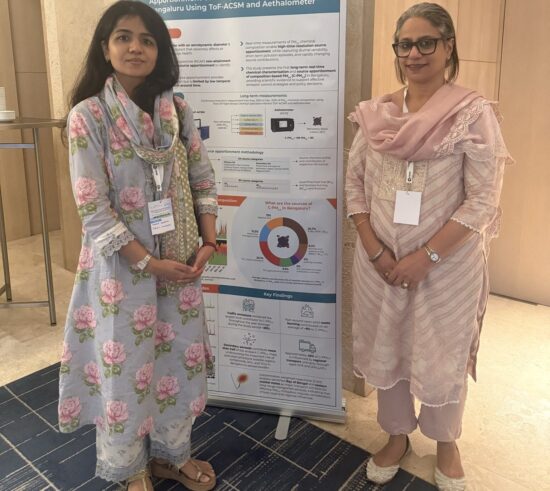
 Bengaluru/Chandigarh- Environmental activist Samita Kaur has called for a fundamental shift in how Punjab tackles air pollution, urging the state to treat it as an interconnected ecosystem, planning and governance challenge rather than an isolated “pollution problem.”Kaur attended the CSTEP India Clean Air Summit 2026 in Bengaluru on 19 August. The three-day event, organised by the Centre for Study of Science, Technology and Policy (CSTEP), focused on the theme “Air Without Borders: Scaling Air Quality Action Across Cities, States, and Regions.”Sharing her key takeaways, Kaur highlighted the potential of scientific tools such as PAVITRA, InMAP and ISCRM.
These tools, she said, help move beyond simply measuring pollution levels to identifying emission sources, understanding how pollutants travel, and designing interventions that actually work.“For Punjab, both the Punjab Pollution Control Board (PPCB) and the Government of Punjab need to actively engage with science, spatial data and research to build evidence-based, region-specific clean-air policies,” Kaur stated. She stressed that clean air cannot be achieved in isolation. Effective solutions require connecting air quality with water, land, energy, transport, forests and the overall ecological carrying capacity of the region. Kaur’s comments come amid ongoing concerns over air quality in Punjab, where industrial emissions, vehicular pollution, agricultural practices and cross-boundary factors continue to pose challenges. Her appeal underscores the growing demand for science-driven, multi-sectoral strategies to deliver lasting improvements in air quality.