
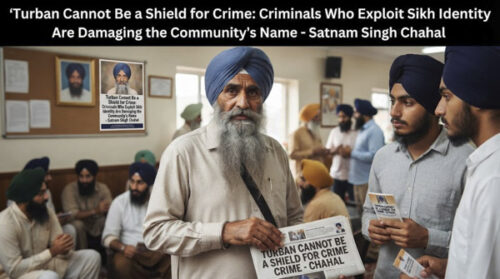
The turban is not a licence to commit crime, and wearing Sikh religious symbols does not make anyone a representative of the Sikh community. Yet a disturbing phenomenon has emerged in Punjab in which some individuals allegedly involved in extortion, intimidation, violence, drug trafficking and other criminal activities present themselves publicly as Sikhs. When such individuals misuse the respect associated with the Sikh identity, they do damage not only to their victims but also to the reputation of millions of peaceful and law-abiding Sikhs.
This distinction needs to be made very clearly: a criminal is a criminal, whether he wears a turban or not. The Sikh community should not be blamed for the actions of individuals who misuse its symbols. At the same time, the community cannot remain silent when somebody deliberately uses Sikh appearance, religious language or community connections to create fear, influence or protection for criminal activities. Punjab has been facing a serious challenge from organised crime and extortion networks. Punjab Police says its anti-gangster campaign has taken action against more than 58,000 criminals during a 200-day crackdown, while recent reports have continued to document extortion threats allegedly connected with organised criminal networks.
The victims are often ordinary people, small businessmen, shopkeepers, property owners, families and people living abroad who have relatives or assets in Punjab. They may have no political influence and no ability to fight powerful criminals. A threatening telephone call, a demand for money or a visit by armed associates can be enough to push an innocent family into fear. The Sikh turban represents dignity, responsibility and identity. It should never become a visual cover behind which an individual hides criminal behaviour.Those who wear a turban while allegedly engaging in extortion, threatening innocent people, carrying illegal weapons, trafficking drugs or participating in violent criminal networks should understand that their actions do not make them “brave” or “powerful.” They make them criminals and they also risk bringing disgrace upon an identity that millions of people carry with pride.
There is an even greater danger when criminals attempt to portray themselves as community figures, use religious vocabulary or cultivate relationships with influential people in order to discourage victims from approaching the police.Religion must never be used as a shield against the law.The Sikh community has a particular responsibility to reject individuals who misuse Sikh identity for criminal purposes.Gurdwaras, Sikh organisations, community leaders and responsible social-media platforms should not provide legitimacy to people merely because they wear a turban, use Sikh terminology or claim to speak on behalf of the community.A person should be judged by his conduct not by his appearance.
If somebody is extorting money from an innocent family, threatening a businessman, dealing in narcotics or participating in violence, the appropriate response is not community protection. The appropriate response is cooperation with law enforcement and the justice system.This is particularly important because criminal networks can exploit community divisions and social relationships. A gangster may try to present himself as a “Sikh youth leader,” “community supporter” or “protector” while privately intimidating vulnerable people. Such behaviour must be exposed.The most worrying aspect of organised crime is its impact on ordinary citizens.
A wealthy or politically connected person may be able to obtain police protection, lawyers and other resources. The ordinary Punjabi family does not have those advantages.For them, an extortion call can mean sleepless nights. A threat against a son or daughter can mean abandoning a business. A demand for money can destroy years of savings.The government therefore has a responsibility to ensure that every genuine complaint of extortion, intimidation or gangster activity is investigated professionally, regardless of the social or political status of the accused.The recent criminal crackdown in Punjab shows that law-enforcement agencies recognise the seriousness of organised crime. But enforcement must go beyond arrests. Criminal networks, their financiers, weapons suppliers, facilitators and local support systems must all be investigated.Do not confuse Sikh identity with gangster cultureAnother important issue is the language used in public debate
The turban commands respect but it does not place anyone above the law.The Sikh identity is associated with courage, service, justice and protection of the vulnerable. Anyone who uses that identity to threaten vulnerable people is acting against the very principles he claims to represent.Punjab needs a stronger partnership between police and ordinary citizens to defeat extortion and organised crime. Victims must be encouraged to report threats, witnesses must be protected, and criminal networks must not be allowed to create an atmosphere in which people are too frightened to speak.The greatest service a Sikh can provide to the Sikh community today is not defending a criminal because he belongs to the same community. It is standing with the victim, demanding justice and refusing to allow the Sikh identity to be misused.
The turban should remain a symbol of honour.Those who commit crimes while wearing it should be made to understand that the turban may identify them as Sikhs but it does not protect them from the law.