
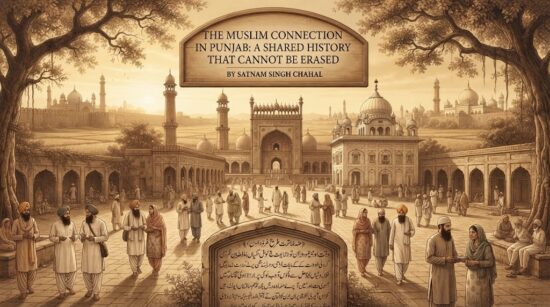
Author’s Note: This article is written in the spirit of historical understanding, mutual respect and communal harmony. It is not intended to criticise, diminish or offend Islam, Muslims or any other religious community. The purpose is to acknowledge the valuable contribution of Muslims to Punjab’s shared history, culture, literature and traditions, while respecting the equally important heritage of all communities that have shaped Punjab-Author
Punjab is often described through the lens of Sikhism, agriculture, courage and sacrifice. But Punjab’s story is much larger than any single community. For centuries, Muslims have been an integral part of Punjab’s social, cultural, political and economic history. Their contribution is deeply woven into the language, literature, architecture, music and traditions of the region.The Government of Punjab itself describes the state as a land of ethnic and religious diversity and notes that Punjab was home to numerous Sufi schools of Islam. The Muslim connection with Punjab, therefore, is an important part of Punjab’s historical and cultural identity. Punjab’s relationship with Islam cannot be understood merely through politics or population statistics. Sufi traditions became deeply connected with Punjabi culture. Figures such as Baba Farid occupy an important place in the spiritual and literary history of the region. His verses became part of the Guru Granth Sahib, creating a remarkable example of spiritual and literary exchange across religious traditions.
Punjabi poetry, folk music and oral traditions were also profoundly enriched by Muslim poets and Sufi thinkers. Waris Shah’s Heer remains one of the greatest works of Punjabi literature, while the poetry of Bulleh Shah continues to be read and sung across Punjab and beyond. This shared heritage demonstrates something important: Punjab’s culture developed through the contributions of people from different communities and traditions.The events of 1947 transformed Punjab forever. The former province was divided between India and Pakistan. The western areas became part of Pakistan, while the eastern areas became part of India. The Partition resulted in enormous displacement and suffering, with families leaving homes and communities that had been connected to them for generations.
Muslims who moved west carried with them memories of their ancestral homes, villages, businesses, mosques, shrines and cultural traditions in Indian Punjab. At the same time, Sikhs and Hindus who moved east carried similar memories of their ancestral homes and communities in what became Pakistani Punjab. These shared memories remain an important part of Punjab’s collective history.The political border changed the geography of Punjab, but it could not erase the cultural connections created over centuries. Muslims remain an important part of Indian Punjab’s social fabric, while the wider Punjabi community on both sides of the border continues to share language, literature, music, food, traditions and historical memories.The discussion should therefore move beyond narrow religious divisions. Punjab’s deeper story is about communities living alongside one another, influencing one another and contributing to a common Punjabi cultural heritage.
Muslims are an integral part of Punjab’s history and contemporary society, just as Sikhs, Hindus, Christians and other communities are part of the region’s continuing story. Every citizen deserves dignity, equality and respect, regardless of faith.One of the important responsibilities of the present generation is to preserve historical memory. A younger generation can easily grow up knowing Punjab only through the politics and borders of the present. But the Punjab of history was much broader. Its villages, cities, poetry, shrines, markets and traditions were shaped by people belonging to different faiths.The Muslim contribution to Punjabi culture deserves to be remembered with respect and appreciation. It is neither necessary to exaggerate that contribution nor to overlook it. It is simply an important part of the historical record.
The same Punjab that produced Sikh Gurus and Sikh warriors also produced Sufi saints and Muslim poets. The same Punjabi language carried the poetry of Sikh, Hindu and Muslim writers. The same soil holds memories belonging to communities that lived together across generations.The Muslim connection in Punjab is therefore not merely about the number of Muslims living in the state today. It is about history, culture, literature, spirituality and the shared experiences of generations.It is about Baba Farid’s spiritual legacy, Waris Shah’s poetry, Sufi traditions, historic mosques and shrines, Punjabi literature, shared villages and the generations that contributed to Punjab’s rich cultural identity.
Punjab does not become less Sikh by acknowledging its Muslim history. Rather, remembering the contributions of all communities helps present a fuller and more meaningful picture of Punjab’s extraordinary heritage.The lesson for today’s Punjab should be simple: remember history with respect, acknowledge contributions with honesty, promote understanding among communities, and protect the dignity and rights of every citizen. Punjab’s cultural heritage is enriched by the many communities that have contributed to its development.Punjab’s past cannot be separated from the people who helped build it. Its history is a shared inheritance, and preserving that history with mutual respect can help future generations understand the deep cultural bonds that have connected the people of Punjab for centuries.
Disclaimer: This article and accompanying images are for informational and illustrative purposes only. Some visuals may be AI-generated or digitally enhanced and may not depict actual events or persons.Views expressed are based on publicly available information and analysis