
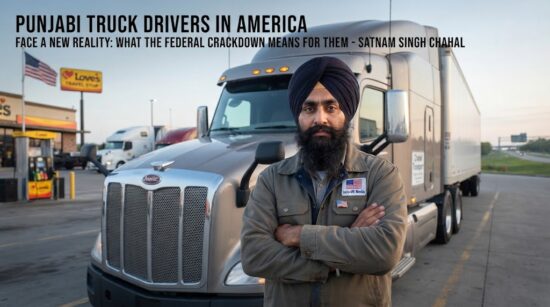
The American trucking industry is facing increased federal scrutiny, and Punjabi truck drivers are among the immigrant communities paying close attention. Recent enforcement actions involving commercial driver’s licenses, immigration documentation and English-language requirements have created concern among drivers, trucking companies and families who depend on this industry.
The recent Operation Highway Shield received national attention after federal authorities announced that more than 800 drivers and commercial vehicles had been removed from the roads. However, this number needs to be understood correctly. The government reported that 766 drivers and/or commercial vehicles were placed out of service. This does not necessarily mean that 800 people were fired, deported or permanently banned from trucking.
The operation took place from July 28 to July 30, 2026, in Illinois, Indiana, Iowa and Ohio. Federal authorities also reported 51 immigration-related detentions, including 21 drivers who had non-domiciled commercial driver’s licenses issued by California and New York. These actions have raised questions about how immigration status, CDL eligibility and federal safety rules are being connected during enforcement operations. For Punjabi truck drivers, especially those working in California, this is more than a distant federal policy announcement. It could affect their licenses, employment, businesses and family income. At the same time, drivers should avoid panic and should not rely on rumours. Every driver’s situation is different, and the effect of these rules depends on the type of CDL, immigration documentation, state of residence and individual licensing history.
Punjabi immigrants have become an important part of the American trucking industry. Many Punjabi families have invested their savings in trucks, trucking companies, warehouses, repair businesses and other transportation-related operations. For many families, trucking is not simply a job. It is the main source of income and the foundation of their financial future.Because of this, changes involving commercial driver’s licenses, immigration status, English-language proficiency and federal enforcement deserve serious attention. A problem with one driver’s license can affect an entire family, a trucking company and sometimes several employees.
However, Punjabi drivers should understand one important point: being Punjabi, being born in India or speaking Punjabi does not make anyone an unsafe or illegal truck driver. The important questions are whether the driver has a valid CDL, meets the applicable federal and state requirements, has the necessary immigration or employment authorization and can operate safely.
Federal rules are supposed to apply based on legal status, licensing requirements and safety qualifications—not simply on a person’s ethnicity or language. Drivers should therefore focus on understanding their own documents and legal situation instead of assuming that every Punjabi truck driver is facing the same problem.
One of the most important issues is the federal government’s new approach to non-domiciled commercial driver’s licenses. A non-domiciled CDL is generally issued to a person who does not meet the state’s regular residency requirements but may qualify under certain federal rules and immigration categories.Under the new federal framework, eligibility for a non-domiciled CDL has become more restricted. The FMCSA identifies specific immigration categories, including H-2A, H-2B and E-2, for certain qualifying foreign-domiciled applicants. Because of these changes, some immigrant drivers are uncertain about whether their existing licenses can be renewed, reissued or continued.
This uncertainty is especially serious for drivers whose licenses were issued under older rules. A CDL that was valid in the past may not automatically remain unaffected if federal requirements have changed. Drivers should check the exact type of CDL they hold and review any notices from their state DMV or licensing agency.California has also stopped issuing, reissuing or renewing certain limited-term and non-domiciled commercial driver’s licenses while federal requirements are being implemented. This does not mean that every Punjabi truck driver in California has lost a CDL. It means that some drivers may face additional review or may be affected when their licenses expire or require renewal.A driver’s situation may depend on the license classification, state of domicile, immigration documents, employment authorization and expiration date. For that reason, drivers should not make decisions based only on information shared in WhatsApp groups, Facebook posts or community rumors.
English-language proficiency is another issue that Punjabi truck drivers must take seriously. Federal officials say commercial drivers must be able to understand and respond to important safety information, communicate with law-enforcement officers and inspectors, understand road signs and follow instructions related to the safe operation of a commercial vehicle.FMCSA has reported that thousands of drivers have been placed out of service for failing to meet English-language requirements. This means that a driver may be temporarily prohibited from operating if officials determine that the driver cannot communicate sufficiently for safety purposes.
However, speaking Punjabi at home is not the problem. Punjabi drivers can continue to speak Punjabi with their families, preserve their culture and use Punjabi in their communities. The issue is whether they can meet the English-language requirements connected to commercial driving.A driver should be able to understand basic safety questions, communicate with inspectors and law-enforcement officers, read important road signs and understand instructions related to the vehicle and the trip. Drivers who are not confident in their English should consider taking additional language or safety training before an inspection or enforcement encounter.The message for Punjabi truckers is simple: Punjabi language and culture should be respected and preserved, but English proficiency is necessary for safe and lawful commercial driving. These two things are not in conflict.
Punjabi drivers should carefully review every letter or notice received from the state DMV, FMCSA, employer or another government agency. A notice may state that a CDL is being cancelled, suspended, downgraded, revoked or affected by a federal or state licensing requirement.Ignoring such a letter can make the situation worse. A driver should first determine exactly what action the agency is taking, the reason for the action and the deadline for responding. Some notices may provide an opportunity to submit documents, request a hearing, correct an error or challenge the decision.If the issue involves immigration status, employment authorization or a non-domiciled CDL, the driver should consider speaking with a qualified immigration attorney or an attorney familiar with commercial-driver licensing. Drivers should be cautious about relying on advice from friends, dispatchers or social-media commentators who may not understand the specific legal requirements.It is also important to keep copies of all letters, applications, licenses, immigration documents and responses. Written records can be extremely important if a driver needs to challenge a decision or explain the situation to an attorney, employer or licensing agency.
California has one of the largest Punjabi trucking communities in the United States. As a result, developments involving California commercial driver’s licenses are especially important to Punjabi drivers and trucking companies.The California DMV has stated that it cannot currently issue, reissue or renew certain limited-term and non-domiciled commercial driver’s licenses under the federal requirements. Drivers who hold these types of licenses should check their individual status rather than assuming that the policy affects everyone in the same way.A driver whose CDL is a standard California license may have a different situation from a driver whose license is classified as non-domiciled or limited-term. The driver’s immigration documents, state residency, employment authorization and license expiration date may all be relevant.
Punjabi drivers should also be careful about exaggerated social-media claims. Statements such as “all Punjabi truck drivers are being deported” or “all California Punjabi truckers have lost their CDLs” are not accurate descriptions of the situation. Enforcement actions may affect certain drivers, but they do not automatically apply to every person from the same ethnic or national background.The safest approach is to verify information through the California DMV, FMCSA, an employer’s compliance department or a qualified attorney.
There has been considerable discussion online about the federal government “kicking 800 truck drivers out.” That description is misleading because it combines several different types of enforcement actions.The government’s reported numbers may include drivers and vehicles placed out of service, arrests and immigration detentions. These are separate legal categories, and they do not all have the same consequences.Being placed out of service generally means that a driver or commercial vehicle cannot continue operating under the circumstances identified by authorities. It does not automatically mean that the driver has been deported or permanently lost the right to work.
An immigration detention is also not the same as a final deportation order. A detained person may still have legal proceedings, hearings or other available options. The final outcome depends on the individual case.Punjabi community organizations, trucking associations and media outlets should report these developments carefully. Inaccurate or exaggerated reporting can create unnecessary fear, cause drivers to stop working without understanding their rights or encourage people to make poor legal decisions.
The larger issue is that federal enforcement is no longer focused only on whether a truck is mechanically safe. Authorities are increasingly examining the entire chain of commercial driving eligibility.This may include the driver’s CDL classification, immigration documentation, employment authorization, English-language ability, medical certification, driver qualification file, training history and the state licensing system that issued the CDL.The federal government has also sought access to nationwide commercial-driver information. More than 20 states have challenged aspects of the federal government’s demands in court. The outcome of that legal dispute could determine how much information federal authorities can obtain from state licensing systems and how that information may be used.For trucking companies, this means compliance systems are becoming more important. Employers may need to review driver files more carefully, verify licensing information and ensure that drivers meet all applicable federal and state requirements.For individual drivers, it means that keeping documents current and organized is no longer optional. A driver should know what type of CDL he or she holds, when it expires and what documents support the driver’s eligibility.
Punjabi truck drivers should begin by checking the exact status and expiration date of their CDL. They should also determine whether the license is a standard CDL or a non-domiciled CDL. This information can usually be found on the license itself or confirmed through the state DMV.Drivers should keep immigration documents, employment authorization documents, medical certification and other required records current. They should also make sure that their employer has accurate copies of the documents required for the driver qualification file.Drivers should take English-language requirements seriously and seek additional training if they are not comfortable communicating with inspectors or law-enforcement officers. English ability is not only a legal issue; it is also a safety issue that can affect a driver during an emergency, inspection or traffic stop.
Drivers should never ignore a letter from the DMV, FMCSA or employer. They should read the notice carefully, identify any deadline and seek professional advice when necessary. If the issue is connected to immigration status or employment authorization, a qualified immigration attorney should be consulted.Drivers should also keep secure copies of their CDL, medical certificate, immigration documents, employment authorization, DMV correspondence and other important records. Having organized documents can save time and reduce confusion during an inspection, renewal or legal proceeding.
This is not a time for rumors, panic or division within the community. Punjabi truck drivers have contributed enormously to the American economy. They transport food, machinery, construction materials, agricultural products and countless other goods that businesses and families depend on every day.The community should support safe and lawful trucking while also demanding fair and equal enforcement. If a driver is genuinely unsafe or does not meet legal requirements, that driver should be removed from the road regardless of nationality, religion or ethnicity.At the same time, enforcement should not be based simply on a person’s language, country of birth or cultural background. A driver who is properly licensed, legally authorized, qualified and safe should be treated fairly.Punjabi trucking organizations, gurdwaras, community leaders and media outlets can help by sharing verified information, organizing educational meetings and encouraging drivers to seek professional advice. Community support should focus on facts, safety and legal compliance rather than fear.
The current federal crackdown should be treated as a warning to become more careful, not as a reason to become afraid. Punjabi truck drivers should understand the new rules, verify their individual status and seek professional help whenever necessary.America’s trucking industry is changing. The old assumption that a CDL obtained under previous rules will always remain sufficient may no longer be safe. Drivers must now pay closer attention to licensing classifications, immigration documents, English-language requirements and government notices.The new reality is simple: check your CDL, check your documents, understand the rules, improve your English if necessary and never ignore a government notice.Most importantly, do not let rumors drive you off the road. Let accurate information guide your decisions.Punjabi truck drivers have worked hard to build their American future. The best way to protect that future is through legal compliance, road safety, accurate information, professional advice and unity within the community.
Disclaimer: This article and accompanying images are for informational and illustrative purposes only. Some visuals may be AI-generated or digitally enhanced and may not depict actual events or persons.Views expressed are based on publicly available information and analysis