
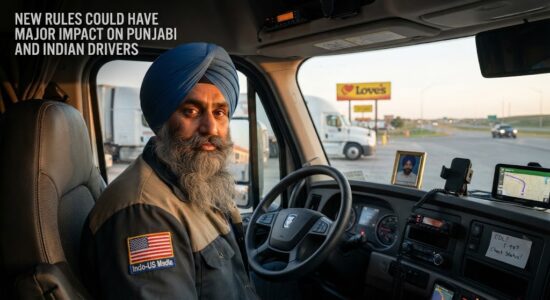
WASHINGTON — The Trump administration is dramatically tightening enforcement of commercial trucking rules across the United States, and the crackdown could have significant consequences for thousands of Punjabi and Indian-origin truck drivers.The latest major operation, Operation Highway Shield, resulted in more than 800 drivers and vehicles being removed from U.S. roads during a three-day enforcement campaign conducted July 28–30 in Illinois, Indiana, Iowa and Ohio.However, an important clarification is necessary: the government did not simply “fire 800 truck drivers.” Federal authorities reported that 766 drivers and/or commercial vehicles were placed out of service, while other individuals were arrested or detained for separate violations.
According to the Federal Motor Carrier Safety Administration (FMCSA), authorities detained 51 people identified by the government as illegal immigrants, including 21 drivers who possessed non-domiciled commercial driver’s licenses issued by California and New York. The operation also resulted in 86 arrests for dangerous behavior and 36 violations involving English-language proficiency requirements. The federal government says the objective is to remove unsafe and unqualified commercial drivers from America’s highways and to ensure that people operating heavy trucks meet federal safety, licensing and immigration requirements.But the issue has become increasingly controversial because immigration enforcement and trucking regulation are now becoming closely intertwined.
One of the biggest developments came in March 2026, when a new federal rule took effect restricting eligibility for non-domiciled CDLs.Under the revised federal requirements, foreign-domiciled applicants generally must demonstrate lawful status in one of three specified employment-based nonimmigrant categories:
* H-2A — temporary agricultural workers
* H-2B — temporary non-agricultural workers
* E-2 — treaty investors
The FMCSA says other immigration categories are not eligible for a non-domiciled CDL under the new rule. The rule also limits the validity period of a non-domiciled CDL to the applicant’s I-94/A admission date or one year, whichever comes first. This is particularly important because many immigrant truck drivers previously relied on state-issued commercial licenses while their immigration cases or employment situations were changing.
California is now under especially close scrutiny.The California Department of Motor Vehicles currently says that, until further notice, California cannot issue, reissue or renew limited-term legal-presence/non-domiciled commercial driver’s licenses. For Punjabi truck drivers in California, this is a major development.It does not mean every Punjabi driver with a CDL has lost the right to drive. Rather, the impact depends on the type of CDL, the driver’s domicile, immigration status, expiration date and compliance with federal and state requirements.Drivers should therefore avoid relying on social-media claims and should check their individual licensing records with the DMV and, where necessary, obtain qualified legal advice.
Another major development came on August 7, 2026, when Transportation Secretary Sean Duffy announced that FMCSA was moving to codify English-language proficiency requirements into a formal federal regulation. The administration argues that commercial drivers must be able to understand road signs, communicate with law enforcement and respond appropriately in emergencies.FMCSA says that since President Trump’s April 2025 executive order, approximately 26,000 drivers have been placed out of service for failing basic English requirements, according to the agency’s own figures.
For Punjabi drivers, this is an issue that should not be underestimated.Being Punjabi, Indian-born or speaking Punjabi at home is not itself a violation. The relevant question is whether the driver satisfies the federal English-language requirement applicable to commercial driving.
The crackdown is also moving beyond roadside inspections.In August, the Transportation Department publicly criticized a lawsuit brought by 21 states and the District of Columbia challenging federal efforts to obtain nationwide commercial-driver information.The federal government argues that access to licensing information is necessary to identify potentially unqualified or illegally operating truck drivers.Opposing states argue that the federal government is going too far and that state driver-licensing information should not simply be turned into a nationwide immigration-enforcement tool. FMCSA’s August 13 announcement confirmed that this legal battle is continuing.
The dispute reportedly involves information relating to approximately 17 million commercial drivers and other large-vehicle operators. Another important new development is the federal government’s focus on CDL training schools.Federal agencies have expanded investigations into allegedly fraudulent or illegal practices at commercial-driving schools. The administration says it has shut down thousands of problematic schools and revoked more than 30,000 licenses that it characterizes as improperly issued to unvetted foreign drivers. This means the enforcement chain now extends from:
CDL schools → testing → state licensing agencies → drivers → trucking companies → immigration status.The government is effectively examining the entire system rather than simply stopping individual trucks on highways.There is another interesting side to the story.At the same time the government is removing drivers it considers unqualified, the administration has launched a campaign to recruit more Americans—including veterans—into the trucking industry.On July 30, 2026, President Trump and Transportation Secretary Sean Duffy promoted the Freedom Haulers campaign, aimed at putting more American veterans behind the wheel of big rigs.
This has led to a broader political debate:
Is the administration simply improving highway safety—or is it also trying to change the composition of America’s trucking workforce?The answer may be a combination of both.The trucking industry already faces concerns about driver shortages.If thousands of drivers are removed from the workforce while new restrictions make it harder for foreign workers to obtain or maintain commercial credentials, trucking companies could face additional recruitment difficulties.Industry reporting has warned that the crackdown is contributing to pressure on driver availability and freight costs.That could eventually affect ordinary Americans because trucks transport an enormous share of the country’s consumer goods.If fewer qualified drivers are available, transportation costs can rise—and those costs can eventually reach consumers through higher prices.
For the Punjabi and Indian-American trucking community, this is a moment for careful compliance—not panic.A driver should know:
1. What type of CDL do I have?
2. Is it a standard CDL or a non-domiciled CDL?
3. Is my CDL currently valid?
4. Does my immigration status satisfy the current federal requirements?
5. Does my I-94 or other relevant immigration documentation remain valid?
6. Am I meeting federal English-language requirements?
7. Are my medical certification and other CDL requirements current?
8. Has my state DMV sent me any notice regarding my CDL?
Drivers who have received a cancellation, downgrade, suspension or other notice should not ignore it.
April 2025: President Trump issues an executive order aimed at restoring integrity to the commercial trucking industry.
February 2026: FMCSA issues its new non-domiciled CDL rule limiting eligibility for foreign-domiciled drivers.
February 2026: Operation SafeDRIVE results in nearly 2,000 unqualified truckers and vehicles being removed from U.S. roads, according to FMCSA.
March 16, 2026: The new non-domiciled CDL requirements take effect. March 2026: First wave of Operation Highway Shield in Florida produces more than 3,300 inspections, with 176 drivers placed out of service.
July 2026: Federal agencies expand their investigation of CDL schools and alleged fraudulent licensing practices.
July 28–30, 2026: Second wave of Operation Highway Shield takes place in Illinois, Indiana, Iowa and Ohio.
August 4, 2026: Federal officials announce preliminary results showing more than 800 drivers/vehicles removed from the roads, including 766 placed out of service.
August 7, 2026: FMCSA announces plans to codify English-language proficiency requirements into federal regulations.
August 13, 2026: Federal and state governments continue their legal fight over federal access to nationwide commercial-driver information.
August 27, 2026: FMCSA announces progress on pilot programs examining greater flexibility in truck drivers’ hours-of-service scheduling.
September 2026: The crackdown continues, with greater scrutiny of drivers, CDLs, immigration documentation, English proficiency, training schools and state licensing systems.
America is entering a new era of aggressive commercial-driver enforcement.The federal government’s message is clear: a person operating a massive commercial truck must be properly licensed, qualified, able to satisfy applicable English requirements and legally eligible to hold the required credential.At the same time, the government must ensure that enforcement is accurate, transparent and based on individual violations.A dangerous or illegally operating driver should be removed from the road—regardless of nationality.
But a lawful, qualified and safe immigrant driver should not be treated as dangerous simply because he or she is foreign-born.For thousands of Punjabi truckers who have built their livelihoods in America, the most important lesson from the current crackdown is simple:
Know your CDL. Know your immigration documents. Know the new federal rules. And do not ignore any notice from your DMV or federal authorities.The “800 drivers” operation may have been only one enforcement action. The much bigger story is that Washington is rebuilding the entire commercial-driver licensing and enforcement system—and immigrant truck drivers are directly in the middle of that transformation.
Disclaimer: This article and accompanying images are for informational and illustrative purposes only. Some visuals may be AI-generated or digitally enhanced and may not depict actual events or persons.Views expressed are based on publicly available information and analysis