
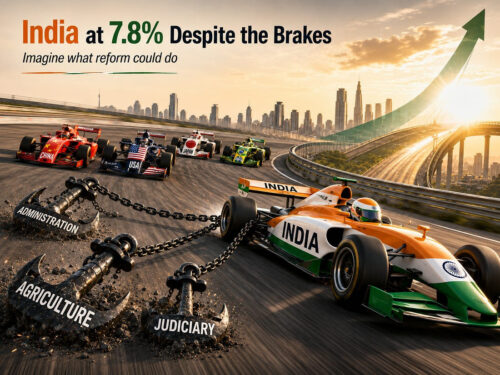
Three numbers released over the last few months deserve to be read together: 7.8 per cent, $863 billion and $729 billion. They tell us something important about the Indian economy, particularly when viewed against what is happening in the rest of the world.
India’s real GDP grew 7.8 per cent in April-June 2026, substantially ahead of most major economies. China grew 4.3 per cent, Indonesia 5.29 per cent, Malaysia 6 per cent and Singapore 5.9 per cent. Vietnam, a much smaller economy, was slightly ahead of India. The more accurate claim, therefore, is not that India is the fastest-growing country in the world, but that it remains the fastest-growing large major economy.
And this growth has not come in comfortable circumstances. India has faced the West Asia war and its accompanying oil and supply-chain shock. Crude prices matter enormously to a country which imports most of its oil requirement. Yet manufacturing grew 9.2 per cent, services 10 per cent and gross fixed capital formation, an important indicator of investment, rose 11.9 per cent. Private investment is showing signs of becoming a broader contributor to growth.
Now add the second number. India’s total exports reached an all-time high of $863.1 billion in FY 2025-26, despite US tariff pressures and the disruption caused by the West Asia crisis. Merchandise exports were $441.8 billion and services exports $421.3 billion. The Commerce Ministry says total exports have nearly doubled over the last decade. That is no small change in the structure and global reach of the Indian economy.

Then comes the third number. India’s foreign exchange reserves have just touched an all-time high of $729.33 billion, as of August 21. The reserves increased by $12.42 billion in one week and have risen for eight consecutive weeks. Part of this increase has come from strong NRI deposit inflows under the RBI’s concessional swap facility and part from higher valuation of gold, so we should not pretend that every dollar represents export earnings. Even with that qualification, a $729 billion reserve cushion gives India considerable protection at precisely the time when oil prices, currencies and geopolitics are volatile.
What interests me most, however, is not that India has achieved these numbers. It is that India has achieved them despite carrying enormous self-created handicaps.
Our administrative system still carries much of the colonial-era mindset of permission, control and suspicion. An entrepreneur can build a modern factory but may still have to negotiate a government system built around files, approvals and multiple authorities. Our judiciary remains independent and respected, but commercial disputes can take years and property disputes sometimes generations. Capital cannot operate at twenty-first-century speed while justice moves at twentieth-century speed.
Agriculture is an even bigger contradiction. Nearly half our population remains connected to agriculture, yet serious structural reform has virtually stopped. Markets remain restricted, landholdings fragmented, diversification slow, technology politically controversial and farmers vulnerable to unpredictable import-export decisions. The three farm laws were withdrawn, but unfortunately the debate on what should replace them also largely disappeared.
This is why 7.8 per cent should not make us complacent. It should make us ambitious. If an economy can grow at nearly 8 per cent despite war, expensive oil, an outdated bureaucracy, a painfully slow judicial system and an almost unreformed agricultural structure, what could India achieve if these brakes were actually removed?
Perhaps the real message in these numbers is not merely that India is growing fast. It is that India may still be growing well below its potential.