
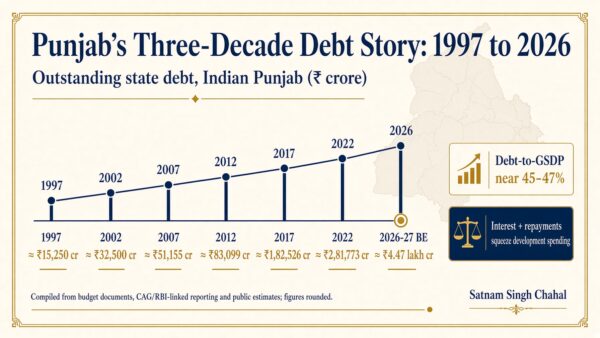
Punjab’s debt story stretches across nearly three decades and successive governments. From 1997 to 2026, the state has been governed by the SAD-BJP alliance, Congress and, since March 2022, the Aam Aadmi Party. During this period, Punjab’s debt and broader liabilities have increased substantially, while successive governments have also repaid large amounts of principal and paid thousands of crores in interest. The real question is therefore not simply how much Punjab owes today, but how much each government inherited, how much it borrowed, how much it repaid and how much it left behind.
The Comptroller and Auditor General’s Finance Accounts provide the official accounting foundation for examining this history. Punjab’s annual Finance Accounts are available from 1997-98 onward, although different documents use different definitions, including public debt, total liabilities and outstanding liabilities. These definitions must be kept separate when making a long-term comparison.
1997–2002: Parkash Singh Badal Government
Parkash Singh Badal became Punjab Chief Minister in February 1997, heading a SAD-BJP government. Punjab entered this period with an already substantial financial burden. The late 1990s were marked by rising expenditure commitments and growing dependence on borrowing.
CAG figures show fiscal liabilities of approximately ₹21,705 crore in 1998-99. The figure increased to ₹24,804 crore in 1999-2000, ₹28,957 crore in 2000-01 and ₹33,921 crore in 2001-02. During the same period, Punjab was paying thousands of crores in interest. Interest payments were approximately ₹2,317 crore in 1998-99 and increased to ₹3,178 crore by 2001-02.These numbers show that Punjab’s debt problem was already firmly established before the turn of the century. However, the figures should not be interpreted as the amount borrowed personally or politically by one government, because the government inherited liabilities and annual debt stocks also reflect repayment, restructuring and other transactions.
2002–2007: Amarinder Singh Government
Captain Amarinder Singh became Chief Minister in February 2002, leading a Congress government that remained in office until March 2007.Punjab continued to carry a significant debt burden during this period. The annual Finance Accounts provide the detailed information necessary to separate fresh borrowing from repayment and interest expenditure.One important feature of Punjab’s debt history during this broader period was central government debt relief. Finance Department records cited in published reports indicate that approximately ₹5,029 crore of special-term loans were ultimately waived by the Centre. Such a waiver must not be counted as repayment made by the Punjab government. A waiver and a repayment are two different financial events.
2007–2012: Parkash Singh Badal Returns
Parkash Singh Badal returned as Chief Minister in March 2007 at the head of another SAD-BJP government.Punjab’s public debt was approximately ₹51,155 crore around 2006-07 and had reached approximately ₹83,099 crore by 2011-12 in the cited public-debt series. This period therefore saw a substantial increase in the outstanding debt stock.But again, the change in debt stock should not automatically be equated with fresh borrowing during the Badal government’s tenure. A complete assessment requires the annual figures for borrowing receipts, principal repayment, interest payments and other adjustments.
2012–2017: Second Badal Government and the Major 2016–17 Jump
After the 2012 Assembly election, Parkash Singh Badal continued as Chief Minister.Punjab’s public debt rose from approximately ₹83,099 crore in 2011-12 to ₹92,282 crore in 2012-13, ₹1,02,234 crore in 2013-14, ₹1,12,366 crore in 2014-15 and approximately ₹1,28,835 crore in 2015-16.The most significant development came in 2016-17, when the public-debt figure jumped to approximately ₹1,82,526 crore.The jump was associated in significant part with the formal conversion or restructuring of existing obligations. Approximately ₹30,584 crore related to the food-grain procurement Cash Credit Limit issue and approximately ₹10,031 crore of UDAY bonds were among the major components. Therefore, the 2016-17 increase should not simply be described as ₹40,000 crore of ordinary new spending by the government.
2017–2021: Amarinder Singh Returns
Amarinder Singh returned as Chief Minister in March 2017.At the beginning of this government, Punjab was already carrying debt of well over ₹1.5 lakh crore. CAG figures show outstanding public debt of approximately ₹1,64,803 crore in 2017-18, rising to ₹1,79,130 crore in 2018-19, ₹1,94,333 crore in 2019-20 and ₹2,15,035 crore in 2020-21.The Covid-19 pandemic created additional fiscal pressure during the final part of this period. Punjab had to continue financing salaries, pensions, subsidies, interest payments and other committed expenditure while economic activity and revenues were affected by the pandemic.
2021–2022: Charanjit Singh Channi Government
Charanjit Singh Channi became Chief Minister in September 2021 after Amarinder Singh’s resignation. His government lasted only around six months before the 2022 Assembly election.Because of this short tenure, the entire financial-year change in Punjab’s debt cannot reasonably be attributed to the Channi government. The government inherited accumulated liabilities and operated for only part of the financial year.This is an important point whenever political parties debate Punjab’s debt. The end-of-year debt number does not automatically belong to the government that happened to be in office when the financial year ended.
2022–2026: Bhagwant Mann Government
Bhagwant Mann became Chief Minister in March 2022 after the Aam Aadmi Party won the Punjab Assembly election.The public-debt series shows a continued rise during this period. The reported figures put public debt at approximately ₹2.82 lakh crore in 2021-22, ₹3.14 lakh crore in 2022-23, ₹3.46 lakh crore in 2023-24, ₹3.83 lakh crore in 2024-25 and approximately ₹4.17 lakh crore as a 2025-26 estimate.At the same time, the Mann government has also made substantial repayments. This is why gross borrowing and debt repayment must be examined together.
2024–25: More Than ₹1 Lakh Crore in Principal and Interest
The 2024-25 figures demonstrate the scale of Punjab’s debt-service burden.Punjab’s actual debt repayment was approximately ₹79,515 crore, while interest payments were approximately ₹24,621 crore. Together, these represented roughly ₹1.04 lakh crore in principal repayment and interest during one financial year.This does not mean that Punjab reduced its outstanding debt by ₹1.04 lakh crore. During the same year, the government also borrowed money, including borrowing required to refinance or meet existing obligations.
2025–26: Repayment Nears ₹1 Lakh Crore
For 2025-26, the revised estimate placed debt repayment at approximately ₹98,199 crore and interest payments at approximately ₹27,679 crore.Combined, these two items represent approximately ₹1.26 lakh crore.Yet Punjab’s debt stock has continued to rise. This illustrates the fundamental mechanics of a debt cycle: a government can repay tens of thousands of crores while simultaneously borrowing even larger amounts or refinancing earlier obligations.
2026–27: The Latest Financial Picture
Punjab’s 2026-27 Budget projects outstanding liabilities at approximately 45.1% of GSDP. The state’s projected GSDP is around ₹9.81 lakh crore.The budget estimates a revenue deficit of approximately ₹21,955 crore and a fiscal deficit of approximately ₹39,971 crore. Interest payments alone are budgeted at approximately ₹28,755 crore.The budget also provides for a large headline debt-repayment figure, but this requires careful interpretation because approximately ₹80,000 crore relates to Ways and Means Advances. WMA is short-term borrowing used for cash-flow management and should not be treated in the same way as long-term debt.
Perhaps the clearest measure of Punjab’s long-term debt problem is the growth in interest payments.Interest was approximately ₹2,317 crore in 1998-99. It reached approximately ₹3,434 crore in 2002-03, around ₹15,334 crore by 2018-19, ₹24,621 crore in 2024-25, ₹27,679 crore in the 2025-26 revised estimate and ₹28,755 crore budgeted for 2026-27.Interest does not create a new road, hospital, school or irrigation project. It is the cost of servicing money borrowed in earlier years. That is why the rising interest bill is an important part of the Punjab debt debate.
The 1997-2026 timeline covers three broad political phases: SAD-BJP governments under Parkash Singh Badal, Congress governments under Amarinder Singh and Charanjit Singh Channi, and the AAP government under Bhagwant Mann.The debt problem, however, crosses all three periods.
Punjab entered the late 1990s with substantial liabilities. The debt increased through the 2000s, crossed ₹1 lakh crore in the 2010s, rose sharply around the 2016-17 restructuring period, crossed ₹2 lakh crore during the following years, crossed ₹3 lakh crore in the early 2020s and has now moved into the ₹4-lakh-crore range in the latest estimates.A genuine government-wise debt audit should use the same five numbers for every administration: the debt inherited, fresh borrowing undertaken, principal repaid, interest paid and debt left behind.Without those five figures, simply saying that one government “increased the debt” can produce an incomplete picture.
For example, a government may borrow ₹50,000 crore but repay ₹40,000 crore of earlier debt. Another government may borrow ₹40,000 crore but inherit a much larger liability created by earlier restructuring. A third government may receive a central debt waiver. All three situations affect the final debt stock differently.The most useful next step would be a publicly available Punjab Debt Ledger covering every financial year from 1997-98 through 2025-26.For every year, the ledger should show opening debt, fresh loans, principal repaid, interest paid, short-term WMA borrowing, debt restructuring, central debt relief, closing debt and debt as a percentage of GSDP.
Such a document would move the political debate away from competing claims and toward a common set of audited figures.Punjab’s debt is therefore not the creation of one government alone. It is the result of financial decisions and accumulated obligations over nearly three decades.The central question for Punjab’s future is not merely who borrowed the most. It is whether the state can generate enough revenue and economic growth to meet its existing obligations while still creating the resources required for infrastructure, agriculture, education, healthcare, employment and development.That is the financial ledger Punjab’s citizens deserve to see.
Disclaimer: This article and accompanying images are for informational and illustrative purposes only. Some visuals may be AI-generated or digitally enhanced and may not depict actual events or persons.Views expressed are based on publicly available information and analysis