
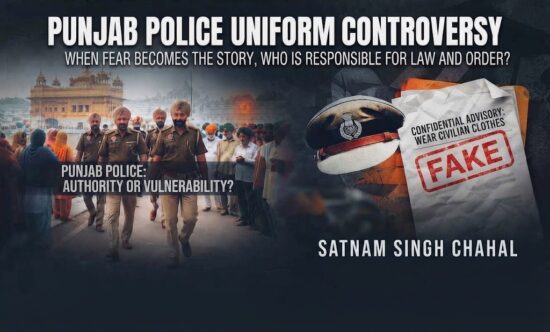
Punjab Outlook Investigative Analysis-Punjab has once again found itself debating a deeply uncomfortable question: how secure are those who are supposed to secure the state?A purported police communication circulating on social media claimed that police personnel, particularly in border districts, had been advised to avoid travelling in uniform and to wear civilian clothes while commuting between their homes and places of duty. The alleged instructions reportedly followed the killing of Assistant Sub-Inspector Harjit Singh in Amritsar and contained a series of security-related precautions for police personnel.
The controversy quickly became political. Opposition leaders cited the purported advisory as evidence of a deteriorating security environment and questioned the Bhagwant Mann government’s handling of law and order. Partap Singh Bajwa, Leader of the Opposition in the Punjab Assembly, said police personnel were reportedly being advised not to travel in uniform and questioned Chief Minister Bhagwant Mann over who was responsible for Punjab’s law and order.
But there is an important fact that cannot be ignored: Punjab Police has officially denied that such an advisory was issued. The department said neither Punjab Police Headquarters nor any subordinate office had directed personnel to avoid wearing uniforms while travelling to or returning from duty, or to wear civilian clothes during their commute. It described the messages circulating on social media as fake and urged citizens and police personnel to rely on official channels.
That clarification changes the nature of the story but it does not make the underlying security question disappear.The alleged communication reportedly contained much more than the controversial reference to uniforms. Reports said it included instructions concerning personal security, avoiding predictable movement, travelling in pairs where possible, strengthening security at checkpoints, maintaining vigilance, and improving coordination with specialised and intelligence agencies.
If the document is fabricated, then another serious question arises: who created it, who circulated it, and why was it believable enough to trigger a political and public controversy?That question deserves an answer.The controversy has emerged against the backdrop of attacks on police personnel. ASI Harjit Singh was killed in Amritsar during patrol duty, and the incident has intensified concerns about the vulnerability of police personnel in the border belt. Reports have also referred to other recent attacks and killings involving police personnel in the region.
A police uniform is not merely clothing. It represents the authority of the state, public accountability and the visible presence of law enforcement. Therefore, even an unverified claim that policemen are being told to hide that identity while travelling can have a powerful psychological effect on both the force and the public.For that reason, the government and police leadership cannot treat the controversy merely as another social-media argument between the ruling party and the Opposition.There are two separate questions here.
First: Is the alleged uniform advisory genuine? Punjab Police’s official answer is no. Until an authenticated document establishes otherwise, the allegation should not be presented as an established government order.
Second: Why has the allegation gained such traction? That requires a broader examination of the security environment, attacks on police personnel, intelligence-sharing, protection of officers travelling to and from duty, and the confidence of the police force itself.This is where the responsibility of the political leadership becomes important—not because every law-and-order incident can automatically be attributed to the Chief Minister, but because Punjab’s Home Department and political leadership ultimately have to ensure that the police have the resources, intelligence, protection and institutional confidence required to perform their duties.
Chief Minister Bhagwant Mann has repeatedly been at the centre of Punjab’s law-and-order debate because he also holds the Home portfolio. The political Opposition is therefore entitled to question the government. But political criticism should be separated from verified facts.The Opposition’s argument is that if police personnel genuinely felt compelled to conceal their identity while travelling, it would represent a serious warning about the security environment. The government’s police machinery, on the other hand, says the specific uniform advisory never existed.
Both parts of this controversy need scrutiny.If the advisory is fake, the state should identify the source of the fabricated communication and explain how misinformation concerning police security was allowed to circulate so widely.If any unofficial instructions were given locally despite the headquarters’ denial, the chain of command should clarify who issued them and under what authority.And if there are genuine intelligence inputs suggesting that police personnel are being targeted, the public deserves reassurance that appropriate protective measures are being taken—without compromising operational security.
The most disturbing possibility would not necessarily be that policemen were asked to change clothes before reaching their stations. The more serious concern would be if police personnel themselves feel vulnerable while performing ordinary duties and commuting between home and work.
A confident police force is essential to a functioning law-and-order system. A frightened police force, or a police force uncertain about its own security arrangements, presents a very different institutional challenge.Punjab therefore needs fewer political theatrics and more transparent answers.
Who is monitoring threats against police personnel?
Are intelligence inputs being systematically shared with field officers?
Are vulnerable police personnel receiving adequate protection?
Are border districts receiving additional security resources where required?
Who is responsible for verifying and countering fabricated police communications?
And, above all, does the Punjab Police leadership have the confidence and operational capacity required to protect its own personnel while protecting the public?
These are legitimate questions regardless of whether the viral advisory was genuine or fabricated.The politics of the controversy will eventually disappear. The underlying issue of police safety will not.For Punjab, the real test of law and order is not how sharply leaders attack one another on social media. It is whether an ordinary police officer can travel to work, wear the uniform of the state with confidence, perform his or her duty without fear, and return home safely.
Punjab Outlook’s central question therefore remains simple: If the viral advisory was fake, who manufactured the fear and if the fear is real, who is responsible for addressing it?
Sources checked: Punjab Police’s official denial as reported by PTI/ Hindustan Times, NDTV, The Tribune and other current reports.
Disclaimer: This article and accompanying images are for informational and illustrative purposes only. Some visuals may be AI-generated or digitally enhanced and may not depict actual events or persons.Views expressed are based on publicly available information and analysis