
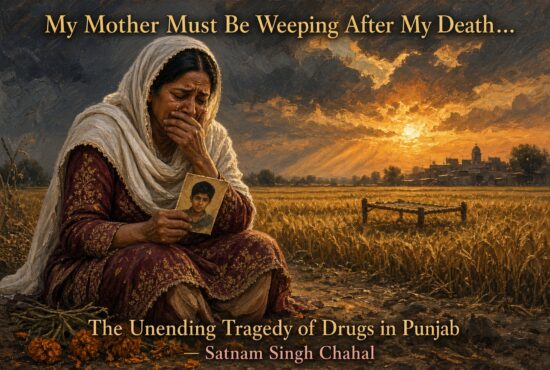
My mother must be weeping after my death…” These few words perhaps capture the deepest pain of Punjab’s drug tragedy. Behind every young life lost to drugs is not merely a death certificate or a newspaper report, but an entire family left struggling with grief, unanswered questions and an emptiness that may never disappear. Across Punjab, from villages to towns and cities, the photographs and newspaper clippings of young people dying because of drugs have become an increasingly disturbing part of everyday life. Each photograph represents a mother who lost her son, a sister who lost her brother, a wife who lost her husband, or children who lost the person they expected to protect and guide them through life.
https://x.com/BJP4Punjab/status/2102742655960859080/video/1
The tragedy is that these deaths are slowly becoming familiar. A photograph appears in the newspaper, people discuss it for a day or two, politicians issue statements, officials announce action, and then the public attention moves on. But for the family, there is no moving on. A mother may continue to look toward the door every evening, knowing intellectually that her son will never return, while emotionally still hoping to hear his footsteps. A sister may continue to remember the brother who once stood beside her during every difficult moment. A father may silently blame himself, wondering whether he could have done something differently. The newspaper story ends after a few paragraphs, but the family’s story continues for the rest of its life.
These are not merely statistics. These are human beings whose absence has changed the lives of everyone who loved them.
Punjab has become accustomed to discussing drugs in terms of numbers, seizures, arrests, cases and government programmes. All of these measurements may be important, but they do not tell the complete story. No statistic can measure the silence inside a house after the funeral of a young son. No government report can calculate the number of nights a mother spends crying beside his photograph. No official press release can explain to a young child why his father will never come home again.
The Punjabi poetic tradition has always understood the pain of separation, and today that old language of grief has acquired a frightening new meaning.
“ਮਾਂ ਦੀਆਂ ਅੱਖਾਂ ਵਿੱਚ ਹੰਝੂ ਰਹਿ ਗਏ, ਪੁੱਤ ਦੀਆਂ ਯਾਦਾਂ ਹੀ ਰਹਿ ਗਈਆਂ।” The mother is left with tears, and the son is left behind only as a memory. This is no longer merely poetic imagery. For too many families, it has become their daily reality.
The most uncomfortable question, therefore, is not simply why young people are consuming drugs. The harder question is how those drugs are reaching them in the first place. Who manufactures them? Who transports them? Who distributes them? Who profits from them? Who provides protection to the networks involved? Who knows about the trade and remains silent? And whenever credible allegations of official negligence or collusion arise, are those allegations being investigated independently and transparently? A serious fight against drugs cannot end with the arrest of an addicted young person. It must follow the entire chain from the street-level seller to the organised network and the money behind it.
There is also a painful political irony in Punjab. Every election cycle brings renewed promises to eliminate drugs. Political parties hold rallies, leaders make emotional speeches and slogans about a “drug-free Punjab” once again become prominent. Yet elections come and go while families continue to suffer. The banners are removed, the microphones are switched off and political attention moves elsewhere, but the mother who lost her son remains where she was—with the same photograph in her hands.Political promises may have an expiry date, but a mother’s grief does not.
If governments genuinely believe that the drug situation is improving, then the public deserves more than declarations. Punjab deserves a transparent, comprehensive White Paper on the drug crisis. The government should place before the people verifiable information about arrests, prosecutions, convictions, major trafficking networks, confiscation of assets, treatment programmes, rehabilitation outcomes and the number of people successfully returning to education, employment and family life. Most importantly, the government should explain what measurable evidence demonstrates that the availability of drugs has actually declined.
The people of Punjab should not have to depend on competing political claims to understand the seriousness of the crisis. They deserve facts. They deserve transparency. They deserve independent evaluation. And they deserve accountability when institutions fail.
At the same time, Punjab must recognise that the drug crisis cannot be solved by the government alone. Families, schools, religious institutions, community organisations, medical professionals, sports organisations and civil society all have responsibilities. Young people need meaningful alternatives—education, employment, sports, skills, recreation and hope. Addiction treatment must be accessible and dignified. A person who seeks help should not be permanently labelled and pushed away from society. Rehabilitation must mean more than getting someone off drugs temporarily; it must help that person rebuild a productive and respected life.
Society also has to confront its own silence. In many villages and neighbourhoods, people often know where drugs are being sold. They may know which places are suspicious and which individuals are involved in criminal activity. Yet fear, political influence, social pressure or simple indifference can prevent people from speaking. That silence has consequences. Communities must develop safer ways of reporting drug activity and protecting those who come forward. The fight against drugs cannot succeed when everyone knows what is happening but nobody wants to talk about it.
But perhaps the greatest responsibility rests with those who make money from human misery. A young person trapped by addiction needs treatment, counselling and rehabilitation. The person who deliberately supplies drugs for profit is a different part of the problem. The two should never be treated as though they carry the same responsibility. Punjab must focus its strongest investigative and enforcement efforts on organised trafficking, financial networks and those who repeatedly profit from the destruction of young lives.
Every death leaves behind a question. Every grieving mother carries that question. Every sister who loses her brother carries it. Every child who grows up without a father carries it. And perhaps that question is the most painful one of all: “Where were you when I was still alive?”
Where was the government? Where was the police? Where was the administration? Where was the community? Where were the institutions that promised to protect Punjab’s younger generation? And where were we as a society?These questions should not be used merely to create another political controversy. They should become the foundation for serious public accountability.
Punjab has heard enough slogans. It has witnessed enough campaigns. It has listened to enough promises that drugs will be eliminated. What Punjab needs now is measurable action, transparent reporting, professional enforcement, accessible treatment, long-term rehabilitation and a relentless focus on dismantling the networks that profit from addiction.
The ultimate measure of success should not be the number of speeches delivered or campaigns launched. It should be whether fewer mothers are standing beside the bodies of their sons, whether fewer sisters are losing their brothers, whether fewer children are growing up without fathers and whether fewer families are forced to turn a young person’s photograph into a permanent memorial.One day, Punjab should open its newspapers and see fewer photographs of young people lost to drugs and more photographs of young people who defeated addiction, rebuilt their lives and returned to their families with dignity. That would be a victory that no political slogan could manufacture and no government advertisement could exaggerate.
Until that day comes, somewhere in Punjab, a mother will still be sitting near a window or standing beside a door, looking down the road out of habit, memory and hope. She may know that her son is gone, but a mother’s heart does not always accept what reality tells it.Her eyes will continue to ask a question that Punjab cannot keep avoiding:
“Where did my son go?”
And sooner or later, Punjab must find the courage to answer.Because a mother’s tears do not follow an election calendar—and Punjab cannot continue counting its dead while pretending that the war against drugs has been won.
Disclaimer: This article and accompanying images are for informational and illustrative purposes only. Some visuals may be AI-generated or digitally enhanced and may not depict actual events or persons.Views expressed are based on publicly available information and analysis