
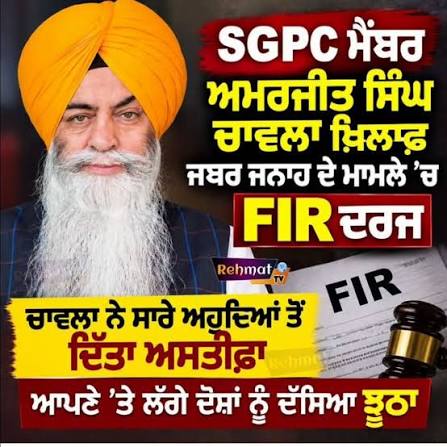
 The controversy involving Amarjit Singh Chawla, an SGPC member and senior Akali leader, has once again brought an uncomfortable question to the forefront: who holds the guardians of Sikh institutions accountable? When serious allegations emerge against a person associated with an institution entrusted with the management of historic gurdwaras and Sikh religious affairs, the issue cannot simply be treated as an individual controversy. It inevitably raises questions about the institutional culture, internal safeguards and standards of accountability within the Shiromani Gurdwara Parbandhak Committee.
A criminal case was registered against Chawla following allegations made by a woman, including allegations of rape and other offences. Chawla has denied the allegations and described them as false and fabricated, maintaining that he would establish his innocence through the legal process. He subsequently resigned from his positions in the SGPC and the Shiromani Akali Dal. The matter later reached the Akal Takht, where institutional religious action was announced against him. The SGPC has also announced an inquiry into the controversy.
These developments demand seriousness, but they also demand fairness. An allegation is not the same as a conviction, and no individual should be declared guilty before the competent legal process establishes the facts. At the same time, the existence of due process cannot become an excuse for an institution to avoid examining its own conduct. The complainant deserves a fair hearing, the accused deserves due process, and the institution itself owes the Sikh community transparency.
The larger question is whether the SGPC has an effective mechanism for dealing with serious complaints against its own members, office-bearers and employees. What happens when a complaint is made against someone influential? Who receives it? Is it formally recorded? Who investigates it? Is the investigation independent? Is there a defined time frame? And does the complainant receive an explanation about what action has been taken?These are not unreasonable questions. They are basic questions of institutional governance.
The SGPC is not an ordinary organisation. It administers major Sikh religious institutions and carries enormous moral and historical responsibility. Its office-bearers are therefore expected to meet standards of conduct that inspire public confidence. When controversy surrounds an office-bearer, the institution cannot simply protect its image and hope that the controversy disappears.Institutional reputation cannot be protected by suppressing questions. It is protected by answering them.
The formation of an inquiry committee can be a useful step, but a committee is meaningful only if it has a clear mandate, access to relevant evidence and the independence necessary to reach an honest conclusion. The findings should not become another confidential file that disappears into institutional cupboards. The Sikh community has a legitimate interest in knowing whether there was wrongdoing, whether there were administrative failures and whether existing safeguards were adequate.
The Chawla controversy should therefore be viewed as an opportunity to examine the SGPC’s entire complaint and accountability system. Serious allegations involving elected members, religious functionaries or employees should automatically trigger a clearly defined process. Criminal allegations should be allowed to proceed through the police and courts without interference, while internal administrative questions should be examined separately and transparently.A religious position must never become a shield against accountability. At the same time, accountability must never become punishment without proof.
That balance is essential.
The Sikh community has witnessed too many controversies involving religious institutions in recent years. Each controversy may have different facts and circumstances, and they should not be artificially combined. But repeated controversies inevitably create a larger question about institutional transparency. If the SGPC wants the community to maintain confidence in its leadership, it must demonstrate that its internal systems are capable of identifying wrongdoing, investigating complaints and taking appropriate action regardless of the status of the person involved.
The institution should also consider publishing periodic accountability reports covering complaints, disciplinary proceedings, inquiries and administrative actions, subject of course to legitimate privacy and legal restrictions. Such transparency would demonstrate that the SGPC is accountable not merely to its own office-bearers but to the Sikh community it claims to serve.
The Chawla case should not become another controversy that dominates public discussion for a few days before disappearing. Whether the allegations ultimately stand or fail is a matter for the appropriate legal and religious processes. But the institutional questions raised by the controversy will remain.If the allegations are established, appropriate action must follow. If they are disproved, that must also be clearly established. If administrative negligence occurred, those responsible must be identified. And if existing procedures failed, those procedures must be changed.
The real test of a religious institution is not how loudly it responds to criticism. The real test is whether it has the courage to examine itself when serious questions are raised.The SGPC cannot expect automatic public respect simply because of its historic status. Respect must be continuously earned through integrity, transparency, discipline and accountability.The Amarjit Singh Chawla controversy should therefore become more than a case involving one individual. It should become a moment for institutional introspection.The question before the Sikh community is ultimately simple: Can the SGPC clean its own house with the same determination with which it expects others to maintain Sikh values and discipline?If the answer is yes, then this controversy can become the beginning of meaningful reform rather than another chapter in an endless cycle of allegations, denials and institutional silence.
Disclaimer: This article and accompanying images are for informational and illustrative purposes only. Some visuals may be AI-generated or digitally enhanced and may not depict actual events or persons.Views expressed are based on publicly available information and analysis