
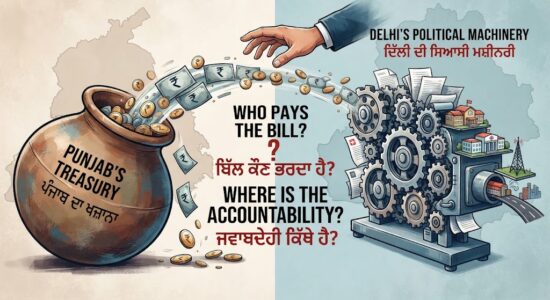
CHANDIGARH: The Aam Aadmi Party government repeatedly tells the people of Punjab that its priority is development, good governance and public welfare. But an increasingly important question is being raised in Punjab: How much of Punjab’s governance is actually being handled by people from Punjab, and how much influence is being exercised by AAP’s Delhi-based political and advisory network?
The issue is not whether a person comes from Delhi, Punjab or any other state. Competence should not be determined by birthplace. The real question is much more fundamental: Who is making decisions for Punjab, what authority do they possess, what does the Punjab government pay for their services and facilities, and what measurable results are they delivering to the people?
This question has gained importance because reports have repeatedly highlighted the involvement of Delhi-based AAP figures in Punjab’s political and administrative affairs. A 2025 report by ThePrint described several prominent Delhi-based AAP figures operating in Punjab, including former Delhi Deputy Chief Minister Manish Sisodia, AAP Punjab co-in-charge Satyender Jain and other political and policy-linked figures. The report said some Delhi-based functionaries were involved in areas including education, health, governance and media management. It also reported claims from an unnamed Punjab government officer concerning government accommodation in Chandigarh. Such claims should be independently verified through official records.
The broader issue, however, goes beyond individual names. Whenever a person performs an official or quasi-official role for the Punjab government, taxpayers have a legitimate right to know the cost. That includes salary, consultancy fees, government accommodation, vehicles, security, office facilities, travel, staff and other expenses ultimately charged to the public exchequer.The people of Punjab should not have to depend on rumours, political speeches or anonymous claims to discover how public money is being spent. They deserve a complete and transparent statement of expenditure.
This becomes particularly relevant in light of the controversy surrounding the Punjab Development Commission. In June 2025, The Tribune reported opposition allegations concerning appointments to the Commission. According to the report, eight advisers were appointed at ₹2.65 lakh per month each, 15 joint advisers at ₹2.20 lakh per month each and 15 senior research officers at ₹1.25 lakh per month each. Opposition leader Partap Singh Bajwa also alleged that ₹7.70 crore had been spent on the Commission from the state exchequer during the preceding year. These figures and allegations should be checked against official Punjab government appointment and expenditure records.The fundamental question is therefore not simply Delhi versus Punjab. The fundamental question is taxpayer money versus measurable public results.
If Punjab is spending substantial amounts on advisers, consultants, political appointees and specialist teams, the government should publish a clear performance report. The people deserve to know how many jobs were created, how much investment came into Punjab, what measurable improvement occurred in government schools and hospitals, what progress was achieved against drugs and unemployment, and how much additional revenue was generated as a result of these interventions.Most importantly, the government should disclose how much each programme and each advisory arrangement has cost the Punjab taxpayer.
A government cannot demand public money in the name of reform and development and then avoid providing a detailed account of what that money achieved.There is also an important distinction between outside expertise and an outside political network. Governments everywhere use specialists, consultants and advisers. There is nothing inherently wrong with bringing expertise from outside a state. But there must be transparency about their authority, responsibilities and accountability.
If individuals who were not elected by Punjab voters are exercising substantial influence over government departments, policies or administration, the government should clearly explain their formal role. Who appointed them? Under which government order? What are their job descriptions? To whom do they report? What remuneration do they receive? What government facilities are provided to them? How is their performance evaluated?These are basic questions of democratic accountability.
Punjab has its own elected government, legislature, civil service, universities and a large pool of experienced professionals. The state has produced outstanding administrators, doctors, engineers, economists, academics and entrepreneurs. The government should therefore explain why particular responsibilities require outside political or advisory networks and whether comparable expertise is available within Punjab.At the same time, Punjab should not reject expertise merely because an expert comes from outside the state. The standard should be the same for everyone: qualifications, competence, transparency, cost and measurable results.
Another sensitive issue is the allegation that people associated with the Delhi AAP establishment enjoy government facilities at Punjab taxpayers’ expense. Such allegations should not be presented as established facts without documentary evidence. But if government houses, vehicles, security personnel, offices or other facilities are being provided to political advisers or party-linked individuals, the Punjab government should make the details public.
The questions are straightforward. Who occupies government accommodation? What is the person’s official entitlement? Who pays the rent and utilities? Who provides the vehicle and driver? What is the security expenditure? What is the total annual cost to the state?
There is nothing unreasonable about asking these questions. It is public money, and public money requires public accountability.
The Punjab government could address much of this controversy by publishing a comprehensive White Paper on political advisers, consultants, OSDs, fellows, boards and commissions associated with the government.
Such a document should provide the names and designations of appointees, dates of appointment, qualifications, formal authority, salaries or consultancy fees, accommodation and vehicle facilities, security expenses, office and staff costs, travel expenditure, funding sources, responsibilities, measurable achievements and total expenditure from the Punjab exchequer.Let the facts speak.If these appointments have produced substantial benefits for Punjab, the government should have no difficulty demonstrating those achievements. If the expenditure cannot be justified, the public will have the information necessary to demand accountability.
Punjab is not short of challenges. Farmers continue to face structural difficulties. Young people are looking for opportunities and many continue to leave the state. The drug crisis remains a major public concern. Government employees have outstanding financial demands. Public infrastructure requires investment, while schools and hospitals need adequate resources.In such circumstances, every rupee of Punjab’s public money matters.
The government therefore has a responsibility to ensure that public money is spent according to clearly defined public priorities and that every appointment or consultancy arrangement can withstand public scrutiny.The debate should not be reduced to whether someone is from Delhi or Punjab. The real test is much simpler: If you are paid by Punjab, serve Punjab. If you use Punjab’s resources, account for them. If you exercise public authority, disclose it. And if you claim to work for Punjab’s welfare, show the results.
The people of Punjab are entitled to know whether the government’s network of advisers and political functionaries represents genuine administrative expertise or whether public resources are being used for arrangements whose costs ultimately fall on Punjab’s taxpayers.
The answer should not come through political speeches or counter-allegations.It should come through government records, audited accounts, official orders, expenditure statements and measurable results.Because ultimately, the biggest question is not who came from Delhi.
The biggest question is:
WHO IS PAYING FOR THEM—AND WHAT IS PUNJAB GETTING IN RETURN?
Disclaimer: This article and accompanying images are for informational and illustrative purposes only. Some visuals may be AI-generated or digitally enhanced and may not depict actual events or persons.Views expressed are based on publicly available information and analysis