
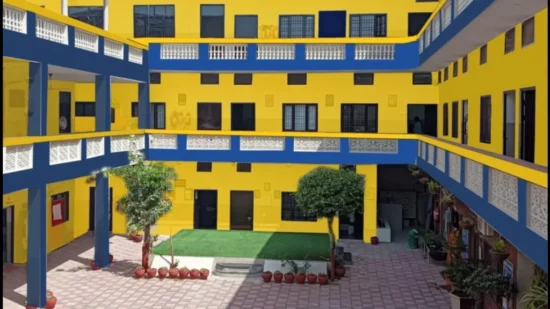
 Punjab Outlook Investigative Analysis: With the 2027 Punjab Assembly elections less than six months away, a fresh political controversy has erupted over the Punjab government’s decision to paint 3,602 government schools in blue and yellow, colours that Opposition parties have alleged resemble the colours associated with the ruling Aam Aadmi Party (AAP).
According to an October 1 order issued by the Director General of School Education (DGSE), Punjab, the colour-coding and whitewashing work will be carried out under the government’s “Converting Govt Schools into Smart Schools” scheme. The department has sanctioned ₹80.45 crore for the exercise. The order specifies shades described as “egg custard” and “enamel rhapsody” for the exterior portions of school buildings, including verandahs and corridors.
The scale of the latest exercise is significant. It covers 1,895 primary schools, 764 high schools, 532 senior secondary schools and 411 middle schools. Amritsar has the highest number of schools included, with 334, followed by Patiala with 326, Ludhiana with 261, Gurdaspur with 240, Hoshiarpur with 236 and Jalandhar with 231. The programme also covers schools in Tarn Taran, Ferozepur, Sangrur, Fatehgarh Sahib, Bathinda and Ropar, among other districts.
The controversy, however, is not simply about painting school buildings. It is about timing, symbolism and the use of public institutions in an increasingly politicised environment. The latest decision comes after a similar controversy in December 2025, when 852 government schools were included in an earlier colour-coding exercise involving blue and yellow. Opposition parties had then questioned why these particular colours were being selected for government institutions.
The government has rejected the political interpretation. DGSE Aravind Kumar MK has confirmed that the October 1 order was issued by his office. During the earlier controversy, the DGSE maintained that there was nothing political behind the colour selection, describing the work as routine renovation and whitewashing.
That explanation may be administratively reasonable, but it does not automatically remove the political question. In a state preparing for another high-stakes Assembly election, governments must recognise that public perception matters almost as much as administrative intention. If a colour scheme associated in public discourse with a ruling political party is repeatedly introduced across government institutions, the government should expect questions about whether political branding is being allowed to enter public spaces.
The larger issue is therefore not whether blue and yellow are inherently political colours. They obviously are not. The question is whether government schools should have a standard, politically neutral identity that remains independent of whichever party happens to be in power.
Government schools belong to the people of Punjab, not to any political party. They are attended by children whose families support different political parties, different ideologies and different social organisations. Their buildings should ideally represent education, equality and public service, rather than becoming part of a political branding debate.
There is also an important question concerning the ₹80.45 crore expenditure. Renovation and maintenance of government schools are unquestionably legitimate priorities. Clean buildings, safe classrooms, proper sanitation, functional toilets, electricity, drinking water, laboratories, libraries and sports facilities can directly improve the educational environment. The government has previously argued that better infrastructure can improve students’ learning experience.
But whenever hundreds of crores are committed to school infrastructure, the public has a right to ask whether the money is being spent in the most educationally productive manner. The government should therefore publish clear district-wise details of the expenditure, the number of schools, the per-school allocation, the contractors or implementing agencies, the specifications and the completion timelines.
Transparency could actually help the government put the political controversy to rest.