
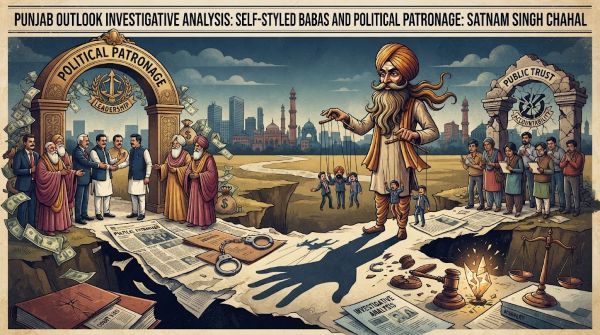
By Satnam Singh Chahal-In Punjab and across northern India, the growing political attention paid to influential religious leaders raises serious questions about the relationship between faith, electoral interests and public accountability. While many religious institutions provide genuine spiritual guidance and social services, concerns arise when self-styled spiritual leaders acquire considerable public influence and political parties seek their support or goodwill. The issue is not religious faith itself, but whether political connections can create an impression that influential individuals receive special treatment or escape scrutiny.
Politicians may visit religious institutions out of genuine respect, community engagement or political calculation. A visit alone is not evidence of wrongdoing. However, when political leaders repeatedly court influential babas before elections, the public has a legitimate interest in understanding whether these relationships involve electoral support, financial arrangements or attempts to influence public officials. Any allegation of improper patronage must be examined through documents, credible testimony and official records rather than speculation.
The case of Dera Sacha Sauda chief Gurmeet Ram Rahim Singh illustrates the complexity of these issues. In August 2017, he was convicted of raping two women followers and sentenced to a total of 20 years in prison. In January 2019, he was convicted in the murder of journalist Ram Chander Chhatrapati, while in 2021 he was convicted in the murder of former dera manager Ranjit Singh. However, the Punjab and Haryana High Court subsequently acquitted him in both murder cases, in 2024 and 2026 respectively. These appellate decisions must be acknowledged alongside the separate rape convictions. The case also raises broader questions about the political significance of large religious followings and the need to keep criminal proceedings independent of political influence.
Another prominent case concerns Asaram Bapu, who was convicted in 2018 of raping a minor and sentenced to imprisonment for the remainder of his natural life. In May 2026, the Rajasthan High Court upheld his sentence in that case while acquitting him of a separate gang-rape charge considered in the appeal. His case highlights the importance of protecting complainants and ensuring that religious status, popularity or institutional influence does not obstruct the judicial process.
The Hathras stampede of July 2, 2024, offers a different lesson. A religious gathering associated with preacher Bhole Baba resulted in 121 deaths. Investigations and subsequent reporting raised questions about crowd management, organisers’ responsibilities and public safety arrangements. The tragedy demonstrated the importance of establishing accountability through evidence, without automatically assuming that every person associated with a gathering is criminally responsible.
For Punjab, the central question is whether political parties sometimes view influential deras primarily through an electoral lens. Relationships between politicians and religious institutions are not inherently improper, and different organisations must be assessed on their own records. Nevertheless, any credible evidence of political interference in investigations, preferential administrative treatment, intimidation of witnesses or unlawful financial arrangements deserves independent scrutiny.
Responsible investigative journalism must distinguish allegations from charges, convictions from acquittals, and political association from proven misconduct. It must also examine the conduct of aides and managers individually rather than automatically attributing their alleged offences to a religious leader. Equally, public officials should be held accountable if documentary evidence establishes that they interfered unlawfully in an investigation or attempted to shield someone from justice.
The central question is not why politicians visit babas, but whether political relationships ever undermine equal treatment under the law. Religious freedom deserves protection, genuine charitable work deserves recognition, and every accused person deserves due process. At the same time, no individual—whether a politician, preacher or influential institution head—should receive immunity from lawful investigation because of popularity or connections.
Punjab Outlook believes that faith must remain a matter of personal conviction, while justice must remain independent of political power. Only transparency, credible evidence and equal application of the law can protect public confidence in both religious institutions and democratic governance.
Disclaimer: This article and accompanying images are for informational and illustrative purposes only. Some visuals may be AI-generated or digitally enhanced and may not depict actual events or persons.Views expressed are based on publicly available information and analysis