
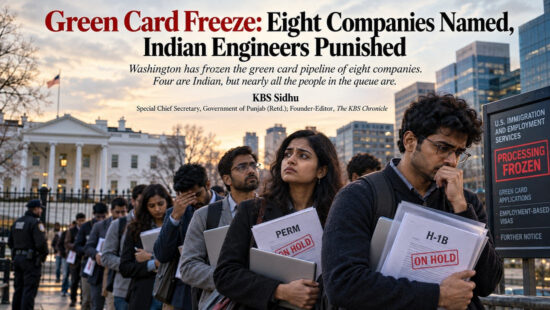
 On Thursday, 8 October 2026, at a White House news conference, the US Labour Secretary, Keith Sonderling, with Vice President JD Vance at his side, suspended eight companies from the Permanent Labour Certification Programme, the Labour Department’s gateway to an employer-sponsored green card, known by its acronym PERM (Program Electronic Review Management). Six were described as the world’s largest IT outsourcing firms: Cognizant, Infosys, Tata (meaning, presumably, Tata Consultancy Services), Wipro, HCL and Capgemini. Two more, Microsoft and Adobe, were added “due to multiple active federal investigations”. The Department will accept no new applications from these companies, and it will process none that are pending.
That last clause is the one to read twice.
A Tweet in September, a Podium in October
The chronology matters. In July the administration opened a wide probe into alleged fraud in the H-1B and PERM programmes. On 8 September the Labour Department’s Inspector General announced, on X, that the PERM filings of Cognizant and Cloudera stood suspended; no allegation was spelled out, and Indian IT stocks lost some ₹55,000 crore in market value the next day. One month later the method has been promoted from a tweet to a podium, and the list has grown from two names to eight.
Look at the list closely, because “Indian IT” is a loose description of it. Cognizant is American, headquartered in New Jersey. Capgemini is French. Microsoft and Adobe are as American as companies come. Only four of the eight fly the Indian flag. What unites the eight is the passport of the people in their green card queues.
The Arithmetic of Accusation
Mr Sonderling offered numbers. Since 2009, he said, these companies have requested almost three million foreign workers, received over 230,000 H-1B approvals and over 100,000 permanent labour certifications; these, he concluded, were jobs taken from Americans.

I have spent enough years reading departmental notes to distrust a figure that arrives without its denominator. Three million “requested” against 230,000 approved suggests that positions listed on wage filings are being counted as workers. And 100,000 certifications, spread over seventeen years and eight of the largest technology employers on earth, comes to under 6,000 a year. That is a talking point, and nobody has yet turned it into a finding.
Mr Vance was more specific about Microsoft: 6,000 Americans laid off in 2025, over 6,000 H-1B approvals, 3,682 PERM applications, nearly a thousand of them for the very positions vacated. If that is established, it is serious, and no Indian should defend it. A labour certification is a sworn statement that no qualified American was available; a false one deserves prosecution. The Indian majors, for their part, carry old baggage of visa settlements, and must not pretend otherwise.
The sequence, however, is the trouble. Suspension has preceded the finding. No reasoned order has been published, no company has been charged, and the penalty falls on an entire class of applicants for what a few may have done.
Girmit, Second Edition
The Vice President called these workers “indentured servants”. The phrase lands differently in India. Our forebears who sailed to Fiji, Mauritius and Trinidad under the girmit, their word for the agreement they could not read, were indentured in the literal sense.
Mr Vance is not entirely wrong about the condition; he is wrong about its author. An Indian engineer on an H-1B is tied to his employer because the green card queue for Indians, under the per-country ceiling, runs into decades, and changing jobs can mean restarting the paperwork. American law built that tether. An employer with a cheque-book merely holds the end of it. To cure this indenture by suspending the one process that ends it is to lengthen the girmit in the name of abolishing it.
And the human cost is precise. An H-1B worker may ordinarily stay six years; he stays beyond that only on the strength of a green card process begun in time. An employee whose company is now barred from beginning it has a clock running, and with him a spouse, a mortgage, and children who may be American citizens.
Bengaluru’s Dividend, Delhi’s Duty
For the Indian companies the blow is real but not mortal. On the very day of the announcement TCS reported a quarterly net profit of ₹13,934 crore, up 15 per cent, and added 4,258 employees. The industry has spent a decade hiring locally in America and shifting delivery offshore. Every door Washington closes moves more work to Bengaluru, Hyderabad and Pune, an outcome that does little for the American worker in whose name the door was closed. The firms should, therefore, do three things: seek the reasons in writing, test the suspension in American courts, where a penalty without a hearing is not readily sustained, and open their own files to an honest audit.
The Government of India has a duty too, and a megaphone will not discharge it. The mobility of professionals is trade in services, and it belongs on the table of the bilateral trade conversation alongside tariffs. South Block should ask Washington for specifics, quietly and promptly: the legal basis, the duration, and above all the fate of pending cases filed in good faith.
To the Indian professional reading this in New Jersey or Texas at an anxious hour: nothing announced on Thursday cancels your H-1B status, and nothing was said about certifications already granted. Get your own filing dates from your employer, in writing. Do not act on a forwarded message.
America is entitled to police its labour market, and it is welcome to prosecute fraud. Punishing the people in the queue for the alleged sins of those who manage it is a different matter, and the Indian side should say so plainly.