
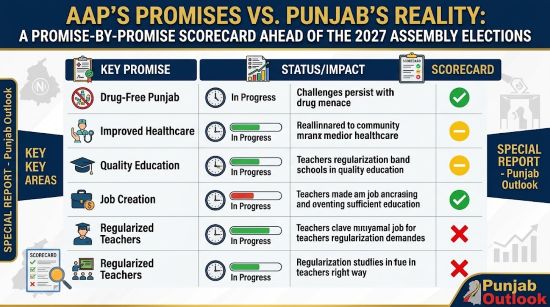
 Punjab’s 2027 Assembly election will bring an important question back to the centre of public debate: how much of the Aam Aadmi Party’s 2022 election programme has been delivered, how much remains incomplete, and why did some of the promises made by Arvind Kejriwal take years to implement?AAP entered the 2022 election with a message of change. It promised financial assistance to women, employment for young people, action against drugs and corruption, improvements in education and healthcare, and more affordable electricity. The party won 92 of Punjab’s 117 Assembly seats, creating enormous expectations among voters.The government’s record must now be examined promise by promise. This requires distinguishing between campaign announcements, budget allocations, schemes that have actually started, and measurable outcomes for ordinary people.
AAP promised ₹1,000 per month to eligible women, with a higher amount for eligible Scheduled Caste women. The Mukh Mantri Mawan Dheeyan Satkar Yojana was launched on July 1, 2026, nearly four years after the election promise.According to reports published on October 1 and 2, 2026, Chief Minister Bhagwant Mann announced that ₹1,262.54 crore was being transferred for the October–December instalment to 36.87 lakh women. The government also reported earlier distributions under the scheme. These payments must be acknowledged: it would be inaccurate to describe the promise as wholly unfulfilled.
The accountability question is why implementation took so long, whether future payments will remain regular, and how many eligible women ultimately receive the assistance. Verdict: Implemented, but substantially delayed. (Source: The Tribune, October 2, 2026; The Times of India, October 1, 2026.)AAP promised free electricity of up to 300 units per household under the applicable scheme conditions. The benefit was introduced after the party took office and became one of the government’s major welfare programmes.
The relevant assessment is not simply whether the scheme exists. It is whether eligible households receive the benefit, how much the government spends on electricity subsidies, whether payments to the power utility are made on time, and how the subsidy affects the finances of the electricity sector.Punjab’s 2026–27 budget estimated power subsidies at ₹15,550 crore, including ₹5,771 crore for domestic consumers. This includes different categories of power subsidy and should not be treated as the cost of the household scheme alone. Verdict: Implemented; fiscal sustainability and payment discipline remain important questions. (Source: PRS Legislative Research, Punjab Budget Analysis 2026–27.)
Employment was a central theme of the 2022 campaign. In January 2026, Chief Minister Bhagwant Mann said his government had provided 61,281 government jobs since taking office.This is a significant government-reported figure, but a complete assessment should examine appointment records, recruitment to existing vacancies versus newly created posts, the number of permanent appointments, recruitment delays and employment opportunities in the private sector.The wider issue is whether young people can find stable, adequately paid work in Punjab without having to migrate elsewhere. Verdict: Government reports substantial recruitment; the wider employment promise requires further evidence-based assessment.
AAP promised strong action against Punjab’s drug trade. The success of that promise must be measured through more than raids, arrests and public announcements.A credible assessment requires information on convictions, the dismantling of supply networks, action against major traffickers, the accountability of officials accused of facilitating the trade, treatment and rehabilitation services, and evidence of changes in drug availability and addiction.
The government must also distinguish between allegations against individuals and proven wrongdoing. Verdict: Requires a comprehensive assessment using enforcement, prosecution, rehabilitation and public-health evidence.AAP promised to improve government education. The assessment should examine school buildings, classrooms, sanitation, teacher vacancies, teacher training, attendance, examination performance and learning outcomes.
Announcements about model schools or infrastructure spending are relevant, but they do not alone establish that students are receiving better education. Independent outcome data and school-level comparisons are necessary. Verdict: Requires a school-by-school and outcome-based assessment.The government promoted neighbourhood clinics and improvements to public healthcare. Their performance should be assessed through the number of fully operational facilities, doctor and staff availability, medicines, diagnostic services, patient attendance and referral arrangements with larger hospitals.
The existence of a clinic does not necessarily mean that every promised service is available. Equally, a functioning clinic providing accessible treatment is a genuine benefit and should be recognised. Verdict: Requires evidence on service quality, access and outcomes.AAP campaigned on the promise of cleaner government. A proper assessment must examine investigations, prosecutions, convictions where applicable, procurement transparency, public-service delivery and safeguards against political interference.An arrest or allegation is not proof of guilt. Nor is an anti-corruption announcement sufficient evidence that corruption has been eliminated. Verdict: Requires a transparent, independently verifiable assessment of enforcement and institutional safeguards.
This is one of the central financial questions surrounding the 2022 campaign. Kejriwal argued that better governance, reduced corruption and the elimination of waste could help finance public benefits. However, projected savings are not the same as money actually collected or saved.Punjab’s government must meet existing obligations, including salaries, pensions, interest payments, electricity subsidies and other recurring expenditure. Any new scheme must compete with these commitments and with spending needs in healthcare, education, agriculture, infrastructure and public safety.PRS Legislative Research reported that Punjab’s 2026–27 budget estimated receipts excluding borrowings at ₹1,26,740 crore and expenditure excluding debt repayment at ₹1,66,711 crore. The budget estimated ₹28,755 crore in interest payments and ₹90,335 crore in committed expenditure on salaries, pensions and interest combined.
These figures demonstrate the pressure on public finances. They do not, by themselves, prove that any individual promise was impossible to fund. To explain delays, the government should disclose the original cost estimates, anticipated revenue, actual collections, realised savings and the decisions that affected implementation.The key question is whether the financial plan presented to voters in 2022 was realistic and whether the government subsequently adjusted its commitments transparently when the expected resources did not materialise as anticipated.
The women’s allowance illustrates why a fair scorecard matters. The scheme has now begun making payments, but only after a substantial delay. Free electricity has been implemented, but its fiscal cost requires monitoring. The government reports significant recruitment, while the broader question of stable employment remains important. Other promises require evidence on enforcement and outcomes rather than conclusions based solely on political claims.Punjab’s electorate will assess these issues alongside law and order, farming, local development, public services, candidate performance and the programmes offered by opposition parties. No responsible analysis can determine the election result in advance.
For Punjab Outlook’s wider study of all 117 constituencies, the same questions should be applied separately across Majha, Doaba and Malwa: what was promised, what was delivered, what remains incomplete, what did it cost, and what evidence supports the government’s explanation?The opposition must also substantiate its criticism with documents and figures. The same standards should apply to the Congress, the Shiromani Akali Dal and every other party offering new guarantees.Punjab needs more than election announcements. It needs transparent costing, realistic deadlines, published implementation data and public accountability. The central question for 2027 is not simply how many promises a party makes, but whether those promises are financially credible, implemented fairly and capable of producing measurable improvements in people’s lives.
Disclaimer: This article and accompanying images are for informational and illustrative purposes only. Some visuals may be AI-generated or digitally enhanced and may not depict actual events or persons. Views expressed are based on publicly available information and analysis