
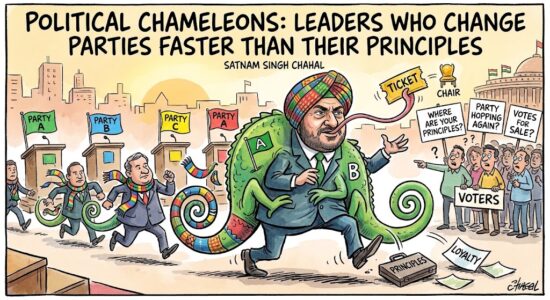
Punjab’s politics has produced a curious breed of leaders who appear to change their colours faster than a chameleon. The only difference is that a chameleon changes its colour to survive in nature, while some politicians seem to change parties to survive politically, secure a ticket, or remain close to the chair of power. Yesterday, they were attacking a rival party with fiery speeches; today, they are standing on the same stage, smiling for photographs and praising the very leaders they once condemned. Their transformation is so remarkable that even their former supporters may wonder whether they are witnessing a political revolution or simply a change of wardrobe.
A politician who fails to secure a ticket suddenly discovers that his old party has abandoned its principles. A leader who loses an important position begins talking about injustice and internal democracy. However, the moment another party offers a comfortable seat and a promising political future, the same leader announces that the new party represents the hopes and aspirations of the people. What a miracle! Apparently, political principles sometimes disappear in the morning and return in the evening wearing a different party scarf.
As a Punjabi-style satirical verse puts it:
Yesterday, you called them enemies, today you call them friends;
Your principles take holidays whenever your ambition demands.
The party flag may change, the slogans may be new;
But the hunger for a comfortable chair keeps shining through.
The real comedy begins when these leaders explain their sudden transformation. They rarely admit that they may have been disappointed over a ticket, an appointment, or a position. Instead, they declare that their decision is based on the interests of Punjab and its people. Apparently, Punjab’s future becomes their greatest concern precisely when their own political future looks uncertain. The public is left wondering whether the leader has changed his ideology or merely found a better political bargain.
In the dictionary of political opportunism, every situation has a convenient explanation. When their party is in power, leaders proudly claim that their government has created history. When the same party loses power, they complain that the leadership failed them. When they join a rival party, they announce that they have taken a historic decision for the welfare of the people. And if the new party refuses to give them a ticket, another historic decision may be just around the corner. At this rate, political history in Punjab is being written less with ink and more with resignation letters, welcome ceremonies and freshly printed party scarves.
Another Punjabi-style satirical couplet captures the situation:
No permanent loyalty, no principles to defend;
Wherever the chair is waiting, that is where they bend.
Yesterday, they cursed the very people they applaud today;
Tomorrow, another invitation may send them the other way.
Of course, every politician who changes parties should not automatically be labelled dishonest. Political disagreements, ideological differences, unfair treatment within a party, or genuine changes in conviction can sometimes justify such a decision. Democracy allows people to reconsider their positions. The real question, however, is whether a leader can honestly explain the reasons for the change. If a politician spent years condemning a party’s policies, the public deserves to know what has changed. Has the party corrected its mistakes, has the leader reconsidered the facts, or has the prospect of a ticket suddenly transformed an enemy into a trusted friend?
Punjab’s voters must also recognise their own power. Instead of being impressed by welcome ceremonies, grand speeches and photographs with senior leaders, they should ask candidates a few straightforward questions. Why did you leave your previous party? What happened to the promises you made under its flag? Do you still believe the policies you once defended? If you fail to get a ticket in your new party, will you search for another political home? These are not insulting questions; they are legitimate questions in a democracy where elected representatives are accountable to the public.
The funniest part of political drama is that leaders often assume voters have short memories. They forget that the same speeches, accusations and promises remain available in newspapers, television recordings and social media posts. A leader who once described a rival as unfit to govern cannot expect the public to forget everything merely because the two are now sharing a stage. A new party membership card may change political identity on paper, but it cannot automatically erase yesterday’s statements from the public record.
There is an old lesson in Punjabi political humour: the chair may be temporary, but the public’s memory can be remarkably permanent. Some leaders spend years building an image of sacrifice, honesty and public service, only to damage it through repeated political U-turns. They may win a ticket through such manoeuvres, but winning the confidence of voters is a different matter altogether. Political arithmetic may help a candidate enter the Assembly, but credibility is what helps a leader earn lasting respect.
Here is another satirical verse for those who treat politics like a game of musical chairs:
The music plays, the leaders run, each searching for a seat;
They speak of service to the poor, then chase a ticket sweet.
When the music stops, the public asks, “What have you done for us?”
And suddenly the grandest leader has very little left to discuss.
The message is not that politicians must remain permanently attached to one party regardless of circumstances. Rather, they must demonstrate consistency, honesty and accountability. Changing parties is a political choice; misleading voters about the reasons is a matter of public concern. Leaders who genuinely believe in a new political direction should explain their change openly instead of wrapping personal ambition in the language of public service.
Ultimately, Punjab does not need leaders who are loyal only to political positions, election tickets or powerful individuals. It needs representatives who remain committed to public welfare, regardless of which party occupies the treasury benches. Voters should judge leaders by their record, their promises and their actions—not by the number of times they have changed their party flags.
So, to the political chameleons of Punjab, here is a friendly piece of advice: before changing your party, hold one honest meeting with your conscience. You might discover that even your conscience is considering joining another party!
And to the voters, remember this: a party can offer a politician a new flag, a new slogan and a new platform, but only the people can offer lasting political credibility. The chair may change hands, the slogans may change overnight, and yesterday’s enemies may become today’s companions. But the public’s right to ask questions must never change.
In Punjab’s politics, the colour of the flag may change every season—but the people must never change their demand for honesty, accountability and genuine public service.