
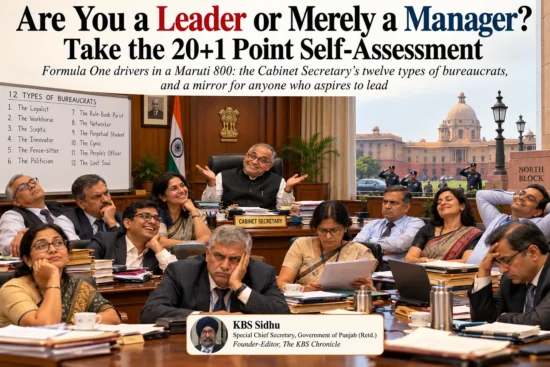
On 27 October 2026, at what should have been a routine performance review of Secretaries to the Government of India, Cabinet Secretary T.V. Somanathan did something unusual. He put up cartoons, several of them reportedly by the late R.K. Laxman, and walked the room through twelve types of bureaucrats.
Reports say several officers were uncomfortable. They had reason to be. Every Secretary in that room had worked with a few of the twelve. Some, perhaps, had seen one in the shaving mirror that morning.
Only some of the twelve have been reported:
The file thrower, who flings files and speaks rudely to subordinates.
The file sitter, who lets files lie pending rather than decide.
The upward referrer, who sends the Minister what he has full power to decide himself.
The after-hours convenor, who calls meetings after 7 pm, or summons staff on Saturday and then arrives late himself.
The officer who crosses the line, asking women colleagues to come uncomfortably close to look at a document.
The last is a question of conduct, and it needs action, not an essay. The others are a question of culture, and that is what this piece is about.
I take the Cabinet Secretary’s list as a peg, not a target. He has done the service a favour by holding up a mirror with a smile. My argument is that most of these types are not born. They are made, and our system makes them with remarkable efficiency.
Two More for the List
Anyone who has spent a career in the Secretariat could add a few types of his own. Let me add two, because they show that indecision is not always a personal failing. Sometimes it is a service the system quietly asks for.
The Bottomless Joe. When a senior officer or a Minister wants a proposal buried but cannot be seen to say no, the file goes to Joe. Joe never rejects anything. He simply raises one more query on page 47, seeks the views of the Law Department, makes a reference to a Ministry last consulted in 2019, and calls for “complete background with all previous orders”. Each step is unimpeachable. Together they form a labyrinth with no exit. The file is never with Joe; it is always “awaiting reply” from someone else. In the Hindi belt they call this thande baste mein daal do: put it in the cold sack.
The Hot Potato. This is Joe’s mirror image. Some files are so sensitive that nobody keeps them on the table for more than five minutes. The note-sheet fills with initials and the stock phrases of the relay: “for kind perusal”, “may kindly see”, “please discuss”, “submitted for orders”. Everyone has dealt with it. Nobody has decided. Its favourite last stop is the Minister’s table, after which every officer below is safe on record.
The cold file and the hot file reach the same destination, no decision, one by freezing and the other by friction. Neither shows up on a pendency report. Joe’s file is always pending elsewhere, and the hot potato never sits anywhere long enough to be counted.
That is the clue. These are not twelve, or fourteen, separate pathologies. They are rational responses to the incentives we have built.
The Asymmetry: Punish the Error, Ignore the Success
The heart of the matter fits in one line: in our civil services, a mistake is heavily punished, while success is seldom, if ever, rewarded.
Consider what an officer weighs when a bold file lands on his table. If the decision works, the credit goes to the scheme, the Minister or “the team”. His appraisal moves from 9.2 to 9.4, if that. If the decision goes wrong, or merely looks wrong ten years later, he faces vigilance, audit paras, an investigation, a court case and a decade with a cloud over his name. Retirement brings no relief; the inquiry outlives the posting. Officers have a name for this fear: the four Cs, the CBI, the CVC, the CAG and the Courts.
No rational person plays a game in which the upside is a pat on the back and the downside is ruin. So he plays a different game. He stops trying to do the most good and starts trying to leave the cleanest file. That is how the file sitter, the upward referrer, the Bottomless Joe and the hot potato are made.
Hindsight, meanwhile, is a cheap auditor. A decision taken in a crisis, on incomplete information and against a deadline, is later examined at leisure by people who already know how the story ended. The Cabinet Secretary himself observed that appraisal scores cluster so close to ten that they cannot tell a good officer from an outstanding one. Yet the same system can tell a mistake from a non-mistake with perfect clarity. And doing nothing never produces a mistake on paper.
The Formula One Driver in a Maruti 800
I have used this image before, and I will use it again, because it still holds.
We select our civil servants as if we were choosing Formula One drivers. Lakhs of aspirants sit a preliminary examination, then a gruelling Mains, then an interview. A few hundred are finally chosen. We test reflexes, judgement, stamina and nerve. We pick some of the fastest minds in the country.
Then we hand each of them the keys to an old Maruti 800. The brakes are soft, the steering pulls to one side, and the road is all potholes. A dozen passengers in the back seat each hold a copy of the traffic rules, ready to report every swerve. And then we wonder why the lap times are so poor.
The car is the system: rules written for another century, files that move on paper even when they move on screens, and a hierarchy that rewards caution. The potholes are the frequent transfers, the pressures from above and the hindsight audit. The passengers are everyone who may question a decision later, and no one who will defend it.
A Formula One driver in that Maruti learns quickly. Drive slowly. Never overtake. Stop at every crossing, even when the light is green. Arrive late, but arrive with the car unscratched. Within a decade, the champion we selected has become a careful, competent, deeply cautious driver. We call him a good administrator. He is, in truth, a manager, and we made him one.
In 2018 I wrote Analyzing the Leader-Manager Continuum, and in 2024 I returned to it as a self-analysis exercise, Where do you stand on the ‘Leader-Manager Continuum’. The central idea of both still holds: the manager and the leader are not two poles apart. Each of us sits somewhere on a 0–100 continuum, with some qualities dominating, and our position shifts with the posting, the boss and the times.
Let me be fair to managers. Managers are necessary. They keep the trains running, the salaries paid and the elections conducted. An organisation of nothing but visionaries would be an exciting place to visit and an impossible place to work. The problem is not that we have managers. The problem is that our system pushes nearly everyone toward the left end of the scale, and keeps them there.
Here is the continuum, 20+1 points, recast for our times.
The Leader–Manager Continuum: 20 + 1 Points
The 20+1 Points, One by One
1. Vision. The manager executes a vision someone else has set; the leader sets the direction and makes others want to follow. A district needs both, but only one of them can answer the question “where are we going?”
2. Influence. The manager controls tasks, processes and targets. The leader moves people through conviction. You can order a man to attend a meeting; you cannot order him to care about it.
3. Thinking. The manager asks how, by when and with what. The leader asks why, what next and what if. Both questions matter; the trouble begins when nobody in the room asks the second set.
4. Culture. The manager implements the values handed down to him. The leader builds the values his office lives by. Every office has a culture; the only question is whether someone shaped it on purpose.
5. Risk. The manager mitigates risk, above all the risk to himself. The leader takes calculated risk for a larger gain. Note the word calculated: the leader is not a gambler, but he does not mistake inaction for safety.
6. Empowerment. The manager directs and supervises. The leader delegates authority and builds ownership. A subordinate who is trusted will often rise to the trust; one who is watched will learn only to be watched.
7. The question asked. The manager asks, “Is this as per rules?” The leader asks, “Is this right, and how do we make it lawful?” The first question protects the officer. The second serves the citizen, and is no less respectful of the law.
8. Decisions. The manager refers upward when in doubt. The leader decides within his powers and owns the decision. Delegated powers are not decorations; an officer who never uses them has effectively returned them.
9. Rules. The manager follows the letter. The leader honours the spirit and, when a rule plainly fails, works to change it. Rules are tools made by people for a purpose. When the purpose and the rule part company, the leader goes with the purpose and takes the rule along.
10. Time horizon. The manager thinks in terms of this posting, this quarter, this review meeting. The leader thinks in terms of the next decade. The saplings planted by a Deputy Commissioner who will be transferred in eighteen months are a small act of leadership.
11. Measure of success. For the manager, success is no audit para and no complaint. For the leader, it is a visible change in people’s lives. The first can be achieved by doing nothing at all, which is precisely its danger.
12. Failure. The manager hides failure, explains it away or passes it on. The leader owns it, learns from it and corrects course. An organisation that cannot admit a failure will repeat it, usually at higher cost.
13. Credit. The manager keeps credit close. The leader passes it down. Nothing builds a team faster than a boss who says “my officers did this” and means it.
14. Blame. The manager passes blame down. The leader takes it on his own shoulders. This is the mirror image of credit, and the hardest row on the list. Officers will forgive a leader many faults, but never one who abandons them when a file goes wrong.
15. Meetings. The manager’s meetings are many, long and, as the Cabinet Secretary noted, often after 7 pm. The leader’s are few, short and end in a decision. A meeting without a decision is simply a well-attended way of postponing one.
16. Innovation. The manager waits for the circular. The leader pilots the idea first and then writes the circular. Many of our best national schemes began as one officer’s experiment in one district.
17. Change. The manager administers the status quo. The leader initiates change and carries people along with it. Change imposed without explanation is resisted; change explained, piloted and shared is adopted.
18. Crisis. In a flood, a riot or a pandemic, the manager seeks instructions. The leader takes charge first and reports later. Crises reveal leaders the way low tides reveal rocks; they were there all along.
19. People. The manager sees posts and personnel. The leader sees potential, and grows successors. A good test: how many of your former subordinates went on to do better than you expected?
20. Communication. The manager issues orders and memos. The leader explains the why and tells the story. People will follow a direction they understand far longer than one they merely obey.
+1. Legacy. The manager leaves behind a clean service record. The leader leaves behind institutions, and people, that outlast him. Thirty years on, nobody remembers how few audit paras an officer had. They remember the hospital, the canal, the school, the young officer he mentored, and the decision he took when nobody else would.
Even Harvard cannot teach leadership to someone who has not grasped its inner dynamics. The author at Harvard Kennedy School Executive Education, Cambridge, Massachusetts, 15 June 2013.
Not Only for Civil Servants
I have written this with the civil services in mind, but the continuum belongs to anyone who leads anything.
An Army officer will recognise every row: the company commander who waits for orders from brigade, and the one who reads the ground and acts within his commander’s intent. A corporate manager will recognise the meetings row and the credit row before he finishes his coffee. A doctor running a ward, a principal running a school, a panchayat sarpanch, a cooperative society secretary, a parent running a household: each of us takes decisions, carries risk, shares credit or hoards it, and builds a culture whether we mean to or not.
So use it wherever it helps: in a training course, a regimental mess, a boardroom offsite or at the kitchen table.
Where Do You Stand? A Self-Assessment
This is an invitation, not an indictment.
How to do it. Score yourself from 0 (wholly the manager) to 10 (wholly the leader) on each of the 21 rows. Add up the scores and divide the total by 2.1. That is your place on the 0–100 continuum. Do it twice: once for the person you were, or are, and once for the person you would have liked to be. The gap between the two numbers is the cost of the system, and, to be honest, of our own choices too.
Who should try it.
The serving officer: where do you sit today, and where did you sit in your first posting?
The retired officer: where did you sit across your career? Did you drift left as the years and the inquiries piled up?
The probationer or cadet: where do you want to be at fifty-five, and what will it take to stay there?
The ground rules. Nobody needs to see your score. Do not use it to blame the system, a Minister or a senior. Do not use it to claim credit either. Most of us were managers on some days and leaders on others. The honest answer usually sits somewhere in the middle, and it moved with the times.
A Word to the Cabinet Secretary
The Cabinet Secretary has named the types with humour. The harder task is to change the incentives that produce them. Cartoons can make us laugh at the file sitter; only a changed system will make him unnecessary.
I am seriously considering forwarding this continuum to the Cabinet Secretary, for him to use in any manner he deems fit: in the academies, in mid-career training, or simply as a mirror for the next review meeting. It carries no copyright worth defending and no agenda beyond the obvious one. If it helps even one Formula One driver keep his nerve in a Maruti 800, it will have done its job.
Where do you stand? I would welcome your score, your disagreements, and the twenty-second point I have surely missed.