
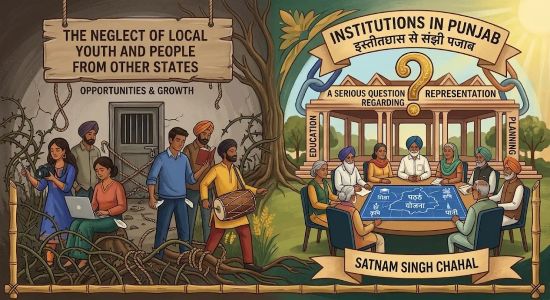
Punjab is facing a serious question that deserves an open, evidence-based public debate: why do so many young people from the state feel that opportunities in their own institutions are increasingly beyond their reach? Across government departments, public-sector organisations, educational institutions and other workplaces, concerns are being raised that people from outside Punjab are occupying a significant share of positions, while qualified Punjabi youth struggle to find stable employment in their home state.
The concern is not about opposing people from other states or questioning anyone’s right to seek employment. India is a constitutional democracy, and every eligible citizen has the right to compete for jobs under the applicable rules. The real issue is whether Punjab is doing enough to educate, prepare, recruit and retain its own young people and whether recruitment policies are being implemented fairly, transparently and in a manner that recognises the state’s legitimate needs.
For decades, Punjabi families have invested heavily in the education of their children. Many young people complete degrees, professional courses and technical qualifications, only to discover that suitable employment is scarce. A large number are compelled to move to other states or countries in search of work. Others spend years preparing for competitive examinations, while vacancies remain unfilled, recruitment processes face delays, or selection procedures become the subject of controversy. This creates frustration and weakens confidence in public institutions.
The problem cannot be reduced to a simple comparison between local and non-local employees. Each appointment must be examined according to the relevant recruitment rules, eligibility conditions, reservation provisions and constitutional requirements. However, the government should publish clear, department-wise information about sanctioned posts, vacancies, applicants, selected candidates and the state or region-wise data that can lawfully be disclosed. Transparency would help establish whether public concerns are supported by facts and identify where corrective action is needed.
Punjab’s universities, colleges, hospitals, technical institutions, boards, corporations and government departments must also examine whether local talent is receiving adequate opportunities. Institutions should strengthen Punjabi-language capacity wherever it is necessary for public service, improve skill-development programmes, and build meaningful links between education and employment. Recruitment examinations must be timely, fair and free from avoidable disputes. Young candidates deserve clear rules, reliable schedules and a transparent grievance-redressal process.
Political parties have a responsibility to address this issue beyond election slogans. Governments change, but the responsibility to create employment and strengthen institutions remains. Every administration should explain how many jobs it has created, how many vacancies it has filled, how many recruitment processes are pending and what steps it has taken to prepare Punjab’s youth for emerging sectors. Public promises must be measured against verifiable outcomes.
The state must also create conditions in which businesses, industries, research centres and technology enterprises can grow. Government employment alone cannot absorb every educated young person. Investment, reliable infrastructure, modern vocational training, support for small businesses and a predictable policy environment are essential if Punjab is to generate jobs at home and reduce distress-driven migration.
Punjabi youth should not be made to feel like strangers in the institutions their families have helped build through generations of public contribution. At the same time, the debate must remain fair and respectful of the rights of all Indian citizens. The demand is not exclusion; it is equal opportunity, transparent recruitment, stronger local capacity and accountable governance.
Punjab’s future depends on whether its young people can see a future in Punjab. The government should place the relevant employment data before the public and begin a serious dialogue with students, educators, employers and recruitment experts. If qualified local youth continue to feel overlooked while opportunities pass them by, the state risks losing not only talent but also the confidence of an entire generation.