
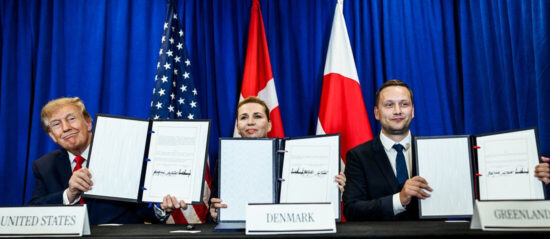
 On Tuesday, 22 September 2026, after delivering his General Assembly speech, President Donald Trump sat down at United Nations headquarters with Denmark’s Prime Minister Mette Frederiksen and Greenland’s Prime Minister Jens-Frederik Nielsen and signed a trilateral agreement. The Greenlandic and Danish press release records that the ceremony took place at the UN, that each government will keep a signed copy in English, Danish and Greenlandic, and that the agreement enters into force only after the necessary parliamentary procedures at home.
The words spoken at the table were larger than the document. Trump called it “long in the making. Many decades, probably centuries.” Frederiksen called it a deal that can last forever, good for the United States, Greenland, Denmark and the wider alliance, and Nielsen called it a win for all three.
I wrote in these columns on Monday that the argument would now move from press statements to paper. The paper is out. So let us read it.
Begin with the title of the instrument. It is an agreement to amend and supplement the 1951 Defence of Greenland Agreement, together with everything built on it since. That parent agreement was concluded on 27 April 1951 in implementation of the North Atlantic Treaty and entered into force on 8 June 1951 after Danish parliamentary approval. The 2004 Igaliku amendment brought Greenland’s own government into the arrangements and left Washington with exactly one base, the former Thule Air Base, now Pituffik Space Base.
Four things are genuinely new. The preamble records the parties’ shared interest in American military access to Greenland, including through the establishment of a Golden Dome defence system, and says the amendments are meant to reinforce the permanent nature of the arrangements. No state outside NATO may establish manned or unmanned military installations on the island. Control or ownership by countries and individuals from states that are neither NATO members nor NATO partners nor members of the European Union is barred, which is the celebrated investment veto, drawn not as an American discretion but as a membership test. And the agreement has no end date and can be amended only by mutual consent, under Article XIII of the 1951 agreement.
Set beside that, the rhetoric of permanent control looks thinner. The 1951 framework already allowed defence areas; the 2026 text widens them and formalises what Washington may build. Title does not move an inch.One clause went unmentioned at the press conferences, and it has the longest reach of any in the document.
Article XIV of the 1951 agreement provides that the agreement, being in implementation of the North Atlantic Treaty, “shall remain in effect for the duration of the North Atlantic Treaty.” Everything the United States holds in Greenland hangs from that hook. The new text does not cut itself loose from it. It amends the parent, recites the North Atlantic Treaty of 1949 in its opening lines, and notes that Greenland has been in NATO through Denmark ever since.
Then comes the remarkable provision. If Greenland exercises its right to self-determination and becomes independent, Denmark and Greenland must together ensure that the new state agrees to remain in NATO, applying for membership if necessary, and assumes all the rights and obligations specified in the agreement from the date of independence.
A caution against over-reading this. NATO is the frame, not the chain of command. American forces in Greenland answer to American commanders, as they always have, and the 1951 arrangement gives Washington exclusive jurisdiction over its own facilities, softened by the Danish and Greenlandic flags flying over Pituffik and by liaison officers from both governments. What the alliance supplies is the legal authority for the presence, not orders to the troops. Remove the alliance and the authority goes with it.
An administration that has spent two years treating the alliance as negotiable has written into a treaty of its own drafting that a future Arctic state must be in NATO. The permanence Washington wanted is available only through the alliance it periodically threatens to leave. Whether the new “no end date” language displaces Article XIV or merely restates it will keep treaty lawyers busy for a decade, and I would not pretend the answer is obvious. On either reading, an American departure from NATO is costlier today than it was on Monday, because the basis of every radar, runway and overflight right in Greenland is an agreement made pursuant to the North Atlantic Treaty.
Denmark has therefore done more than rewrite the Arctic chapter. Frederiksen has re-locked the alliance’s front door.
The Welcome, Measured in Adjectives
NATO reacted first. Mark Rutte welcomed the signing within hours, saying that greater security in the Arctic and the North Atlantic is essential for Europe and North America alike, and called it a positive step for transatlantic cooperation grounded in respect for sovereignty, territorial integrity and Greenlandic self-determination. Ursula von der Leyen followed, celebrating the agreement for strengthening security in the Arctic and North Atlantic, a marked change of tone from a Commission that had spent the year pledging solidarity against the very pressure that produced this text. Emmanuel Macron, asked in passing, said the pact was positive because it calms things and respects Danish sovereignty, after a weekend in which European capitals said remarkably little.
Canada’s welcome is the most interesting, given how poor its own relations with Washington have become. Defence Minister David McGuinty called the deal encouraging, since it boosts the American presence while keeping the island under Danish control. Ottawa’s stake is plain enough. Foreign Minister Anita Anand opened Canada’s consulate in Nuuk in February with the line “Nothing about the Arctic without the Arctic peoples”, and she has been pressing NATO to make its Arctic Sentry initiative a permanent fixture. A Greenland that stays Danish, stays in NATO and admits no non-NATO forces is precisely Canada’s preferred neighbour, whatever Ottawa thinks of the president who signed for it.
A Win to Take Home Before November
The American domestic calendar explains the hurry, and the adjectives.
On 16 September the Federal Reserve raised the federal funds rate by 25 basis points to 3.75–4.00 per cent, with sixteen members of the committee projecting at least one further increase before the year ends. Consumer prices in August were 3.4 per cent higher than a year earlier, the economy grew at 1.5 per cent in the second quarter, down from 2.1 per cent in the first, and tariffs have begun to bite the job market. Approval ratings have settled around 38 per cent against nearly 60 per cent disapproval, with the economy rated well below even that.
The midterm elections fall on 3 November, and the president has told Republicans to campaign as though he were on the ballot. A signing ceremony adds nothing to the price of petrol or groceries, but it costs nothing either, and it photographs well. Expect Greenland to be described on the stump as an acquisition. The text describes an amendment.
Two things, and both belong in the ledger.
The first is the title. Sovereignty remains with the Kingdom of Denmark, Greenlandic self-determination is written into the document rather than promised at a podium, and Greenland signs in its own right, which it could not do in 1951.
The second is the alliance. By routing American permanence through the North Atlantic Treaty, and by binding even a future independent Greenland to NATO membership, the agreement converts the alliance from a political preference into the legal foundation of the largest American strategic asset in the Arctic.
What remains is ordinary parliamentary business. Both legislatures must approve before the diplomatic note can be exchanged. Nobody has costed the Golden Dome works. And the investment screen will have to be squared with Greenland’s own control of its subsoil, which it has exercised since 2010. Copenhagen and Nuuk take those up in the coming session.