
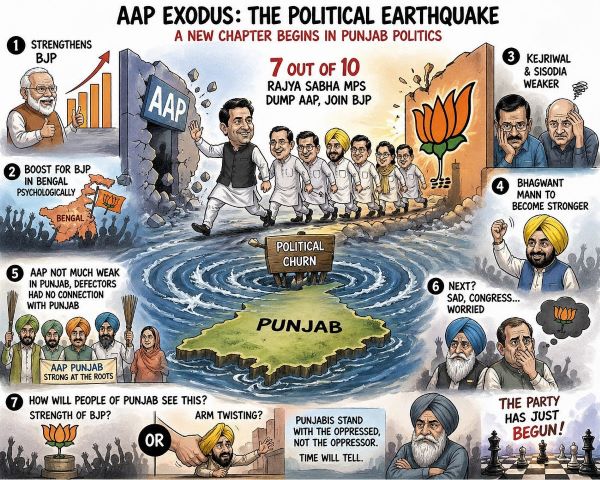
 The sudden exit of 7 out of 10 Rajya Sabha MPs from Aam Aadmi Party and their merger with the Bharatiya Janata Party is not just another episode of political defection it is a structural political rupture with far-reaching consequences. This is not speculation. The move has been formally announced as a two-thirds merger, a constitutional route that shields defectors from disqualification. What makes this moment extraordinary is its scale and timing: a dominant chunk of AAP’s parliamentary presence has shifted in one stroke, signalling a deep internal breakdown.
First, there is no denying that this development strengthens the BJP, both numerically in the Rajya Sabha and symbolically. It reinforces the perception of the BJP as a political magnet capable of drawing leaders even from parties that once positioned themselves as its principal challengers.
Second, the impact goes beyond Parliament. Psychologically, this move will boost the BJP’s narrative in states like West Bengal, where it has been trying to expand its footprint. The message is clear: if AAP—a party that once claimed to redefine politics can fragment so dramatically, then the BJP’s dominance appears even more inevitable.
Third, the biggest immediate casualty is the leadership of AAP. The exit exposes internal tensions and raises serious questions about the authority of Arvind Kejriwal and Manish Sisodia. Reports indicate that the split followed growing rifts and dissatisfaction within the party’s upper ranks. This is not merely a loss of numbers; it is a loss of cohesion and credibility.
However, the Punjab dimension needs a more nuanced reading.
Contrary to initial perceptions, this may not significantly weaken AAP in Punjab. Most of the defecting MPs had limited organic or rather no political roots in the state. They had no influence at the grassroots. In that sense, the political base of the party in Punjab, led by Bhagwant Mann, remains largely intact.

In fact, this churn could strengthen Bhagwant Mann. With central leadership under pressure, Mann’s relative authority within Punjab is likely to increase. The state unit may become more autonomous, more Punjab-centric, and less dependent on Delhi’s command structure.
At the same time, this episode will send shockwaves across other parties. Both Shiromani Akali Dal and the Indian National Congress will be watching closely. The possibility of similar defections whether through persuasion, pressure, or political opportunity cannot be ruled out. The phrase “Operation Lotus” will once again dominate political discourse, with allegations already being raised by AAP leaders.
The most interesting question, however, is how the people of Punjab will interpret this development.
Will they see it as the expansion of the BJP’s influence in the state? Or will it be viewed as political arm-twisting and betrayal?
Punjab’s political psychology is distinct. Historically, Punjabis have often shown a tendency to side with the perceived underdog rather than the dominant force, regardless of ideological alignment. If this narrative of coercion gains traction, it could actually generate sympathy for AAP rather than damage it.
At the same time, there is also a segment that may view this as a sign of AAP’s internal weakness and drift towards stronger, more stable alternatives.
The truth is, it is too early to draw definitive conclusions.
What is certain is this: Punjab politics has entered a new phase of churn. Established equations have been disturbed. Old certainties have collapsed. And a sense of unease is now visible across political formations.
This is not the end of the story—it is the beginning.
As they say in politics, the game has just begun.