
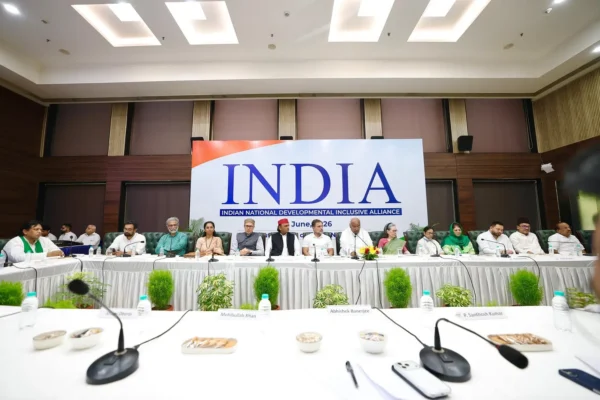
 There is a telling asymmetry at the heart of the INDIA alliance. When it gathers, it issues demands. When it disperses, it fractures. The meeting held today at the Constitution Club in New Delhi — attended by representatives of 25 parties — produced five decisions, several press statements, and an atmosphere of studied solidarity. What it did not produce was an answer to the question that has shadowed this coalition since its formation: what, precisely, is it for?
I. What Was Decided — and What It Reveals
Congress president Mallikarjun Kharge announced five decisions from the press conference. The alliance will meet every two months, with the next formal gathering in Hyderabad in August. The parties will write to the Chief Justice of India regarding the Special Intensive Revision of electoral rolls and alleged irregularities in the electoral process. They demand the immediate resignation of Union Education Minister Dharmendra Pradhan over the NEET and CBSE examination controversies. They have called on the Union government to convene an all-party meeting on the economy, unemployment, inflation, and agrarian distress. And during the Monsoon Session, INDIA parties will hold daily morning coordination meetings in the office of the Leader of Opposition.
On the surface this reads as a credible agenda. The SIR controversy is a genuine matter of democratic process — allegations of arbitrary voter deletions targeting specific communities deserve judicial scrutiny. The NEET debacle, with its paper leaks and systemic irregularities affecting hundreds of thousands of students, is a legitimate governance failure. The concerns around employment and agrarian distress are real, documented, and politically potent. And parliamentary coordination during the Monsoon Session is institutionally sound — a united, well-briefed opposition floor presence is worth more than individual grandstanding.
Yet examine the five decisions together and a pattern emerges. Three are institutional escalations. One is a resignation demand. One is a housekeeping arrangement about meeting frequency. Not a single decision amounts to a substantive policy alternative. There is no common economic platform, no drafted legislative agenda, no articulated vision of what the INDIA bloc would do differently in power. The alliance has mastered the grammar of opposition while remaining studiously silent about the grammar of governance.
II. The Personality Trap
The demand for Education Minister Dharmendra Pradhan’s resignation is the most visible instance of the alliance’s persistent tendency to personalise what are fundamentally systemic failures. The NEET crisis is not, at its root, a crisis of ministerial incompetence. It is a crisis of examination architecture — of the National Testing Agency’s structural vulnerabilities, of the political economy of coaching institutes, and of a centralising impulse in education policy that has concentrated enormous power, and enormous risk, in single national mechanisms.
A ministerial scalp, even if secured, would deliver a momentary political victory and resolve nothing. The students who lost a year of their academic lives to the NEET chaos are not served by a resignation. They are served by systemic reform. The INDIA bloc has not articulated what that reform should look like. Its demand for Pradhan’s exit is safer than developing a comprehensive education policy — one that would immediately expose internal fault lines among coalition partners on reservation architecture and the proper division of authority between state and centre in school education. Rhetorical accountability is easier than programmatic coherence. That is precisely why the alliance defaults to it.
III. The Fracture Lines — Absent, Diminished, and Defecting
The most eloquent statements at today’s meeting were made by those who stayed away — and by one who came but arrived politically broken. DMK chose not to attend. AAP chose not to attend. And Mamata Banerjee, who did attend, did so as a figure whose authority has been so dramatically diminished that her presence said almost as much as an absence would have.
The DMK: Principled Distance
The DMK’s calculation is straightforward. M.K. Stalin’s party has its own consolidating mandate in Tamil Nadu, and visible association with a Congress-led national platform carries diminishing returns in a state where Dravidian identity politics and anti-Centre sentiment are best prosecuted independently. The DMK will coordinate in Parliament when it serves Tamil Nadu’s interests. It will not share every press conference.
AAP: The Punjab Arithmetic
AAP’s absence is more pointed, and Punjab explains it with particular clarity. In the 2024 Lok Sabha elections, despite being nominal INDIA bloc allies at the national level, AAP and Congress fought each other independently across all 13 Punjab constituencies. The outcome was a body blow to the ruling party: Congress — the very party AAP had routed 92 seats to 18 in the 2022 Vidhan Sabha — returned to claim 7 of 13 Lok Sabha seats, while AAP, governing Punjab with a commanding legislative majority, was reduced to a mere 3. That wound has not healed, and with the Punjab Vidhan Sabha election due in February 2027, it will not heal any time soon. Congress and AAP are already the two principal adversaries in what will be the state’s defining electoral contest. For Kejriwal’s party to share a platform today with Congress — lending it the halo of opposition unity on the very issue of education that AAP considers its signature brand — would be to hand a direct rival a free political gift on the eve of a campaign that is, for all practical purposes, already under way. AAP’s absence was not a snub. It was a rational calculation.
Mamata Banerjee: A Solitary Figure in a Crowded Room
And then there is Mamata Banerjee — who attended, but as a shadow of the leader who once aspired to be the national convener of this very alliance and positioned herself as an alternative prime ministerial face. The TMC chief arrived at Constitution Club carrying the wreckage of May 2026, when the BJP won 206 seats in the West Bengal Assembly election, ending fifteen years of uninterrupted TMC rule in the state. That defeat was comprehensive. And today, as she sat in the INDIA conclave in Delhi, the humiliation deepened further: twenty of her twenty-eight Lok Sabha MPs wrote to Speaker Om Birla formally expressing their desire to join the BJP-led NDA. She came to a meeting of the opposition even as her own parliamentary group was in the process of crossing the floor. The woman who once declared that the INDIA alliance was her brainchild, who demanded the bloc’s national convenorship, sat today as a lone and diminished figure — politically isolated, institutionally enfeebled, and abandoned by the majority of her own MPs. The INDIA alliance once needed Mamata. The Mamata who attended today needed the INDIA alliance.
Together, these three stories — DMK’s strategic distance, AAP’s Punjab calculus, Mamata’s collapse — illuminate the alliance’s deepest structural problem. Coalitions function when partners pool their identities in pursuit of a shared and sufficiently precise goal. When that goal remains vague, the cost of association outweighs its benefits, and parties attend selectively, coordinate instrumentally, and defect when defection serves them. This is the INDIA alliance’s condition in June 2026.
IV. A Verdict
Today’s meeting was not a failure. It was an affirmation — cautious, qualified, and structurally constrained — of the INDIA platform’s continued existence. In a political environment where coalition-building is difficult and defection is constant, 25 parties agreeing on five decisions is not nothing. The letter to the Chief Justice on electoral rolls, if drafted with legal rigour rather than political fervour, could matter. The parliamentary coordination mechanism, if sustained, could produce a more disciplined opposition floor presence than the one India’s Parliament has seen in recent years.
But it is considerably less than what the moment requires. What distinguished India’s most consequential opposition moments — the JP movement’s constitutional challenge to Emergency authoritarianism, the NDA’s patient coalition-building through the 1990s, even the United Front’s Common Minimum Programme of 1996 — was not shared antagonism to the incumbent but the possession of an affirmative agenda. Something they were for, not merely against. The INDIA alliance has the electoral arithmetic, the constitutional instinct, and the institutional legitimacy to mount a serious challenge to BJP’s dominance. What it has not yet produced is the discipline to translate any of those assets into a governing vision that voters can evaluate on its merits.
The Hyderabad meeting in August is the next test. If it produces only another round of resignation demands, CJI letters, and televised unity photographs, the honest verdict will be that the alliance is functioning as a grievance platform rather than a governing alternative. Grievance platforms do not win power. They exhaust themselves against incumbency and fade. India’s opposition deserves better than that. So does India.