
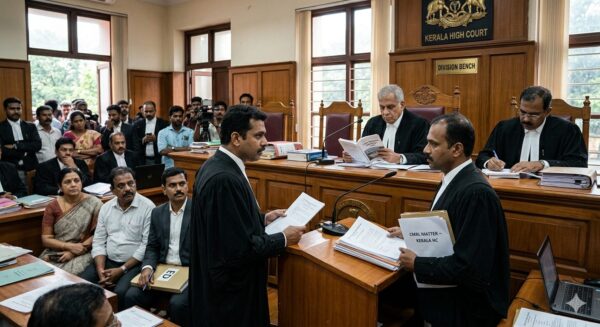
AI-generated representational image. This photograph is entirely fictitious and does not depict, purport to represent, or bear resemblance to any real person, living or dead.
Kerala High Court Reinforces ED’s Jurisdcition
The Kerala High Court’s division bench ruling in the CMRL matter — arising from alleged fictitious payments of Rs 1.72 crore to a company associated with the daughter of former Chief Minister Pinarayi Vijayan — is, strictly speaking, a judgment binding only within the territorial jurisdiction of the Kerala High Court. No other High Court is obliged to follow it. No citizen outside Kerala can be compelled to submit to its ratio. That is elementary constitutional law.
And yet, it would be premature to dismiss this ruling as a regional footnote.
When a High Court of constitutional standing — a division bench at that — articulates a coherent and structured framework on the civil-penal bifurcation of the Prevention of Money Laundering Act (PMLA), and when that framework is broadly consistent with the Supreme Court’s reading in Vijay Madanlal Choudhary v. Union of India (2022), the judgment carries considerable persuasive authority. It will be placed before every High Court in the country in which PMLA petitions arise. It signals the current direction of judicial thinking. And it raises, with renewed relevance, constitutional questions that the Supreme Court has thus far left incompletely answered: principally, at what point does the PMLA’s investigative machinery engage the protections of Articles 20 and 21 of the Constitution?
What the Kerala HC Actually Decided
The CMRL case originated in a 2019 Income-Tax search that allegedly uncovered Rs 133.82 crore in fictitious cash expenses. Central to the controversy were payments totalling Rs 1.72 crore to a company owned by Veena Vijayan, which the IT Settlement Commission later found to be fictitious. The ED then initiated money laundering proceedings. CMRL approached the High Court seeking to quash the Enforcement Case Information Report (ECIR) and related proceedings. The HC dismissed the plea.
In doing so, the court made rulings on four distinct legal questions, each with significant implications.
First, on the civil-penal bifurcation of the PMLA. The bench drew a clear distinction between the civil limb of the Act — inquiry, attachment, confiscation — and its penal limb of prosecution. It held that the civil limb requires only “sufficient credible information” suggesting the existence of proceeds of crime, and may be activated without a registered scheduled offence, without an FIR, and even without an ECIR. The penal limb, by contrast, does require a registered scheduled offence as a foundational prerequisite, since the statutory definition of “proceeds of crime” under Section 2(1)(u) is explicitly anchored to criminal activity relating to a scheduled offence. This distinction — civil action needing no criminal predicate, penal action needing one — is the jurisprudential core of the ruling.
Second, on the nature and status of the ECIR. The court held that the ECIR is merely an internal departmental document, with no statutory basis in the PMLA. Since the PMLA does not require an ECIR to be registered before the ED acts, the quashing of an ECIR confers no legal relief on the petitioner — the ED’s powers remain entirely intact regardless. This forecloses what had become a frequently litigated tactical route for those seeking to stall ED proceedings.
Third, on the power to issue summons under Section 50. The court held that this power is an instrument of the civil limb of the Act, not of prosecution. At the stage of issuance of summons, the person summoned “does not assume the character of an accused” — there is no formal accusation. Consequently, the existence of a prior FIR or registered scheduled offence is not a jurisdictional prerequisite for the ED to exercise this power.
Fourth, on the immunity conferred by the IT Settlement Commission. The court held that the commission’s jurisdiction to grant immunity is expressly confined — by the second proviso to Section 245H of the Income Tax Act — to offences under the I-T and Wealth Tax Acts alone. The PMLA is an independent statute with its own legal regime. A tax settlement, therefore, cannot extinguish money laundering liability or oust the ED’s jurisdiction.

How This Builds on — and Extends — Vijay Madanlal Chaudhary Case
The Supreme Court’s 2022 ruling in Vijay Madanlal Choudhary upheld the PMLA’s twin conditions for bail, sustained the reversal of the burden of proof, shielded the ECIR from mandatory disclosure to the accused, and affirmed the ED’s arrest powers. It was a comprehensive validation of the ED’s statutory architecture. The Kerala HC’s CMRL ruling is consistent with that framework, but it moves into territory that Vijay Madanlal had left relatively unaddressed.
Vijay Madanlal was primarily concerned with the arrest and prosecution stages. The Kerala HC ruling addresses the earlier, pre-accusation stage — and in doing so, establishes that the civil limb of the PMLA can be set in motion without any formal criminal predicate at all. This is an extension, not merely an application, of Vijay Madanlal’s logic. It gives the ED a broader and earlier entry point than the Supreme Court had expressly articulated in 2022. Whether the Supreme Court, when this eventually reaches it, will endorse this extension fully, partially, or with modifications, remains to be seen. But the Kerala HC has staked out a clear position, and that position will carry weight in courts across India.
The Unanswered Question: Witness, Suspect, or Accused?
The most practically significant aspect of the ruling — and the one that deserves the most careful scrutiny — is the “witness-not-accused” formulation at the Section 50 stage.
Consider the situation of a person who receives a Section 50 summons. He does not know whether he is being called as a witness to another person’s transactions, as someone whose own conduct is under examination, or as a person whom the ED is already treating internally as a future accused. The PMLA imposes no obligation on the ED to inform the summoned person of the purpose of the inquiry, his own status within it, or the nature of the case being investigated. There is no notification requirement — statutory or judicial — that compels the ED to tell a person that his status has shifted from witness to suspect. This is not a procedural technicality. It is a structural feature of the PMLA regime as currently constituted.
The Supreme Court confirmed this squarely in Abhishek Banerjee v. Enforcement Directorate (2024), affirming that at the stage of summons and recording of statements for the purpose of inquiring into proceeds of crime, Article 20(3) does not apply because there is ordinarily no formal accusation and the person is not an accused. The constitutional protection attaches — in the Court’s framework — only upon formal accusation, and formal accusation is an event entirely within the ED’s control to determine and to time.
This creates a procedural gap that deserves attention. A person summoned as a witness is compelled to answer questions on oath under Section 50. Refusal to answer is a punishable offence under Section 50(3). The proceedings are deemed judicial proceedings, meaning a false statement exposes the person to liability for perjury. He has no right to silence at this stage. He has no statutory right to be informed that his answers may later be used against him. And the ED is under no legal obligation to notify him when his status, in the agency’s internal assessment, crosses from witness to suspect.
The Admissibility Question: Can a Witness Statement Be Used Against Its Maker?
This brings us to the second question of practical importance — and the answer, under current law, is largely yes.
The Supreme Court in Rohit Tandon v. Enforcement Directorate (2017) confirmed that statements recorded under Section 50 of the PMLA are admissible as evidence. Since ED officers are not classified as “police officers” under the Evidence Act, statements made to them — including confessional statements — do not attract the bar under Section 25 of the Evidence Act, which renders confessions to police officers inadmissible. A Section 50 statement, unlike a statement under Section 313 of the CrPC, is made on oath and can form a significant part of the evidentiary record in a prosecution. In practice, the ED routinely uses Section 50 statements as the foundation for its Prosecution Complaint under Section 44.
This means that a person who answers questions in good faith as a witness, not knowing that he is already under suspicion, may find that his own sworn answers become central to the case subsequently filed against him. The statement given at the inquiry stage, under compulsion and without awareness of personal jeopardy, can follow the maker into the courtroom as evidence of guilt.
The Supreme Court has carved out two situations — and only two — where Section 50 statements cannot be used against their maker.
The first exception — already in judicial custody — was clearly established in Prem Prakash v. Union of India (2024). The Court held without qualification that when an accused is in custody under PMLA, irrespective of which case he is in custody for, any statement recorded under Section 50 by the same investigating agency is inadmissible against the maker. The reasoning was that a person in custody cannot be treated as operating with a free mind, and the custodial environment creates conditions that are inherently conducive to obtaining statements that may not be truly voluntary. The Court went further, holding that it does not matter that the statement was recorded under a different ECIR — so long as the same agency is involved and the person is in its custody or judicial custody in a related proceeding, the taint of coercion attaches.
The second exception follows logically from the first: where the ED wishes to record a valid Section 50 statement from a person already in custody, it must obtain prior approval from the court supervising the custody. Without that approval, the statement is inadmissible.
Outside these two exceptions, Section 50 statements recorded from free persons — regardless of whether they were told they were suspects — are fully admissible.
The Constitutional Framework: What Articles 20 and 21 Require
The constitutional questions raised by this framework are genuine and deserve to be examined without overstating the tension.
Article 20(3) of the Constitution provides that no person accused of any offence shall be compelled to be a witness against himself. The Supreme Court in M.P. Sharma v. Satish Chandra (1954) held that this protection attaches from the moment of formal accusation. Nandini Satpathy v. P.L. Dani (1978) extended the principle, holding that even a person being questioned at the pre-accusation stage — including as a witness — retains the right to decline answers that may tend to incriminate him personally, on the basis that the right against self-incrimination under Article 21 is broader than the textual scope of Article 20(3).
The tension with the PMLA’s Section 50 regime is apparent. The Act requires answers on oath, makes refusal an offence, and does not require the summoning authority to inform the person of his jeopardy. The Supreme Court in Vijay Madanlal addressed this by relying on the “witness-not-accused” formulation — holding that Article 20(3) simply does not engage at the pre-accusation stage. That is a defensible legal position, but it leaves open the question that Nandini Satpathy raised: whether a person who is, in substance, being questioned as a suspect retains any right to refuse self-incriminating answers, even if he has not been formally accused.
The Supreme Court’s three-judge bench in Tofan Singh v. State of Tamil Nadu (2021), dealing with analogous provisions under the NDPS Act, offered a principle that has not yet been applied to PMLA. The Court held that what matters is not the label attached to the officer or the proceeding, but whether the coercive apparatus of the state is being used to extract self-incriminating statements. If that principle were applied to Section 50 of the PMLA, it would raise serious questions about the admissibility of statements obtained from persons who were, in substance, suspects — even if not formally accused. The Supreme Court has not yet taken this step. But the question remains open, and a future bench will need to address it.
Article 21’s proportionality requirement — articulated in Maneka Gandhi (1978) and elaborated in K.S. Puttaswamy (2017) — asks whether the procedure used by the state is fair, just, and reasonable, and whether the means are proportionate to the end. The anti-money laundering objective is unquestionably legitimate and important. The question that proportionality raises is narrower: whether the specific mechanism of compelled sworn testimony, without status notification, without right to silence, and without judicial oversight at the summons stage, is the minimum necessary intrusion to achieve that objective — or whether procedural safeguards, such as a notification requirement when status changes, could be introduced without materially impairing the ED’s investigative effectiveness.
The Practical Landscape: A Summary of Where Things Stand
The following represents the current legal position on Section 50 statements, as it emerges from the cases discussed.
A person who is free, summoned as a witness, and not in any form of custody has no right under current law to be told that he is a suspect. He must answer questions on oath. His answers are admissible against him in subsequent proceedings. Article 20(3) does not apply at this stage.
A person who is already in judicial custody under PMLA — in any ECIR, not just the one being investigated — cannot have his Section 50 statement used against him in any proceeding by the same agency, unless the ED obtains prior court approval before recording the statement.
A person who has secured a settlement before the Income Tax Settlement Commission has no immunity against PMLA proceedings. The two regimes are independent, and the commission’s jurisdiction to grant immunity explicitly excludes offences under the PMLA.
A person who has had his ECIR quashed by a High Court has obtained no substantive relief, because the ED’s powers under PMLA do not depend on the existence of an ECIR.
The Moral Weight of a Jurisdictionally Limited Ruling
This is a Kerala High Court judgment. It binds no court outside Kerala. But the persuasive authority of a well-reasoned division bench ruling on questions that arise identically in every state — and on which the Supreme Court has not spoken definitively — is not negligible. PMLA petitions are litigated in every High Court in India. The CMRL ruling will be cited by ED counsel across the country. It will inform how other benches approach these questions until the Supreme Court provides comprehensive guidance.
The questions it leaves open — whether a person must be informed when his status changes from witness to suspect, at what point Article 20(3) attaches to pre-accusation interrogation, and whether Tofan Singh’s substance-over-form reasoning applies to PMLA Section 50 — are questions of national importance that affect every citizen who may find himself in the ED’s investigative net, in any state.
Conclusion
The Kerala HC’s CMRL ruling is a carefully reasoned judgment that clarifies several important aspects of PMLA’s architecture and is largely consistent with Vijay Madanlal Choudhary. It deserves to be taken seriously, both for what it holds and for what it implicitly leaves open.
What it holds is clear: the civil limb of the PMLA operates independently of the criminal justice system; the ECIR is an internal document whose quashing is of no legal consequence; a Section 50 summons is a civil inquiry instrument and the summoned person is not an accused; and an I-T settlement cannot extinguish PMLA liability.
What it leaves open is equally important: the ED has no statutory obligation to inform a person that his status has shifted from witness to suspect. His sworn statements, made in that state of unawareness, are admissible against him. The only protection available is if he is already in custody — a narrow exception that does not address the far more common situation of the free person who answers questions in good faith, unaware that he is, in the ED’s assessment, already the primary target.
India has strong reasons to enforce its anti-money laundering laws rigorously. The integrity of the financial system and the accountability of public officials both require it. But rigour in enforcement and fairness in procedure are not mutually exclusive. A notification requirement — informing a person when his status changes from witness to suspect — would not impair investigation. It would simply ensure that those who give sworn evidence under compulsion are not doing so in ignorance of their own jeopardy.
That is a modest ask of a constitutional democracy. It is a question the Supreme Court must eventually answer. Or else, the Parliament should clarify.