
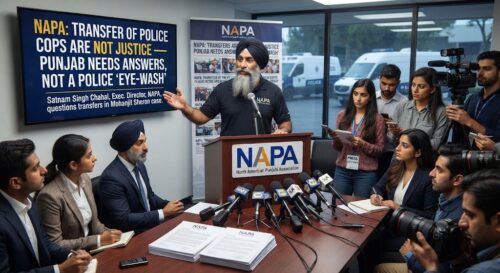
Sangrur/Milpitas(California)The North American Punjabi Association (NAPA) has questioned the Punjab Government’s handling of the Mohanjit Sheron case, saying that the sudden transfer of DSP Sunam and other police officials, after the government initially defended the police action, raises more questions than it answers.NAPA Executive Director Satnam Singh Chahal said: “First, the government and police defended the action. Now, suddenly, officers are being transferred. What changed? If the police action was completely justified, why were the officers moved? And if there was an overreach, merely transferring them elsewhere cannot be called justice. At best, it risks looking like an administrative eye-wash or damage control.”
Chahal said the central questions remain unanswered: Who gave the orders? Who authorised the action? Who was supervising the operation? And where does the chain of command ultimately lead? “A transfer does not answer any of these questions. It simply moves an officer from one chair to another,” he said.
“NAPA is concerned that the government may try to close the chapter by making a few officers the fall guys, while the larger chain of command remains unexplained. Accountability cannot stop at the lowest visible level if decisions were taken or authorised higher up,” Chahal said.
He demanded that the Punjab Government make the findings of any inquiry public and clearly establish responsibility at every level. “Punjab does not need cosmetic action. Punjab needs the truth. If officials acted within the law, the government should explain why they were transferred. If they crossed the line, the government must explain who authorised the action and what disciplinary or legal action will follow.”
“Transfers are administrative orders; they are not accountability. The people of Punjab deserve to know what happened in the Mohanjit Sheron case, who was responsible and whether anyone higher in the chain of command will be held accountable. The government cannot simply transfer a few officers and expect the public to forget the unanswered questions,” Chahal said.